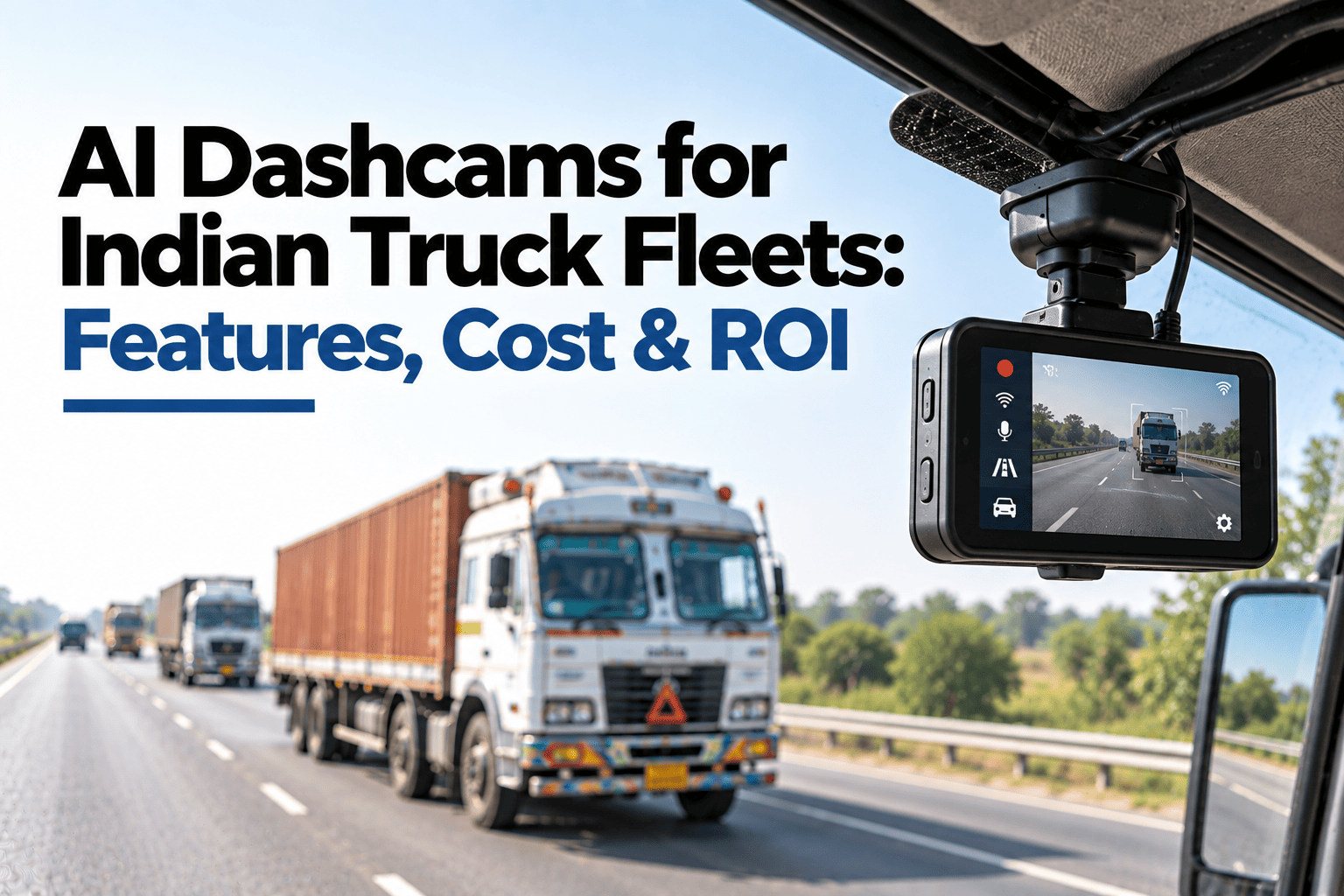
Every transporter knows the call nobody wants: a truck has been in an accident, the driver says it was not his fault and there is no proof either way. Ordinary dashcams only help after the crash. AI dashcams try to stop it happening, by spotting drowsiness, phone use and unsafe following distance and warning the driver in real time. They also give managers clear video for coaching and claims. This guide covers the features, costs and returns, and how fleets keep dashcam events alongside vehicle records in HVI.
AI Dashcams for Indian Truck Fleets: Features, Cost and ROI
Understand what driver monitoring and ADAS alerts actually do, what you will pay for and how to judge the return before rolling cameras out across your fleet.
- Forward collision warning
- Unsafe following distance
- Lane departure
- Records the road for evidence
- Drowsiness and eyes closing
- Phone use while driving
- Distraction and looking away
- Seatbelt and smoking, on some models
The Alerts That Matter Most
Each alert should lead to two actions: a warning to the driver in the cab now, and a review or coaching step for the manager later.
| Alert | What it detects | In the cab | For the manager |
|---|---|---|---|
| Drowsiness | Eyes closing, yawning, head nodding | Loud audio warning | Review shift length and rest breaks |
| Phone use | Phone held to ear or in hand | Audio warning | Coaching conversation with clip |
| Distraction | Eyes off the road for too long | Audio warning | Coaching if repeated |
| Forward collision | Closing fast on the vehicle ahead | Urgent warning | Check clip and following habits |
| Close following | Too little gap at speed | Warning | Trend by driver and route |
| Lane departure | Drifting without indicator | Warning | Often linked to fatigue |
From Alert to Safer Driver: The Coaching Loop
Cameras alone do not change behaviour. The loop below is what turns alerts into fewer accidents.
Detect
AI spots a risky event on the road or in the cab.
Warn
The driver hears an alert and corrects at once.
Upload
A short clip is sent over 4G for review.
Review
A manager checks the clip and context.
Coach
A short, fair talk with the driver using the video.
Track
Watch the driver's events fall over the next weeks.
A Simple Driver Safety Scorecard
Comparing risky events per 1,000 km keeps it fair across drivers with different distances. The figures below are an example.
Risky events per 1,000 km over the last month. Use scores to guide coaching, not to punish.
Keep Safety Events and Vehicle Records in One Place
Use HVI to record dashcam events, coaching notes and accident inspections next to each vehicle's history, so safety and maintenance teams work from the same facts.
What You Actually Pay For
Prices vary widely between vendors and change often, so compare written quotes. Make sure each quote covers all of these items.
Work Out Your Break-Even Point
The simplest ROI test: how many accidents must cameras prevent each year to pay for themselves? Figures below are illustrative, so use your own.
Returns beyond fewer accidents
- Video evidence to defend against false claims
- Faster insurance claim handling with clear footage
- Lower fuel and wear from calmer driving
- Better customer trust in safety
Installation and Connectivity Checklist
Most dashcam problems come from poor installation, not poor cameras. Check these before signing off each vehicle.
Privacy and Driver Acceptance
Drivers accept cameras when they understand the purpose and see them used fairly. Handle video as personal data.
Tell drivers first
Explain in writing what is recorded, why and who can see it.
Coach, do not punish
Use clips to improve driving and recognise good drivers too.
Limit access
Only safety managers should view driver-facing video.
Set retention rules
Keep clips only as long as needed, and delete the rest.
India's Digital Personal Data Protection Act, 2023 applies to personal data such as driver video. Take legal advice on notices, consent and retention for your fleet.
How Dashcam Events Connect to Maintenance
Safety events often point to vehicle problems too. Keeping them next to vehicle records helps both teams act.
AI Dashcam FAQs
What is the difference between a normal dashcam and an AI dashcam?
A normal dashcam only records video. An AI dashcam analyses the road and the driver in real time, warns the driver about risks such as drowsiness or close following, and sends short clips of important events to managers. That makes it a prevention tool, not just a recorder.
How much does an AI dashcam cost in India?
Costs vary widely by vendor, camera type and plan, and usually include hardware, installation, data and a software subscription. Ask for written quotes that include every item and compare the total over three years. Then test the break-even point using your own accident costs.
Do AI dashcams really reduce accidents?
They help most when alerts are followed by regular coaching. Real-time warnings can stop a risky moment, and coaching with video changes habits over time. Fleets that install cameras but never review events usually see much smaller benefits.
Will drivers object to a camera facing them?
Some will at first. Explaining the purpose, limiting who sees the video and using it for coaching rather than punishment usually builds acceptance. Many drivers come to value the evidence when an accident was not their fault.
How can dashcam data work with HVI?
Dashcam events, coaching notes and accident inspections can be recorded against each vehicle and driver in HVI, next to inspections, defects and service history. Teams that keep these records in HVI see safety and maintenance together. Book a demo to discuss your setup.
Safer Drivers, Stronger Claims, Healthier Trucks
Pair AI dashcams with a clear coaching routine, and keep safety events next to inspections, defects and service history in HVI. Fewer accidents, faster claims and one source of truth for your fleet.