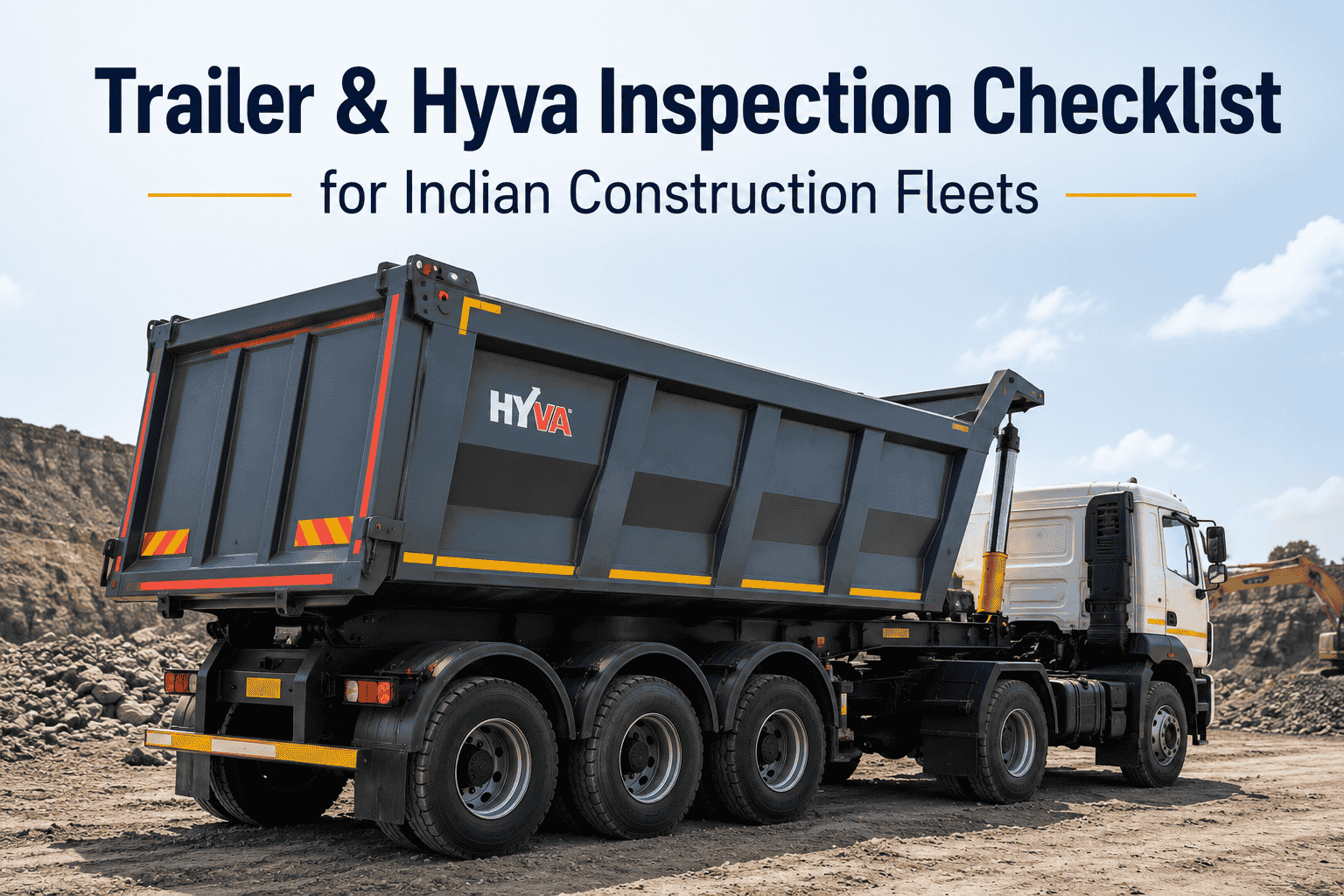
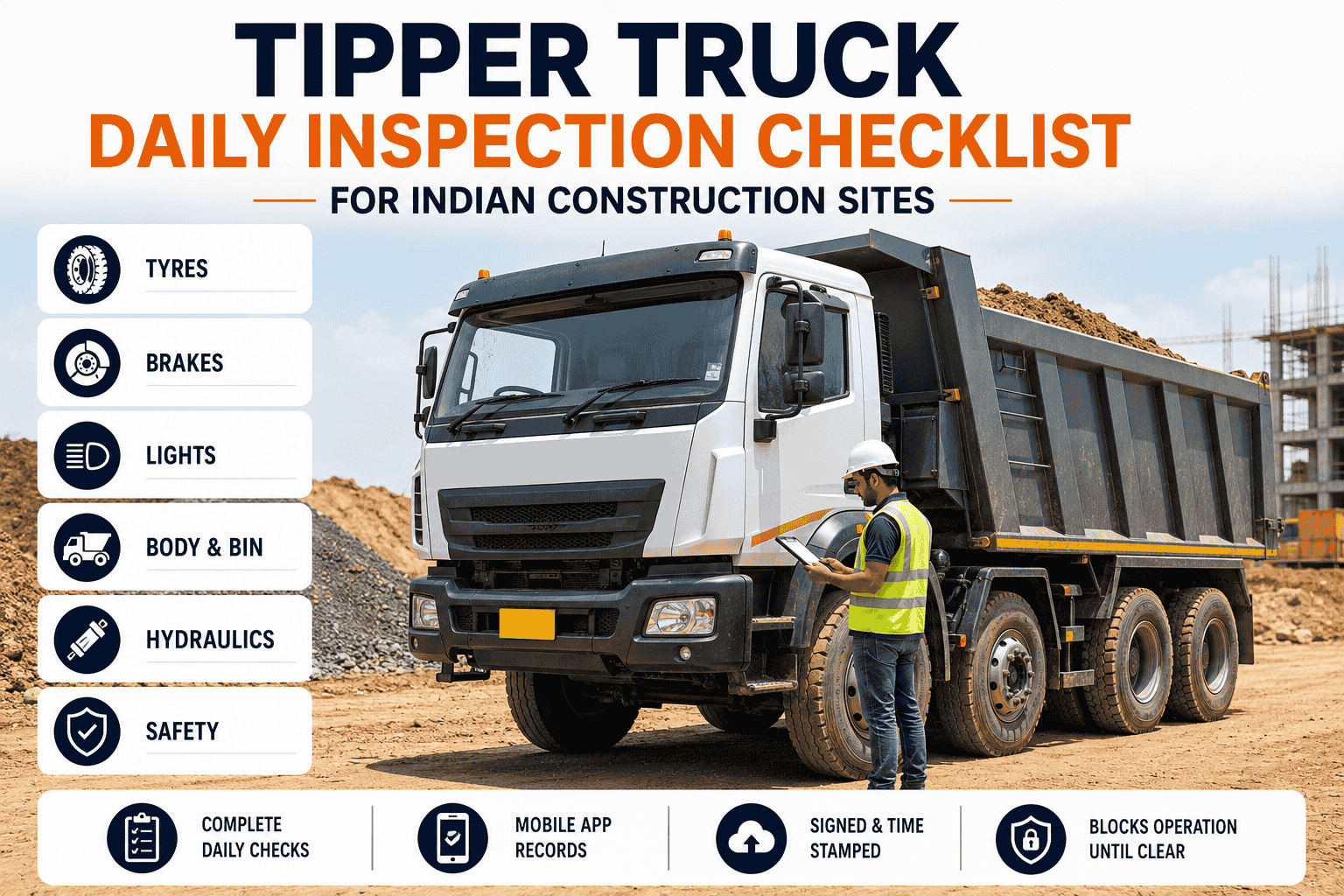
Trailer & Hyva Inspection Checklist for Indian Construction Fleets
By Riley Quinn on June 3, 2026
Trailers and hyvas are the two equipment types Indian construction fleets ignore most in daily inspection — until one fails. A trailer kingpin that disengages on the highway sends an excavator off a flatbed. A hyva ram seal that bursts mid-tipping drops 25 tonnes of aggregate on the chassis. Both incidents are entirely preventable through a 10-minute daily walk-around. This checklist covers both the trailer system (coupling, kingpin, suspension, brake lines, axles, landing legs, lights, load-securing) and the hyva system (front-end hydraulic ram, pivot pins, body locks, PTO, tipping geometry, tailgate) — the two parts of the rig that the truck driver's standard pre-trip inspection often misses because they sit outside the cab. Built for Indian construction fleets running Bharat Benz / Tata Signa / Ashok Leyland tractors with semi-trailers, low-beds, and hyva-mounted tippers on highway, mining, infrastructure, and aggregate-haul duty. Sign up free to run this checklist digitally with photo evidence on HVI.
DAILY INSPECTION CHECKLIST · 2026
Trailer & Hyva Inspection Checklist · Indian Construction Fleets
For tractor-trailer combinations, low-bed trailers, flatbeds, and hyva-mounted tippers on highway, mining, infrastructure, and material-haul operations. 38 inspection points across 6 sections.
FREQUENCYDaily · Pre-trip
DURATION10-15 minutes
PERFORMED BYDriver + Supervisor
CHECK POINTS38 items · 6 sections
Two Equipment Types · One Daily Walk
A trailer and a hyva are different systems but often share the same daily inspection window. Below is what each equipment is, what fails most often, and why they need their own dedicated check sequence outside the truck cab.
EQUIPMENT 1
TRAILER
The trailing unit pulled by a tractor/puller truck. Includes flatbeds for equipment haul, low-beds for heavy machinery (JCB, excavator), semi-trailers for material, and box trailers. Connects to the tractor via the king pin + fifth-wheel coupling.
Top failure modes:
King pin wear / coupling disengagement
Brake line air leak between tractor and trailer
Suspension hanger / shackle pin failure
Load tie-down anchor point fatigue
Landing leg gear stripped under heavy load
EQUIPMENT 2
HYVA
The hydraulic tipping body system mounted on a truck chassis or trailer. "Hyva" is the genericised term in Indian fleets (Hyva brand is the market leader). Includes the front-end (FE) hydraulic ram, pivot pins, body, tailgate, and PTO-driven hydraulic pump.
Top failure modes:
FE ram seal failure mid-tipping
Body pivot pin (rear hinge) seizure or wear
Hydraulic oil leak at ram joints / hose burst
PTO engagement failure
Tailgate latch malfunction during dump
Section 1 · Trailer Coupling & Kingpin
The kingpin is the single most critical safety component on a trailer. A failure here decouples the entire trailer from the tractor at speed. Inspectors and fleet managers should treat this as a zero-tolerance category. Book a demo to track every kingpin's wear measurement history on HVI.
King pin condition — Check for scoring, cracks, ovalisation. Standard 50mm or 90mm diameter; replace if wear exceeds 2mm from new spec. CRITICAL
Fifth-wheel jaws fully locked — Visual confirmation jaws are closed around king pin. Try and pull trailer away from tractor — must not separate. CRITICAL
Fifth-wheel grease — Plate adequately greased; no dry spots that cause jaw friction. Refresh weekly.
Coupler plate flat & clean — Upper coupler plate on trailer free of rust scale, debris, or warping. No gap when seated on fifth wheel.
Air brake lines connected & tight — Red (emergency) and blue (service) gladhand couplers seated. No audible air leak. CRITICAL
Electrical 7-pin plug seated — Trailer lights, indicators, brake lights working. Wiring loom not chafed at the bend point.
Landing legs fully retracted — Both legs wound up to highest position before moving. Gear teeth not stripped. Crank handle present.
Section 2 · Trailer Tyres, Wheels & Axles
A multi-axle trailer can carry 12-16 tyres. One failed tyre at speed loaded with construction equipment is catastrophic. Walk around the trailer at every fuel stop and inspect every wheel. Book a demo to capture tyre-wear photos against every wheel position on HVI.
Tyre tread depth > 1.6 mm — Across all tyres. CMVR minimum. Replace earlier on heavy-load trailers. CRITICAL
Tyre pressure as per OEM spec — Check cold pressure. Indian summer heat adds 15-20% to running pressure; do not bleed.
No cuts, bulges, or sidewall damage — Walk every tyre. Sidewall bulge means impending blow-out under heavy load. CRITICAL
Wheel nuts torqued & secure — All wheel nuts present and tight. Indicator paint marks aligned (visual torque check).
Axle hub temperature normal — Hand-check at fuel stops. Excessive heat = bearing wear or brake drag.
Wheel bearing grease seal intact — No oil weeping from hub centre cap. Repack grease at OEM service interval.
Mud flaps present & secure — Behind every tyre. Mandatory under CMVR for highway operation.
Section 3 · Trailer Suspension, Brakes & Lights
Suspension failures on a loaded trailer can shift the load and pull the rig off-line. Brakes on trailers are air-actuated from the tractor — any compromise in the trailer end means stopping distance increases significantly. Sign up free to log brake and suspension findings against each trailer on HVI.
Suspension hangers & shackles — No cracks visible at the frame attachment points. Bushes not collapsed.
Leaf springs / air bags intact — Spring leaves not broken or shifted. Air bags inflated and not chafed against frame.
Brake actuator pushrod travel < 50mm — Excessive travel = worn linings. Adjustment needed before next trip. CRITICAL
Brake drum / disc condition — No deep scoring, cracks, or heat-blue discolouration on the drum face.
All tail lights, brake lights, indicators working — Walk to rear with engine running, ask helper to operate.
Reflectors & side marker lights intact — Critical for night highway visibility. Reflective tape on rear bumper bar.
Number plate light working — Mandatory under CMVR Rule 105. Often missed during inspection.
Section 4 · Hyva Hydraulic System
The hyva system is what separates a tipper from a flatbed truck. The front-end (FE) hydraulic ram lifts the body to dump the load. Failures here either prevent tipping (operational loss) or cause catastrophic accidents during tipping (safety event). This is the section daily-pre-trip checks most often skip.
FE ram cylinder body — No external damage, dents, or oil weeping on the cylinder surface. Chrome plunger clean and unscored. CRITICAL
Ram top & base pivot pins — Pins secure with retaining clips/nuts present. No visible cracking around the spherical bearing housing. CRITICAL
Hydraulic oil level — Sight glass shows level between MIN-MAX with body in lowered position. Oil colour: light brown, not dark/burnt.
Hydraulic hose condition — No external fraying, bulging, or oil leaks at hose ends. High-pressure hose (HP) connected and crimped.
PTO engagement — Test PTO from cab; engages without grinding. Pump operates silently — no whine indicating cavitation.
Tipping test (empty body) — Tip body to full height and lower. Lift smooth without hesitation. Hold position 30 seconds — no drift down.
Section 5 · Hyva Body, Pivot Pins & Tailgate
The body itself takes the load impact daily. Body pivot pins at the rear are the hinge point — a seized or worn pin causes uneven body lift, which stresses the FE ram and accelerates seal failure. Tailgate latches if mis-rigged can dump load prematurely or refuse to release.
Body pivot pins (rear hinge) — Both sides secure with retaining bolts present. No play when body is rocked side-to-side. CRITICAL
Pivot pin grease points — Greased within last 7 days. Grease nipples present and accept gun pressure (not blocked).
Body inner liner condition — Check for major cracks, holes, or sharp edges that could spill load mid-transit. Concrete sticking adds weight.
Tailgate latch operation — Latch closes positively. Test the locking mechanism — no movement when body lowered. CRITICAL
Tailgate safety chain / cable — Where fitted, chain attached & not damaged. Secondary lock to prevent unintended swing.
Body prop / safety stand — Where fitted, prop usable. Critical for any maintenance work under raised body. Never work under unsupported tipped body.
Body-down indicator light in cab — Confirms body fully lowered before moving. Mandatory on modern hyvas; should be functional.
Section 6 · Load Security & Documentation
Load shifting in transit is a leading cause of trailer rollover on Indian highways. Tie-down anchor points fail more from corrosion and abuse than from poor design. Documentation gaps are the leading cause of audit penalty under the MV Act. Book a demo to keep load-security and documentation evidence live on HVI.
Load tie-down anchor points — All anchors on the trailer bed secure, not corroded through, welds intact. Rated for the load mass. CRITICAL
Load distribution within axle limits — No axle overloaded. Long equipment (excavator, JCB) centred over trailer's centre of gravity.
Wheel chocks / equipment locks — Construction equipment on flatbed has parking brake on + transmission in park + chocks at all 4 wheels.
Registration certificate (RC) & permit — Both tractor and trailer RC current. National Permit / State Permit valid for the route.
Insurance & PUC certificates — Current and on-person. PUC for both tractor and trailer where separately registered.
Driver licence valid for class — Heavy goods vehicle (HGV) endorsement. Trailer-specific endorsement where applicable.
Critical-Item Summary — The Items That Cannot Wait
Across the 38 inspection points above, 10 are flagged CRITICAL. A failure on any of these items means the rig should not move until the issue is resolved. Below is the summary list every driver and supervisor should keep printed in the cab. Sign up free to enforce these 10 critical items as dispatch-blocking on HVI.
10 Critical Items · Stop-and-Fix Before Moving
1King pin condition · scoring, wear, or ovalisation
2Fifth-wheel jaws fully locked around king pin
3Air brake lines (red + blue) connected & sealed
4Tyre tread depth above CMVR minimum
5No cuts, bulges or sidewall damage on any tyre
6Brake pushrod travel under 50mm
7FE ram cylinder body undamaged & oil-tight
8Ram top & base pivot pins secured
9Body pivot pins secure & no play
10Tailgate latch positive closure verified
Quick Reference Answers
What is the difference between a trailer inspection and a hyva inspection?
A trailer inspection covers the trailing unit pulled by a tractor — the coupling, king pin, fifth-wheel engagement, brake lines, axles, suspension, tyres, lights, and load-securing system. A hyva inspection covers the hydraulic tipping body system — the front-end (FE) hydraulic ram, ram pivot pins, body hinges, hydraulic hoses, oil tank, PTO/pump, tailgate latch, and tipping geometry. A single rig (semi-trailer with hyva-mounted body, or a hyva-mounted tipper truck) needs both. The truck driver's standard pre-trip covers the cab and chassis but rarely the trailer end or the hyva system, which is why daily inspection of both as a separate routine is the standard recommendation for Indian construction fleets.
How long does a complete trailer-and-hyva inspection take?
10-15 minutes for an experienced driver doing the full 38-point walk. New drivers take 20-25 minutes initially. Key time savers: have the same person inspect the same rig every day so they know its baseline; use a phone-based digital checklist instead of paper (faster, also captures photo evidence); inspect at fuel stops as well as start-of-shift to catch issues that develop in transit (overheating bearings, brake drag, loose tie-downs). The full inspection should never be skipped — but it can be split: kingpin + brake lines + FE ram + tailgate at pre-trip; tyres + lights + load securing at every fuel stop.
What's the most common reason hyva FE rams fail on Indian construction fleets?
Two causes dominate: (1) Tipping with un-aligned chassis — driver tips on a slope rather than level ground, which puts side-load on the ram seal and accelerates seal failure within months. (2) Skipped grease maintenance on the ram top and base pivot bushes — once the bushes dry out, the ram twists slightly during lift, scoring the cylinder and burst-failing the seal. Both are preventable through daily inspection (level check before tipping) and 7-day greasing schedule. A failed FE ram typically costs ₹40,000-₹1,20,000 to replace including labour and downtime — orders of magnitude more than the cost of the daily check that prevents it.
Are there specific Indian regulations for trailer-hyva inspections?
Yes, multiple layers. CMVR 1989 covers vehicle roadworthiness — Rules 62 (tyres), 105 (lights), 138 (commercial vehicle fitness). MV Act 1988 requires fitness certification annually for commercial vehicles. CMV Rules mandate quarterly inspection records for commercial fleets above 10 vehicles. BOCW Act 1996 applies where trailers operate on or alongside active construction sites. For projects under NHAI / state PWD contracts, the project's safety annexure typically requires daily pre-trip inspection records to be maintained and produced during EHS audits. The 38-point checklist on this page covers all four regulatory frameworks plus the practical operational items not in regulation.
How does HVI handle dual trailer-and-hyva inspections?
HVI treats the tractor, trailer, and hyva body as three separate inspectable assets even when they operate as a single rig. Each has its own inspection trail, photo evidence, defect log, and compliance status. Daily walkthroughs are organised in the same 6-section structure as this page — driver completes one section before unlocking the next, with photo capture required for critical items. Failed items become corrective work orders routed to the workshop with deadline. Pre-shift dispatch checks can be configured to BLOCK rig movement until all 10 critical items have passed inspection — moving the operation from "check-and-hope" to "verified-and-cleared." Sites running structured daily digital inspections see trailer/hyva-related breakdowns drop by 60-70% within the first 6 months.
DIGITAL INSPECTION · 38 POINTS · PHOTO EVIDENCE
Run trailer & hyva inspections digitally from your driver's phone.
Indian construction, EPC, mining, and aggregate-haul fleets use HVI to keep every trailer and hyva inspection trail audit-ready — photo evidence, GPS timestamps, defect-to-work-order automation. Critical-item gating prevents dispatch until safety checks pass.