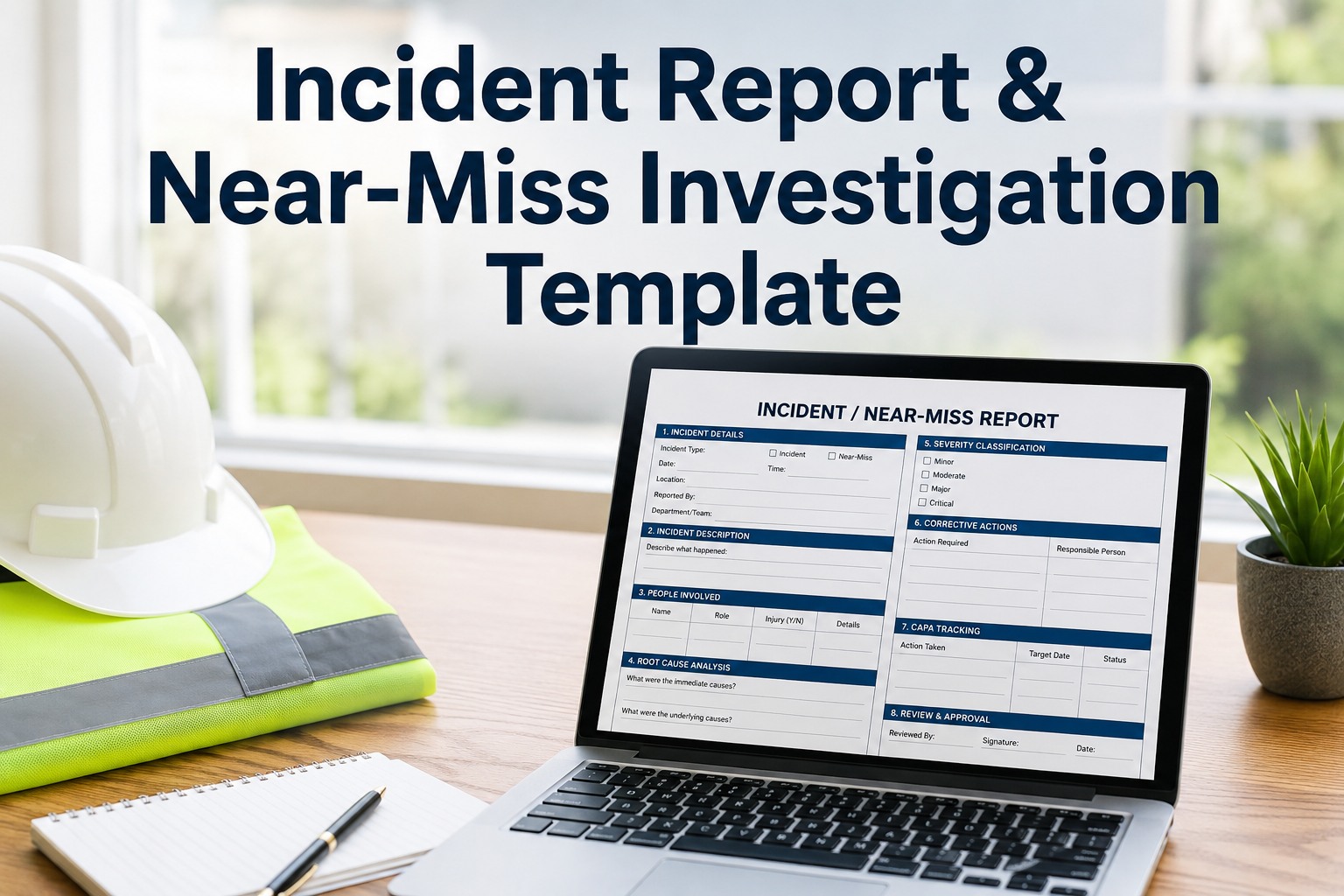
Every Indian construction site, mine, or workshop runs on one truth that EHS leaders know well. Behind every serious injury sit hundreds of unreported near-misses and thousands of unsafe acts that nobody bothered to log. A clean, easy-to-use incident report and near-miss investigation template changes that. This page gives you a ready-to-use template covering severity classification, witness statements, 5 Whys root cause analysis, corrective and preventive action (CAPA) tracking, and final closure sign-off. Built for sites running JCB, L&T Komatsu, BEML, TATA Hitachi, and Schwing Stetter equipment. Start free with HVI to digitise every incident from first report to closure.
Incident Report & Near-Miss Investigation Template
A complete incident management format for Indian EPC, mining, and infrastructure sites. Severity classification, witness statements, 5 Whys root cause, CAPA tracking, and inspector-ready closure documentation.
Heinrich's Safety Pyramid
Every fatal accident sits on a foundation of unreported events. The pyramid below is the single most important visual in workplace safety. Capture the base of unsafe acts and near-misses, and the top of the pyramid shrinks.
Most Indian sites report only fatalities and majors honestly. The HVI app pushes near-miss and unsafe-act reporting up by 4 to 6 times in the first quarter of use. Book a 30-minute demo to see the live reporting dashboard.
Sample Incident Report Format
This is the standard incident report layout used on Indian highway, mining, and EPC sites. The same template works for an actual injury, an equipment damage event, or a no-harm near-miss. Only the severity field changes.
Excavator EX-07 boom swung into stationary tipper TIP-22 during reverse manoeuvre. No personnel injured. Tipper rear panel dented. Excavator boom undamaged. Work halted for 90 minutes.
Area cordoned, machines isolated, photos taken from 4 angles, supervisor and EHS notified within 15 minutes, work resumed after toolbox talk.
Save this format as a base and run every incident through the same five-block structure. Get the HVI digital incident form free to file reports from the site, with photos auto-attached.
5 Whys Root Cause Cascade
The first answer is never the root cause. The 5 Whys method walks the investigator down a chain until the system-level cause is exposed. Here is how the EX-07 strike incident unfolds.
Incident Report & Near-Miss Investigation Template
HVI digitises the full incident lifecycle. Report from site with photo and GPS. Run 5 Whys on the app. Assign CAPA to owners with deadlines. Close with EHS sign-off.
CAPA Tracking Workflow
The investigation does not end when the root cause is found. Each finding turns into a Corrective and Preventive Action (CAPA) with an owner, a deadline, and a verification step. This is what the CAPA board looks like on a working Indian site.
Severity Classification Matrix
Every incident must be classified by Probability x Consequence. This 5x5 matrix decides whether the case needs a 24-hour notification, a 7-day investigation, or just an entry in the register.
Use the matrix to set investigation priority and inspector notification timeline. Book a HVI demo to see auto-classification running on real site incident data.
Expert View from the Field
For three years we recorded only the obvious injury cases. Near-misses and unsafe acts almost never reached me. When something serious did happen, we had no upstream data to learn from. We were always investigating in the dark.
After we moved to the HVI digital incident template with one-tap near-miss reporting from the operator's phone, reports jumped from around 8 a month to almost 60 a month. Our injury rate dropped 40 percent in the next two quarters. The pyramid worked exactly as the textbook says.
Paper Incident Reports vs HVI Digital
- ×Near-misses almost never reach the EHS desk
- ×Photos rarely attached, no GPS or timestamp
- ×CAPA items slip without deadline tracking
- ×Pyramid base invisible to management
- ×Audit pack assembled manually in panic
- ✓One-tap near-miss reporting from any phone
- ✓Photos, GPS, time auto-attached
- ✓CAPA board with owners and live deadlines
- ✓Full pyramid visible on EHS dashboard
- ✓Inspector audit pack exported as PDF in 1 click
For Indian highway, mining, and EPC sites running 50+ machines, digital incident reporting is what shifts the safety culture from reactive to preventive. Sign up free with HVI and bring every event into one digital trail.
Frequently Asked Questions
What is the difference between an incident and a near-miss?
An incident is any unplanned event that has resulted in injury, illness, equipment damage, or environmental harm. A near-miss is an unplanned event that could have caused harm but did not, often by chance. Both must be reported, investigated, and closed using the same template. Indian sites that report near-misses honestly catch root causes long before they turn into injuries.
What is the legal reporting timeline for serious incidents in India?
Under Section 88 of the Factories Act 1948, fatal accidents and serious bodily injuries must be notified to the Chief Inspector within the prescribed timeframe, typically within 24 hours by fastest means. DGMS Regulation 9 sets similar requirements for mines with a 7-day investigation report. BOCW rules require notification of accidents involving construction workers. Failure to report on time attracts penalties under the respective statute.
Why is the 5 Whys method preferred for root cause analysis?
The 5 Whys method is simple, fast, and forces the investigator to move past the obvious immediate cause to the underlying system-level cause. Stopping at the first or second why typically points to operator error, which leads to blame and not learning. Pushing through to the fourth or fifth why typically exposes a policy, SOP, or training gap that the organisation can actually fix.
Who should be on the investigation team for a major incident?
A typical Indian site investigation team for a major incident includes the EHS lead as chair, the site project manager, the operations or workshop in-charge, the worker representative, and an external safety consultant if the case involves a fatality. For minor incidents, the EHS officer and supervisor are often sufficient. Independence of the team from the area where the incident occurred is critical for honest findings.
How long should CAPA items be tracked before closure?
A CAPA item is closed only when the verification step confirms that the corrective action has actually addressed the root cause and is being followed in the field. Typical timelines range from 7 days for simple training-related CAPA to 90 days for engineering or SOP changes. On HVI, every CAPA carries a verification step that requires a photo or evidence upload before closure, and an EHS sign-off lock that prevents premature closure.
Bring Every Incident Into One Digital Trail
HVI gives Indian sites a single digital home for incidents, near-misses, witness statements, 5 Whys root cause, CAPA tracking, and inspector-ready closure reports. Lift near-miss reporting by 4 to 6 times in the first quarter.
No credit card. No hardware. Live on your site in under 10 minutes.