Most CMMS software was built for factory floors — fixed machines, one location, a maintenance team that walks a few hundred metres. Indian construction and infrastructure work is the opposite: machines spread across highway packages, remote mining sites, and metro corridors, often in different states, frequently with no internet. Choosing a CMMS built for a Pune factory and forcing it onto an NHAI highway fleet is why so many maintenance software rollouts fail in India. This guide gives you a clear buyer's framework — what to evaluate, which features actually matter for construction, and how to pick the right CMMS for an Indian infrastructure fleet in 2026. Start free with HVI to try a CMMS built for Indian sites.
Best CMMS Software for Indian Construction & Infrastructure (2026)
A practical buyer's guide for fleet and maintenance managers — the 8 criteria that matter when choosing CMMS software for Indian construction, highway, and mining operations, and why construction needs a different tool than a factory.
Of Indian industrial and infrastructure operations still run maintenance on paper or spreadsheets
Indian industry survey data, 2024Equipment uptime improvement reported in Year 1 of a structured CMMS preventive maintenance programme
Deloitte predictive maintenance analysisMaintenance cost reduction possible with predictive and preventive maintenance over reactive
Deloitte maintenance studyMobile-first, offline-capable field workflow is the single biggest factor in CMMS adoption success on sites
CMMS implementation research 2026Why Construction Needs a Different CMMS Than a Factory
A factory CMMS assumes the machine stays in one place, the network is always on, and a trained technician fills the records at a desk. None of these hold true on an Indian construction or mining site. This mismatch is the root cause of most failed CMMS rollouts in Indian infrastructure.
The right question is not "which CMMS is best overall" but "which CMMS is built for how my fleet actually works." For Indian infrastructure, that means mobile-first, offline-capable, and construction-compliance ready. Book a 30-minute demo to see a CMMS built around the Indian site, not the factory floor.
The 8 Criteria to Evaluate Any CMMS for India
Use this as your scorecard. Score every CMMS you shortlist against these eight criteria — and weight the first three highest if your fleet works on remote or multi-state Indian sites.
Mobile-First & Offline Capable
Can an operator complete an inspection on a basic Android phone with no signal, and does it sync when back online? On Indian sites this is non-negotiable — a desktop-first CMMS will simply not be used in the field.
Equipment Inspections with Photo & GPS
Does it support guided pre-shift inspections with mandatory photos, GPS, and timestamps? For construction, the daily inspection is where breakdowns are caught — a CMMS without strong field inspection is missing the most important feature.
Multi-Site & Multi-State Fleet View
Can you see every machine across every package and state on one dashboard? Indian EPC fleets run across jurisdictions — the CMMS must consolidate them, not force a separate login per site.
Preventive Maintenance Scheduling
Does it trigger PM on hour meter and calendar, alert before due, and auto-create work orders? PM automation is the core of any CMMS — for construction it must work on hour-based intervals, not just calendar.
Work Order Management
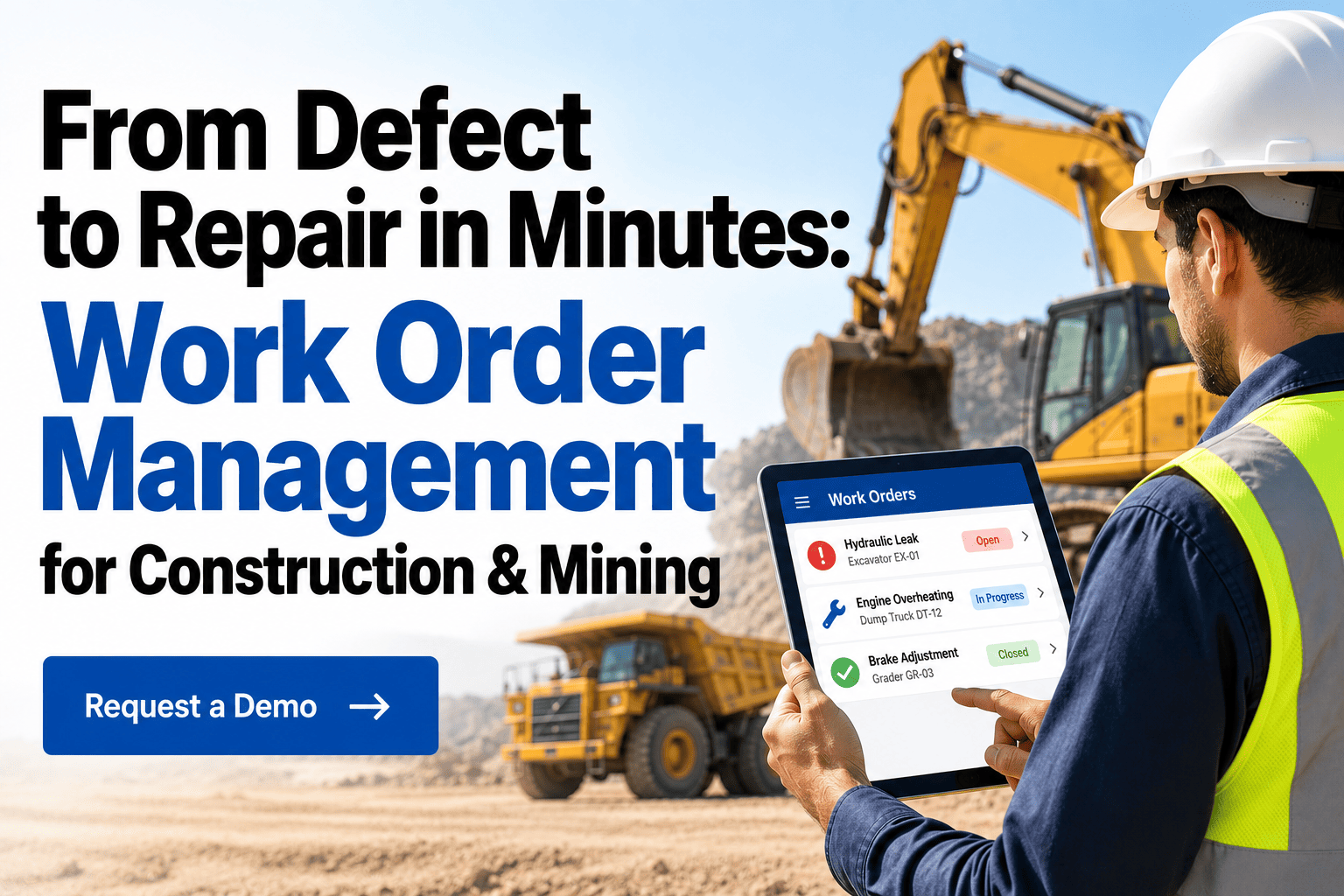
From defect raised to work order to closure — with parts, mechanic assignment, and cost tracking. The defect-to-work-order loop is what turns inspection findings into actual repairs.
Indian Compliance Support
Does it handle DGMS, NHAI, BOCW, and client audit documentation — not just Factories Act or ISO? Construction and mining compliance is different from factory compliance, and a generic CMMS will not cover it.
INR Pricing & Easy Onboarding
Is pricing in rupees and sized for Indian economics, or dollar-denominated enterprise licensing? Can your team start in days, not months? Global platforms often price out Indian mid-market fleets.
Easy English & Operator-Friendly UI
Can a site operator with limited English and no software training use it on day one? The simpler the operator interface, the higher the adoption — and a CMMS no one uses is worthless.
Score your shortlist honestly against all eight, and the right CMMS for your fleet becomes obvious. Start free with HVI and check it against every criterion yourself.
Types of CMMS — and Which Fits Indian Infrastructure
The CMMS market splits into three broad types. Knowing which type you are looking at saves weeks of evaluating tools that were never built for your use case.
| CMMS Type | Built For | Strength | Construction Fit |
|---|---|---|---|
| Factory / Plant CMMS | Fixed manufacturing assets | Deep asset hierarchy, IoT sensors | Weak — built for fixed sites |
| Enterprise CMMS / EAM | Large global corporations | ERP integration, deep analytics | Heavy — costly & slow to deploy |
| Field / Construction CMMS | Mobile equipment on sites | Mobile inspection, offline, fleet view | Strong — built for the field |
For most Indian construction, highway, and mining fleets, a field-focused CMMS like HVI delivers faster adoption and value than a heavyweight factory or enterprise platform that needs months of configuration. Sign up free with HVI and see the difference a purpose-built tool makes.
Core Features Every Construction CMMS Must Have
Beyond the evaluation criteria, these are the must-have features. If a CMMS is missing any of these, it will not fully serve an Indian infrastructure fleet.
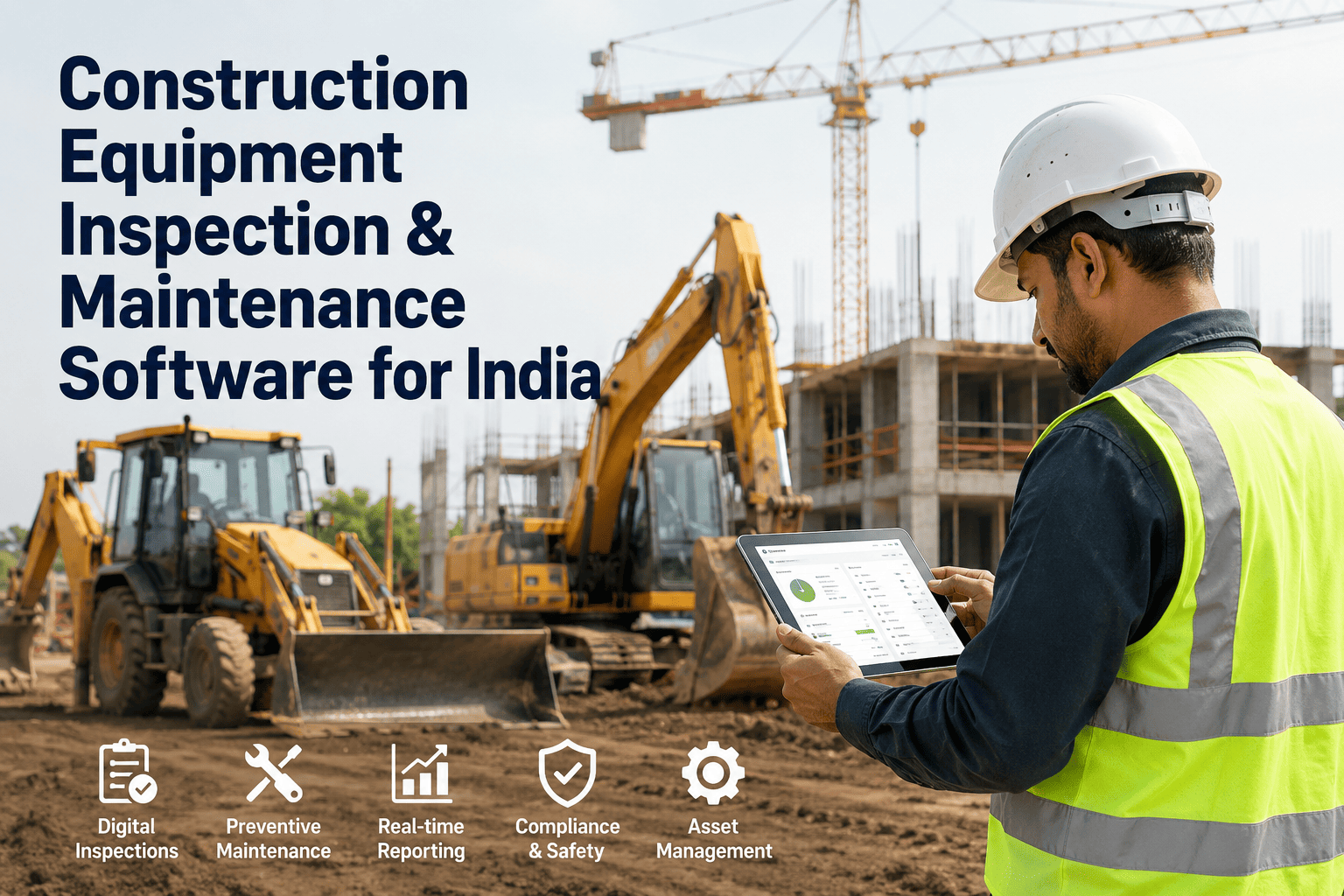
Mobile Inspections
Guided pre-shift checks with photo, GPS, and timestamp — done from any phone, online or offline.
PM Scheduling
Hour-based and calendar triggers with auto-alerts before due and one-tap work order creation.
Work Orders
Defect to work order to closure, with parts, mechanic assignment, time and cost tracking.
Asset Registry
Every machine with full service history, documents, hour readings, and lifecycle records.
Compliance Docs
FC, insurance, PUC, DGMS, and NHAI records with expiry alerts and one-click audit PDF.
Reports & Analytics
Utilization, downtime, cost-per-hour, and fleet leaderboards across all sites in one view.
HVI ships with all six of these built for the Indian construction context — no configuration project required. Book a HVI demo to see them working on a real Indian fleet.
Expert View from the Field
We first tried a well-known global CMMS that our IT team liked on paper. It had every feature, but it was built for a factory. Our site supervisors in remote Rajasthan locations could not use it — no signal, the interface was too complex, and the pricing per asset in dollars made no sense for a 130-machine fleet. After eight months, adoption was under 20 percent. The data was useless because no one entered it.
We switched to HVI because it was built for exactly our situation — operators doing inspections on their phones, offline, in simple English, with the compliance reports our NHAI clients actually ask for. Adoption crossed 90 percent in the first month. The lesson we learned the hard way: the best CMMS is not the one with the most features. It is the one your field team will actually use every single day.
Suresh Patil, Fleet Manager, GR Infraprojects, Rajasthan — 130 machines across 4 NHAI packages
Frequently Asked Questions
What is CMMS software and why do Indian construction companies need it?
CMMS stands for Computerized Maintenance Management System — software that centralises equipment inspections, preventive maintenance schedules, work orders, asset records, spare parts, and compliance documents into one digital platform. Indian construction and infrastructure companies need it because over 60 percent still run maintenance on paper or spreadsheets, which leads to missed services, untracked breakdowns, and no audit trail. A structured CMMS programme typically improves equipment uptime by 10 to 20 percent in the first year and can cut maintenance costs by up to 25 percent by shifting from reactive to preventive maintenance. For construction specifically, the CMMS must work on mobile and offline, because the machines are spread across remote sites rather than sitting in one plant.
What is the difference between a factory CMMS and a construction CMMS?
A factory CMMS is built for fixed assets in one location with reliable internet and desk-based technicians entering data. A construction CMMS is built for mobile equipment spread across multiple remote sites, often with poor connectivity, where the operator does the inspection on a phone at the machine. The key differences are: offline capability (essential for construction, optional for factory), mobile-first design (critical for field operators), multi-site and multi-state fleet consolidation, and compliance support for DGMS, NHAI, and BOCW rather than only the Factories Act. Forcing a factory CMMS onto a construction fleet is the most common reason maintenance software rollouts fail in Indian infrastructure.
How much does CMMS software cost in India?
CMMS pricing in India varies widely. Global enterprise platforms use dollar-denominated per-user or per-asset licensing that can be expensive for mid-market Indian fleets, often with long implementation projects. India-focused and field-focused platforms typically offer rupee-denominated subscription tiers sized for the Indian market, with faster onboarding measured in days rather than months. When comparing cost, look beyond the subscription price to total cost of ownership — implementation time, training, integration fees, and any per-asset charges added on top of per-user subscriptions. For most Indian construction fleets, a mobile-first field CMMS delivers a faster return because adoption is higher and value starts in the first month rather than after a long configuration project.
What features matter most in a CMMS for heavy equipment fleets?
For Indian heavy equipment fleets, the features that matter most are: mobile-first inspections with photo and GPS that work offline, hour-based preventive maintenance scheduling (not just calendar, since machine utilisation varies), a complete defect-to-work-order-to-closure workflow, multi-site fleet consolidation across packages and states, an asset registry with full service history per machine, and Indian compliance documentation for DGMS, NHAI, and BOCW. Deep IoT sensor integration and complex asset hierarchies, while valuable in a factory, are far less important than field usability and offline reliability for a construction fleet. The single biggest predictor of CMMS success on a construction site is whether the field team will actually use it every day.
How long does it take to deploy a CMMS on an Indian construction fleet?
It depends entirely on the type of CMMS. Heavyweight enterprise platforms and factory-oriented systems can take several months to configure, integrate, and train teams on — and many Indian construction rollouts stall during this phase. A mobile-first field CMMS built for construction can typically be live on a fleet in days, because the inspection templates and compliance formats are pre-built for the Indian construction context and operators can learn the app in a single session. The fastest path to value is to start with the daily inspection and defect workflow on your highest-priority machines, then expand to full PM scheduling and compliance tracking once the field habit is established.
Try the CMMS Built for Indian Construction Fleets
HVI is mobile-first, offline-capable, and built for Indian construction, highway, and mining operations — photo inspections, hour-based PM, defect-to-work-order, multi-state fleet view, and DGMS and NHAI compliance. INR pricing. Easy English. Live on your fleet in days, not months.
No credit card. No hardware. Built for Indian sites from day one.