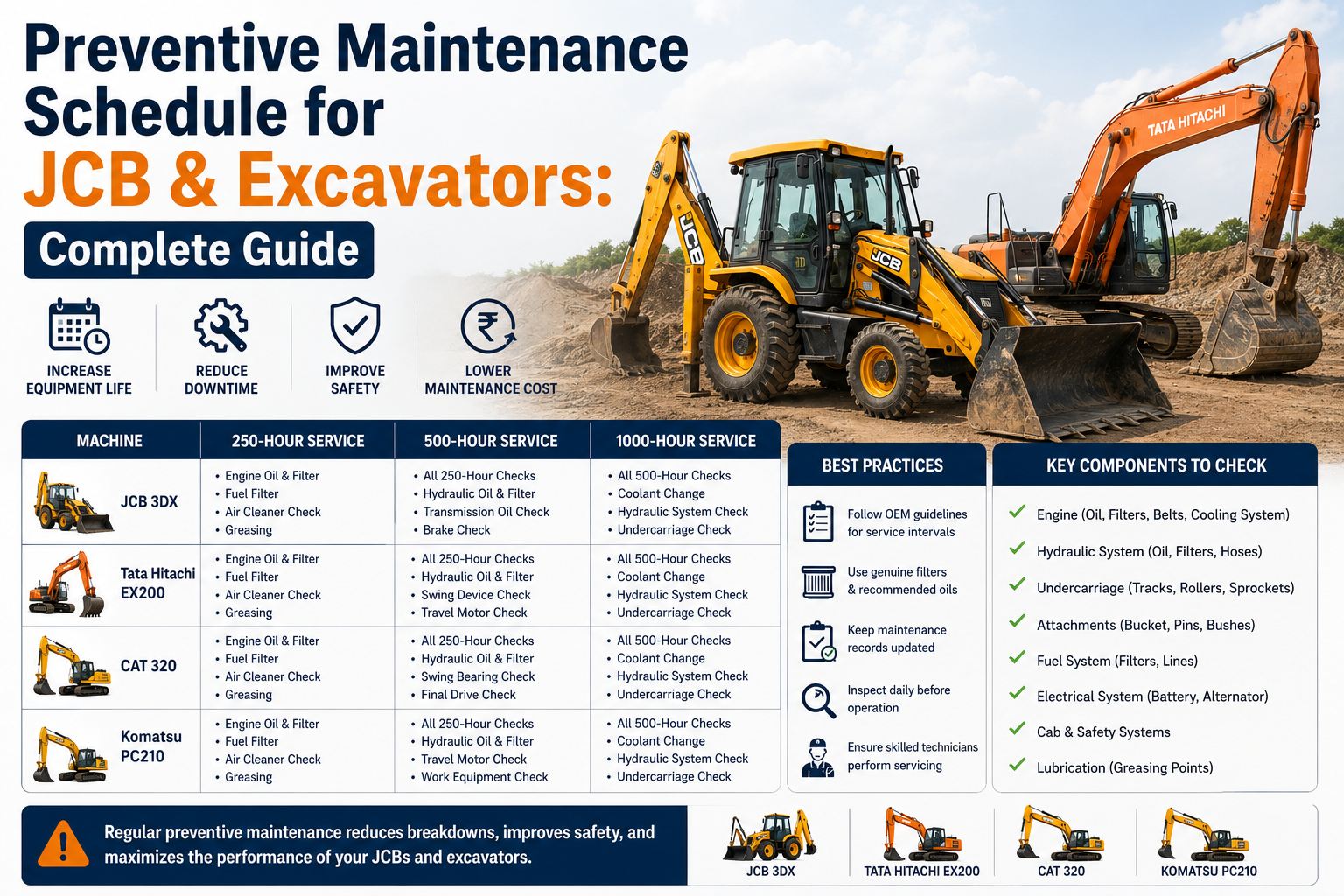
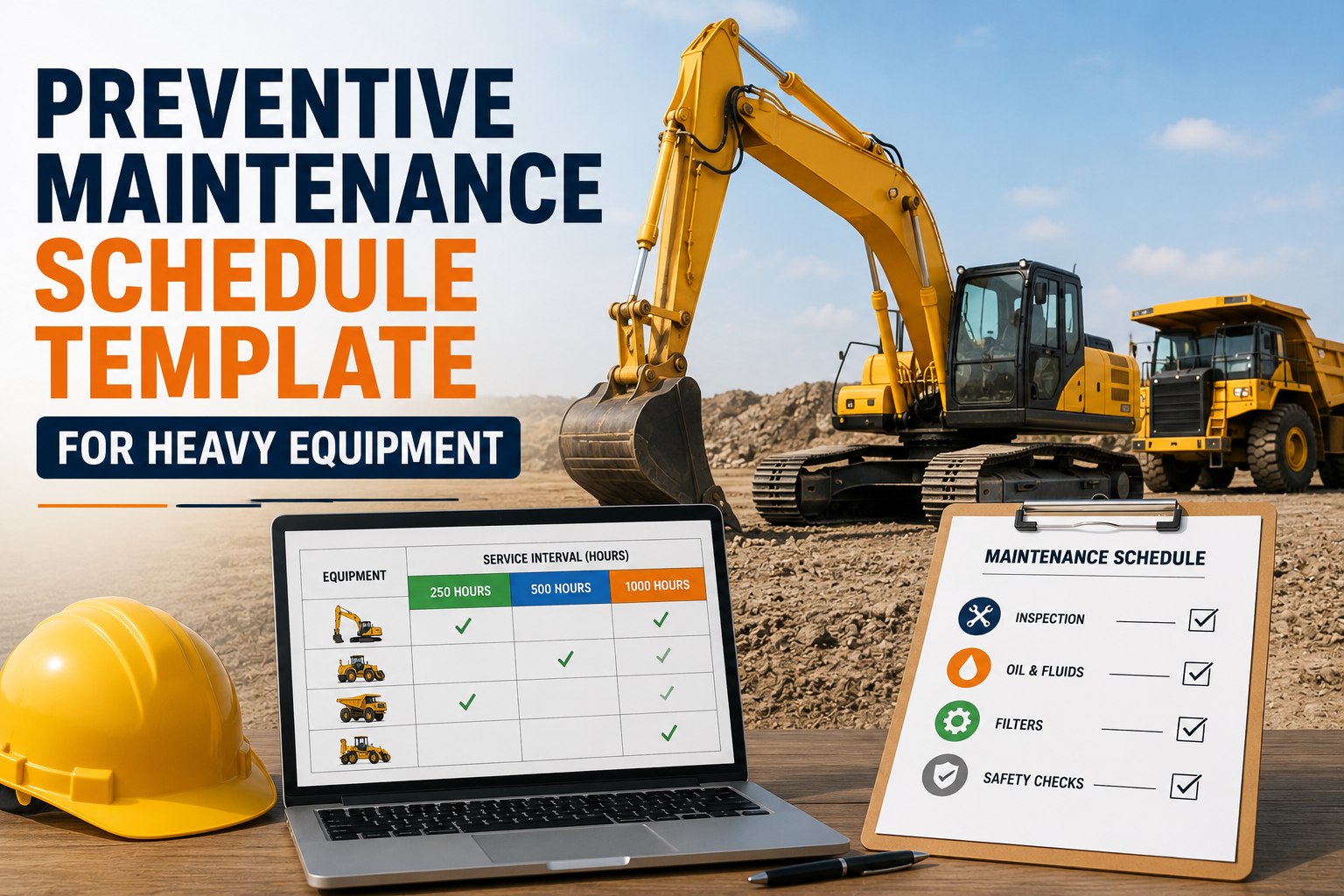
Preventive maintenance is the difference between a Tata Hitachi ZX200 completing 12,000 hours before its first overhaul and the same machine suffering a hydraulic pump failure at 6,000 hours on a Hyderabad metro site. Most Indian contractors know they need a PM plan but struggle with setting intervals for mixed fleets and tracking compliance across scattered sites. This guide walks you through building a practical PM program designed for Indian construction conditions. Digitise your PM plan with HVI today.
Build a Preventive Maintenance Plan for Indian Construction Equipment
From OEM service intervals to DGMS compliance — structure your PM program to maximise uptime and minimise breakdown costs across JCB, Tata Hitachi, and SANY fleets.
Why Generic PM Plans Fail on Indian Sites
Dust Loading Exceeds OEM Assumptions
An excavator on a Rajasthan highway project clogs air filters 40 to 60 percent faster than the OEM-recommended 500-hour interval. Following the manual blindly causes premature engine wear and turbocharger failure before the first major service.
Multi-Brand Fleets Create Scheduling Chaos
A mid-size contractor runs JCB, Tata Hitachi, SANY, and Ashok Leyland machines on the same site. Each OEM uses different interval metrics — engine hours, calendar months, or fuel consumed. Spreadsheets become unmanageable beyond 15 machines.
Labour Turnover Breaks Maintenance Discipline
Indian sites see 25 to 35 percent operator turnover annually. A new operator taking over a JCB 3DX has no visibility into what the previous operator skipped. Without digital PM tracking that follows the machine, maintenance continuity is lost every time.
Fragmented Sites Kill Central Oversight
A contractor building across Pune, Thane, and Nagpur cannot verify whether daily checks and weekly greasing are actually happening. Paper logbooks give false compliance — HQ has zero real-time visibility into actual ground conditions.
Step 1: Build Your Equipment Register With OEM Data
Capture Per Machine
Serial number, model variant, engine hours at purchase, commissioning date, OEM service intervals in hours and months, warranty terms, and primary application — trenching machines need more frequent swing bearing checks than loading machines.
Find OEM Schedules
Every JCB, Tata Hitachi, and SANY machine comes with a maintenance manual. If lost, download from the OEM India portal. Cross-reference with the dealer service booklet given at delivery for any India-specific amendments.
Track Hours and Calendar Separately
Engine oil changes are hour-based (every 500 hours) while coolant replacement is calendar-based (every 24 months). A machine idle for 3 months still needs time-based services. Track both metrics to avoid missing critical tasks.
Step 2: Adjust Service Intervals for Indian Conditions
| Service Task | OEM Standard | High-Dust Sites | Heavy-Duty Mining |
|---|---|---|---|
| Engine Oil Change | 500 hours | 350 hours | 250 hours |
| Hydraulic Oil Filter | 1000 hours | 750 hours | 500 hours |
| Air Filter Service | 250 hours | 125 hours | 100 hours |
| Fuel Filter Replacement | 1000 hours | 500 hours | 500 hours |
| Swing Bearing Lubrication | 50 hours | 50 hours | 25 hours |
| Coolant Replacement | 2000 hrs / 24 mo | 2000 hrs / 18 mo | 1000 hrs / 12 mo |
Step 3: Build Tiered PM Checklists
Operator Checks — 15 Minutes
Engine oil and coolant levels, hydraulic oil level, fuel drain, air filter indicator, leak visual check, tyre or track condition, lights, horn, fire extinguisher, and seatbelt. Logged digitally before every shift without exception.
Site Mechanic — 60 Minutes
Grease all zerk fittings per OEM chart, check battery terminals, inspect hydraulic hoses for abrasion, verify swing gear grease, check track shoe wear, inspect bucket teeth, and test cylinder rods for scoring.
Supervisor Review — 2 Hours
Review daily and weekly logs for recurring issues, verify overdue services, check hydraulic pressure against OEM specs, test brakes under load, review fuel consumption trends — a 10 percent increase signals a developing problem.
Dealer Service — Full Day
Complete OEM-scheduled service including oil, filter, and fluid changes. Hydraulic oil sampling, injector calibration, turbo boost test, transmission service, and comprehensive safety device testing.
Step 4: Embed DGMS and Statutory Compliance Into PM
Pre-Use Machinery Examination
Daily checklists must include operator name, licence number, machine condition declaration, and competent person sign-off. Without this, any accident results in a negligence finding against the contractor.
Brake and Steering Testing
Documented brake test every 30 days with stopping distance recorded against prescribed limits. Your PM plan needs a separate monthly brake test checklist that produces a compliance record, not just a maintenance note.
Vehicle Fitness for Road Travel
Equipment on public roads needs valid fitness certificates. PM must cover RTO inspection items: brakes, steering, lights, reflectors, horn, speed governor, and structural integrity for smooth fitness renewal.
Maintenance Register Requirement
Every machine must have a register showing all examinations and repairs. Your digital PM system must produce this on demand as a direct export from normal inspection and service records.
Four Mistakes That Destroy PM Plans
Using Calendar Instead of Hours
A JCB working 10 hours daily in Ahmedabad accumulates 300 hours monthly versus 120 hours on a part-time Coimbatore site. Monthly PM over-services one and under-services the other. Always use hour-meter triggers.
Ignoring Operator Feedback
If an operator reports sluggish hydraulics but the checklist only calls for pressure tests every 500 hours, you miss a developing pump issue. Add an operator-concern field that auto-escalates to maintenance.
Not Adjusting After Oil Analysis
Oil analysis at 2,500 to 4,000 rupees per sample reveals if your interval is right. Three clean results at 1,000 hours means safe extension to 1,200. Degradation at 800 hours means tightening the interval immediately.
Not Tracking PM Compliance as KPI
Set a 95 percent PM compliance target per machine per month covering daily checks, weekly greasing, and OEM services. Review it weekly. What gets measured gets done — without tracking, PM erodes within three months.
Cost Comparison: PM Plan vs No PM Plan (Per Machine, Annual)
| Cost Category | With PM Plan | Without PM Plan | Difference |
|---|---|---|---|
| Scheduled Servicing | 1,20,000 | 0 | +1,20,000 |
| Unplanned Breakdown Repairs | 35,000 | 2,80,000 | -2,45,000 |
| Spare Parts (Wear + Emergency) | 1,50,000 | 3,20,000 | -1,70,000 |
| Production Downtime Loss | 40,000 | 4,50,000 | -4,10,000 |
| Fuel Overconsumption | 0 | 1,80,000 | -1,80,000 |
| Compliance Risk Penalty | 0 | 1,50,000 | -1,50,000 |
| Total Annual Cost | 3,45,000 | 13,80,000 | -10,35,000 |
Frequently Asked Questions
How do I set PM intervals for equipment working across different site conditions?
Use the most severe condition as baseline. If a machine spends 40 percent of its time on a high-dust site, set intervals for that condition. The incremental cost of an extra oil change is far lower than a premature engine failure. Set condition-based intervals in HVI.
Can I use the same PM checklist for JCB and Tata Hitachi excavators?
No. While the daily, weekly, monthly structure is similar, lubrication points, fluid capacities, filter part numbers, and torque specifications differ between OEMs. A generic checklist misses model-specific checks like swing bearing bolt torque patterns that vary between brands.
How do I track PM compliance when operators are not tech-savvy?
Make the digital checklist simpler than paper — large touch targets, dropdown selections instead of typing, photo capture instead of written descriptions. HVI's mobile interface is built for first-time smartphone users who tap and select rather than type. See the mobile interface in a demo.
What is the minimum fleet size to justify a digital PM system?
Even 5 machines benefit. That means 150 daily checks and 20 weekly services per month — already error-prone on paper. The real question is whether you can afford a single unplanned breakdown that a digital PM system could have prevented.
How does oil analysis fit into a PM plan for Indian conditions?
Make it mandatory at every quarterly or 500-hour service. Send samples to SGS, Intertek, or Bureau Veritas with 3 to 5 day turnaround. Results reveal whether intervals are right, if contamination is entering the system, and whether internal components are wearing abnormally. Track oil analysis alongside PM in HVI.
Stop Reacting to Breakdowns. Start Preventing Them.
HVI gives you pre-built PM checklists for JCB, Tata Hitachi, SANY, and L&T — with hour-meter tracking, auto-escalation for overdue services, and DGMS-compliant reporting built in.