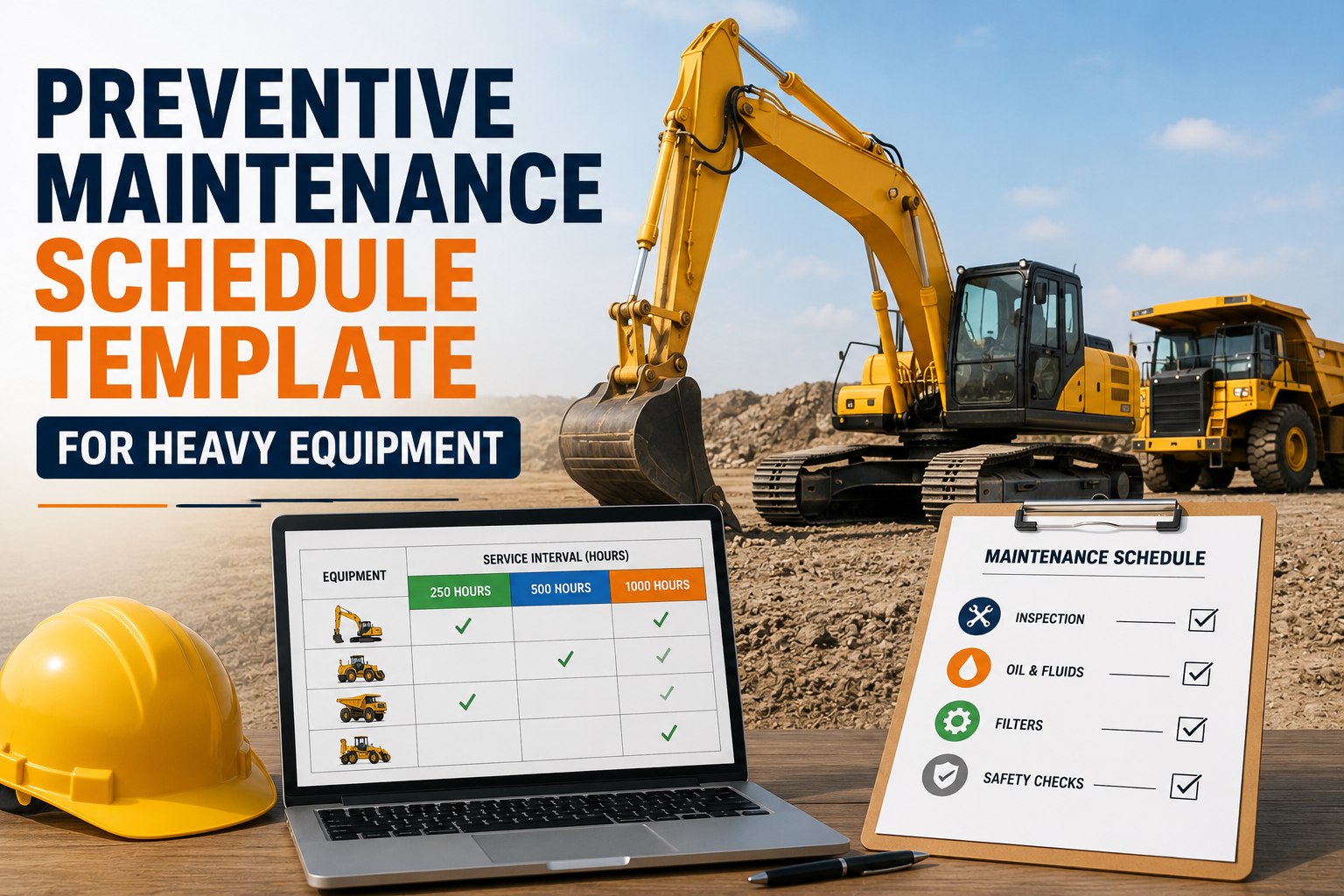
A heavy machine without a maintenance log is a machine flying blind. Every JCB 3DX, L&T Komatsu PC210, TATA Hitachi EX200, and BEML BD80 on every Indian site carries a story written in its service history. Get that story on paper and the next owner pays 10 to 15 percent more for the same machine. Lose it, and you spend lakhs every year debugging problems that were already solved last quarter. This page gives you a ready-to-use heavy equipment maintenance log template covering service history, repairs, parts, downtime, costs and the four KPIs every fleet manager should track. Start free with HVI to digitise the full service book.
Heavy Equipment Maintenance Log Template & Service Record
A complete maintenance log format for Indian EPC, highway, mining, and infrastructure fleets. Capture every service event, every spare part, every rupee spent, and every hour run, all in one searchable record per machine.
Annual maintenance cost as share of equipment asset value
Higher resale value for machines with a complete service log
Typical maintenance cost per operating hour for a 20-ton excavator
Healthy ratio of planned to corrective maintenance events
Anatomy of a Complete Heavy Equipment Service Log Entry
Every entry in your maintenance log should answer eight questions. Miss any of them and the log loses its audit, warranty, and resale value.
Date & Time
When the service started and ended. Required for warranty claims and cost-per-period roll-ups.
Equipment ID + Hour Meter
Machine number, model, and hour-meter reading at start. Photo of the meter preferred.
Service Type
PM-A, PM-B, PM-C, PM-D, Corrective, Inspection, Breakdown, or Modification.
Work Description
What was actually done in plain language. The text every future buyer will read.
Parts Used
Part number, quantity, unit cost, supplier. Without this, warranty arguments are impossible to win.
Labour Hours & Cost
Mechanic hours plus labour rate. Splits in-house from outsourced spend cleanly.
Mechanic & Sign-Off
Name and code of the technician who did the work, plus workshop in-charge sign-off.
Next Service Due
Hours or date when the next PM is expected. Drives the live PM alert system.
Sample Service History Timeline for Equipment Maintenance Log
This is what 90 days of service history looks like for a single machine when logged properly. The timeline reads top to bottom, newest entry first. One glance and any buyer, auditor, or workshop in-charge knows the whole story.
Engine Oil & Filters Service
Engine oil change, oil filter, fuel filter primary, fuel filter secondary, air filter clean. Visual leak check passed.
Hydraulic Hose Replacement
Replaced burst boom-up hose. New OEM hose 1/2 inch by 800 mm. Pressure tested at 320 bar, no leak.
Quarterly Safety Inspection
Full 30-point inspection covering undercarriage, hydraulic, structural, cab, and document audit. No findings.
500-Hour Service
PM-A items plus hydraulic return filter, transmission oil sample, coolant test, undercarriage measurement.
Starter Motor Failure
Starter motor seized. Replaced with OEM unit. Battery load tested, terminals cleaned, alternator output verified.
One screen, 90 days, full story. Book a 30-minute demo to see live service timelines running on real Indian fleet data.
The 4 KPIs Every Maintenance Log Should Track
A log without numbers is just a diary. These four metrics turn the log into a decision tool that workshop heads, project managers, and CFOs all use.
Mean Time Between Failures
Average operating hours between breakdowns. Higher is better. Trend up means reliability is rising.
Mean Time To Repair
Average hours from breakdown to back-in-service. Lower is better. Drives availability directly.
Cost Per Hour
Total maintenance spend divided by operating hours. The single most-watched number by CFOs.
Availability
Hours the machine was ready to run as a share of scheduled hours. The contract-facing number.
Annual Maintenance Cost Breakdown
One of the biggest wins of a digital maintenance log is the cost breakdown that falls out automatically. Here is the typical split for a 20-ton excavator over a year on an Indian site.
-
PM Services Rs 77,400Scheduled engine, hydraulic, filter changes
-
Spare Parts Rs 51,600Genuine OEM and aftermarket components
-
Corrective Rs 33,100Breakdown repairs and unplanned work
-
Labour Rs 22,100In-house and outsourced mechanic hours
When CM climbs above 30 percent of total spend, it is a signal that the PM schedule is slipping. Get the HVI cost dashboard free for your fleet.
Healthy PM-to-CM Ratio in Equipment Maintenance Logs
A well-maintained fleet runs 70 percent planned (PM) and 30 percent corrective (CM) work. If your ratio is flipped, your fleet is firefighting instead of planning. Here is what each ratio looks like.
Planned work dominates. Cost is predictable. Downtime is controlled. Resale value stays high.
Breakdowns dominate. Cost is unpredictable. Downtime is high. Resale value drops sharply.
The PM:CM ratio is the single fastest health check on any Indian fleet. HVI's maintenance dashboard plots the ratio live for every machine and the fleet average. Book a HVI demo to see your fleet ratio on real data.
Expert View from the Field
For years we kept service logs in three separate places. Mechanic copy in a notebook, parts issue in the store register, and a summary Excel that the workshop in-charge updated when he remembered. When a machine had a recurring hydraulic problem, we would spend half a day reconstructing what had been done last.
After we moved to HVI, every service event has the work, parts, labour, and cost on one screen, searchable by machine. We sold three used excavators last year for Rs 2 to 3 lakh more each because we could hand the buyer a clean PDF service book on the spot. That alone paid for the platform five times over.
Vinod Kumar, Workshop Head, EPC Contractor, Telangana — 128 machines across 4 packages
Paper Service Book vs HVI Digital Maintenance Log
- ×Entries scattered across notebooks, store register, Excel
- ×Search means reading every page one by one
- ×Cost roll-up requires manual Excel work
- ×Resale buyer rarely trusts hand-written log
- ×Pages lost, torn, or stained beyond reading
- ✓One log per machine, fully searchable
- ✓Photo proof on every service event
- ✓Cost, MTBF, MTTR auto-calculated
- ✓One-click PDF service book for resale
- ✓Cloud backed up, never lost
For Indian EPC, mining, and infrastructure fleets, the digital service log pays back its setup cost on the very first machine resold with a clean log. Sign up free with HVI and bring every service record under one searchable platform.
Frequently Asked Questions
What fields are mandatory in a heavy equipment maintenance log?
The eight mandatory fields are date and time, equipment ID plus hour meter, service type (PM-A, PM-B, PM-C, PM-D, corrective, inspection, or breakdown), work description, parts used with cost, labour hours and cost, mechanic name with sign-off, and next service due hours. State-specific add-ons may include workshop registration number under the Factories Act and DGMS mine asset code for mining fleets.
How long should maintenance records be retained in India?
Most Indian compliance requirements expect maintenance records to be retained for the full asset life plus 3 years post-disposal. Under the Factories Act and BOCW Rules, statutory test certificates like pressure vessel and lifting equipment records must be retained for the equipment's full service life. For tax and warranty purposes, parts purchase invoices linked to maintenance events should be kept for at least 8 years.
Does a maintenance log help with resale value?
Yes. Used heavy equipment dealers and procurement teams in India typically pay 10 to 15 percent more for a machine that comes with a complete, photo-verified service log. The reason is simple: the buyer can see exactly what has been done, what is due next, and what cost trend the machine has shown. Most premium-priced used JCB, L&T Komatsu, and TATA Hitachi machines that move on the Indian market come with full HVI-style digital service books.
What is a good cost-per-hour benchmark for Indian fleets?
For a 20-ton class excavator like the L&T Komatsu PC210 or TATA Hitachi EX200, the typical maintenance cost-per-hour benchmark on Indian sites is Rs 250 to Rs 350. For backhoe loaders like the JCB 3DX, the range is Rs 150 to Rs 250. Dozers like the BEML BD80 run between Rs 300 and Rs 450 per hour. These ranges exclude fuel and operator cost. Cost-per-hour rising consistently is the earliest indicator of a machine approaching end-of-life.
Can HVI generate a PDF service book for a resale buyer?
Yes. HVI's maintenance log module exports a complete PDF service book for any machine, sorted by date, including every service event, photo proof, parts used, labour cost, and mechanic sign-off. The document is timestamped, GPS-tagged, and contains a verification stamp that lets the buyer cross-check the authenticity. Indian fleet owners using HVI typically attach this PDF as part of the resale package.
Give Every Machine a Digital Service Passport
HVI captures every service event with photo proof, parts, labour, and cost. Auto-calculates MTBF, MTTR, cost-per-hour, and availability. Generates a clean PDF service book on demand. Built for Indian EPC, mining, and infrastructure fleets.
No credit card. No hardware. Live on your fleet in under 10 minutes.