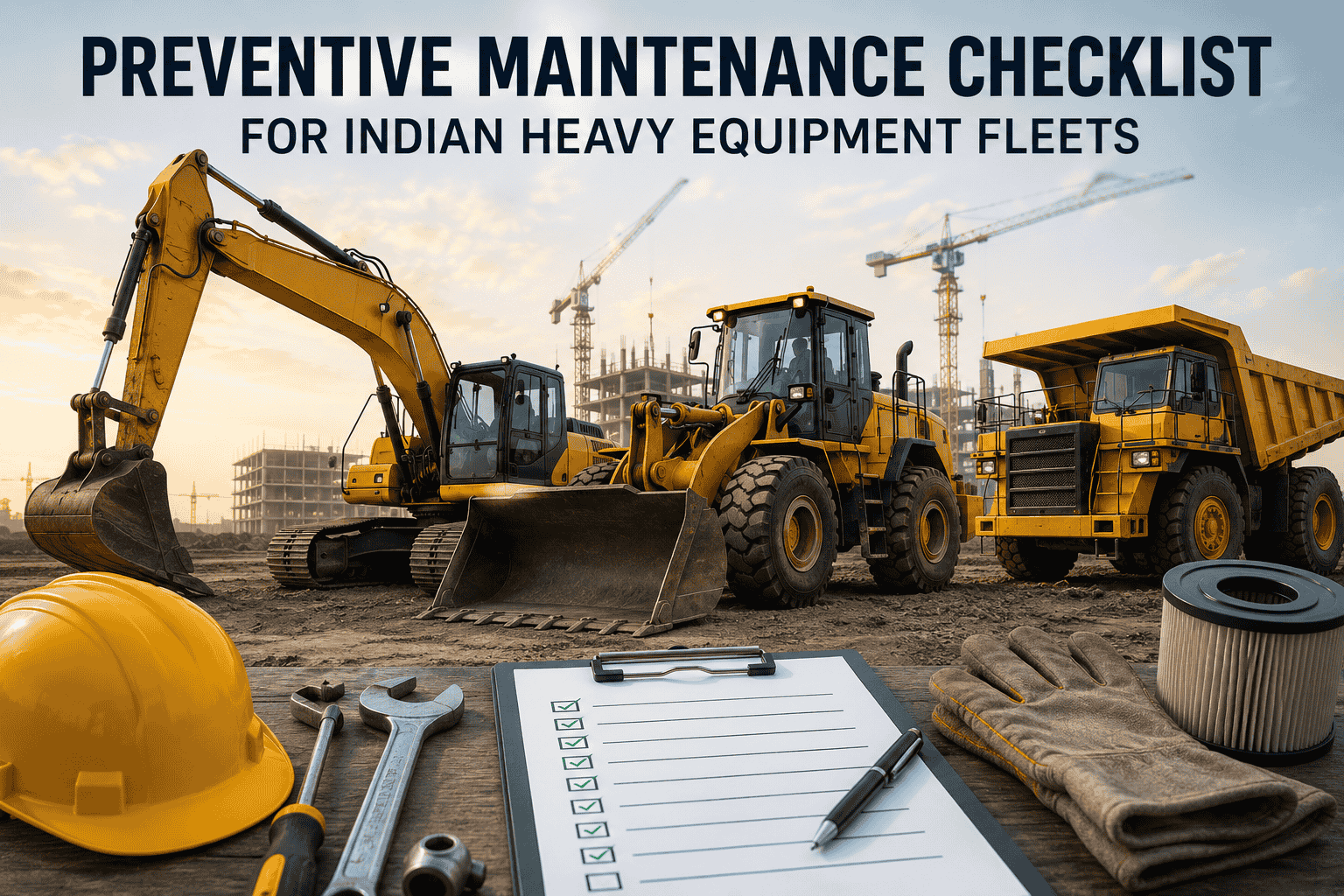
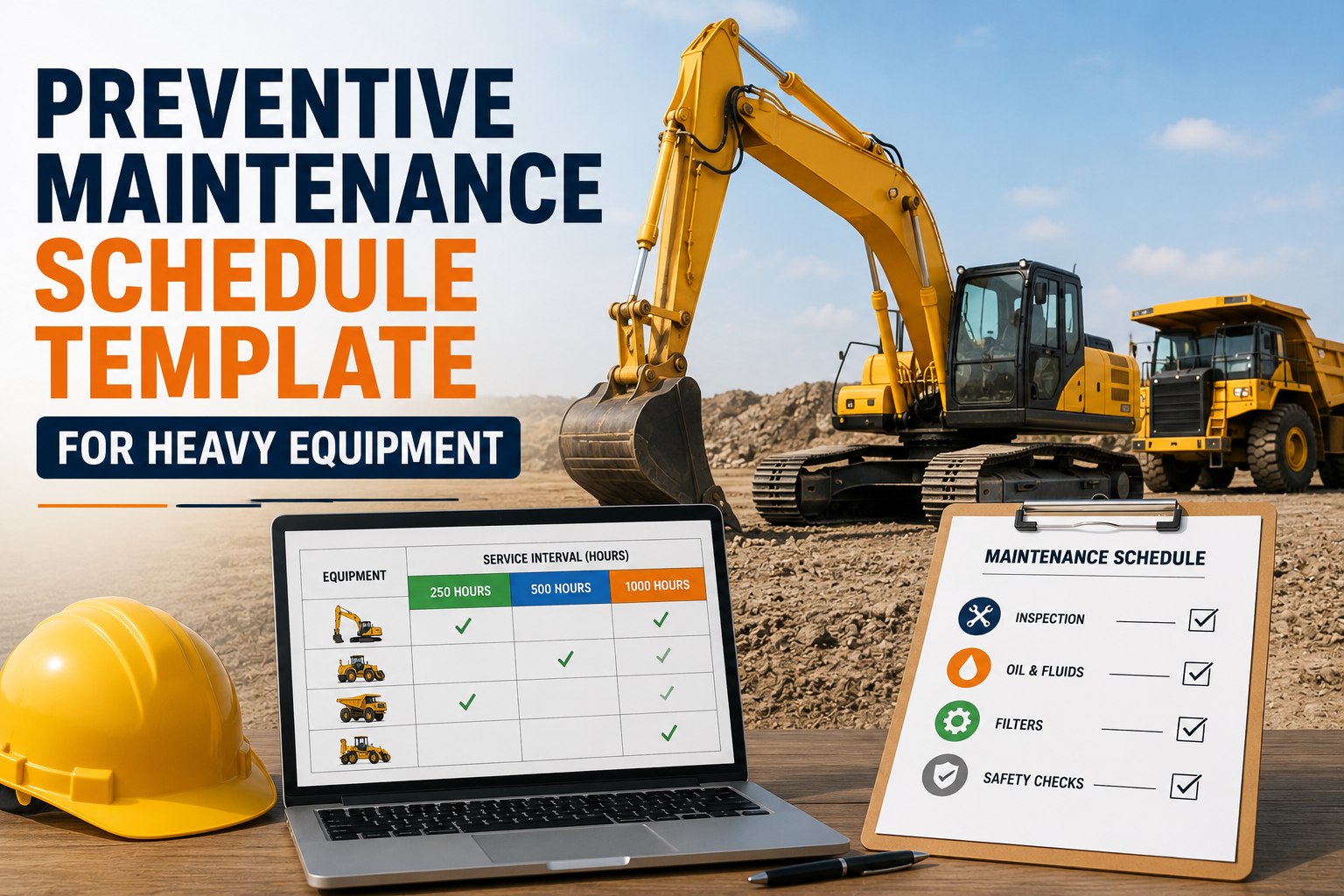
A heavy machine does not fail on a random day. It fails because a filter was not changed at 250 hours, hydraulic oil was not serviced at 500, or the undercarriage was never inspected at 1000. Preventive maintenance is simply doing the right job at the right hour, before the machine decides for you. This heavy equipment preventive maintenance checklist lays out exactly what to do at the 250-hour, 500-hour and 1000-hour service intervals for excavators, cranes, loaders, dozers, and tipper trucks on Indian sites. Reactive breakdown repairs cost three to five times more than planned service — this checklist is how you stay on the cheaper side. Start free with HVI to schedule every interval automatically.
Heavy Equipment Preventive Maintenance Checklist (250, 500 & 1000 Hour Service)
The complete hour-based service checklist for Indian fleets — what to do at every interval for excavators, cranes, loaders, dozers, and tipper trucks. Each service builds on the last. Schedule by hour meter and never miss a service again.
More that reactive breakdown repairs cost compared to planned preventive service
Industry maintenance cost dataReduction in unplanned downtime achievable with a structured, data-driven PM programme
Industrial maintenance analysisOf an excavator's operating cost is in the undercarriage — inspected at the 1000-hour service
Excavator cost benchmarksHigher resale price commanded by machines with a complete, documented service history
Equipment resale dataHow Hour-Based Service Intervals Work
Heavy equipment is serviced by operating hours, not by date — because a machine running two shifts wears twice as fast as one running half a day. The hour meter is the true clock. Services are tiered and cumulative: each bigger service includes everything from the smaller ones, plus more.
Minor Service
Oil, filters, basic checks. The frequent, quick service.
Major Service
All 250h tasks, plus hydraulic filters and deeper inspection.
Overhaul Service
All 500h tasks, plus undercarriage, coolant, and drivetrain.
In harsh Indian conditions — dust, heat above 40°C, heavy loads — many fleets shorten these intervals by 20 to 30 percent. Book a 30-minute demo to see HVI auto-schedule every interval by hour meter.
The Complete 250 / 500 / 1000 Hour Checklist
Here is exactly what happens at each service interval. Remember the golden rule: every service includes all the tasks from the intervals before it.
- Change engine oil and oil filter
- Replace primary fuel filter and water separator
- Check and clean air filter element
- Inspect hydraulic system for leaks
- Grease all pivot points and bushes
- Check coolant, brake, and battery levels
- Inspect belts and hoses for wear
- Test lights, horn, and reverse alarm
- Replace hydraulic oil filter
- Replace secondary fuel and air filters
- Lubricate and inspect all moving parts
- Inspect undercarriage and track tension
- Test all safety devices and interlocks
- Check battery, terminals, and wiring
- Inspect bucket, teeth, and cutting edge
- Change hydraulic fluid and suction filter
- Change swing drive and final drive gear oil
- Drain, flush, and replace engine coolant
- Check and adjust engine valve clearance
- Inspect swing bearing and drive sprockets
- Full undercarriage wear measurement
- Inspect boom, stick, and structure
Get this checklist free on HVI — pre-built for excavators, loaders, cranes, dozers, and tippers. Customise tasks to match your OEM manual.
Service Intervals by Equipment Type
The 250 / 500 / 1000 hour structure applies across the fleet, but the focus areas differ by machine. Here is what each type needs special attention on.
| Equipment | Key Focus Area | Watch Closely |
|---|---|---|
| Excavator | Hydraulics & undercarriage | Track tension, boom pins |
| Wheel Loader | Transmission & tyres | Bucket pins, articulation |
| Dozer | Undercarriage & blade | Track, rollers, sprockets |
| Crane | Wire rope & hydraulics | Rope wear, load test |
| Tipper Truck | Tipping hydraulics & brakes | Hoist cylinder, tyres |
HVI lets you build a separate interval checklist for every machine type and OEM in your fleet. Book a HVI demo to see machine-specific service schedules in action.
Why Skipping a Service Costs So Much More
Skipping a small scheduled service to "save time" is the most expensive decision in fleet management. Here is what a missed service at each interval can turn into.
A full PM programme pays for itself within the first quarter just by avoiding emergency call-outs. Start free with HVI and stop paying the breakdown premium.
Expert View from the Field
For years our service intervals lived in one mechanic's diary. When he was on leave or busy, services got missed — not on purpose, just forgotten in the rush of a live highway project. We lost two engines in one year because the 250-hour oil changes slipped by a few hundred hours each. That is over Rs 15 lakh gone, plus the machines sitting idle on a project where every day counts.
Now HVI tracks the hour meter on every machine and tells us a week before each 250, 500, or 1000 hour service is due. The service simply does not get missed any more, because the system does not forget. Our breakdowns dropped sharply and our machines hold their value better at resale because we can show a complete service history. The intervals were always known — what we lacked was a system that never sleeps.
Mohan Reddy, Plant Manager, GR Infraprojects, Telangana — 75 machines on a highway project
Frequently Asked Questions
What is done at each 250, 500, and 1000 hour service?
The 250-hour minor service covers engine oil and filter change, fuel and air filter service, greasing, leak checks, and basic fluid and safety checks. The 500-hour major service includes everything in the 250-hour service plus hydraulic oil filter replacement, deeper undercarriage and safety-device inspection, and bucket and battery checks. The 1000-hour overhaul service includes everything in the 500-hour service plus a full hydraulic fluid change, swing and final drive gear oil change, coolant flush, valve clearance adjustment, swing bearing inspection, and complete undercarriage wear measurement. The key principle is that each bigger service is cumulative — it includes all the tasks from the smaller intervals plus its own additional work.
Why are heavy equipment services based on hours instead of dates?
Heavy equipment wears according to how much it runs, not how many days pass on the calendar. A machine working two shifts a day on a busy highway package wears twice as fast as one used for half a day, so a date-based schedule would over-service the light user and dangerously under-service the heavy user. The hour meter is the true measure of wear, which is why OEMs like CAT, Komatsu, Tata Hitachi, and Volvo publish their service intervals in operating hours — 250, 500, 1000, and 2000. The best practice on Indian sites is to schedule by hour meter where it works, and apply a calendar backstop for machines that sit idle, servicing whichever trigger comes first.
Should service intervals be shortened for Indian site conditions?
Often, yes. Standard OEM intervals assume moderate operating conditions. Many Indian sites — quarries, mines, road projects in summer — involve heavy dust, ambient heat above 40°C, and continuous heavy loading, all of which accelerate wear on filters, oil, and the undercarriage. In these harsh conditions it is common practice to shorten intervals by 20 to 30 percent, for example servicing at 175 to 200 hours instead of 250. Air filters in particular may need checking far more often on dusty sites. The right approach is to start with the OEM manual as a baseline and then tighten the intervals based on your own machines' actual wear patterns, which a digital maintenance history makes easy to spot.
How much does preventive maintenance really save?
Industry data consistently shows that reactive breakdown maintenance costs three to five times more than planned preventive service once you add in call-out fees, expedited parts, secondary damage, and lost production. A single skipped 250-hour oil change can lead to an engine rebuild costing Rs 5 to 12 lakh, and a missed undercarriage inspection can turn into Rs 4 to 9 lakh of damage. Beyond direct repair costs, a structured PM programme can cut unplanned downtime by a large margin and adds 10 to 20 percent to resale value through a documented service history. Even a basic preventive maintenance programme typically pays for itself within the first quarter just by reducing emergency call-outs and preventing major component failures.
How does HVI help manage service intervals across a fleet?
HVI tracks the hour meter for every machine in your fleet and automatically schedules the 250, 500, and 1000 hour services based on actual operating hours. It sends an alert before each service is due, so nothing is missed when a mechanic is on leave or a project gets busy. When a service falls due it can open a work order, the technician completes the interval checklist on a phone with photos, and the full service history is logged permanently against the machine. This gives fleet managers three things they rarely have on paper: services that never slip, a complete documented history for resale and audits, and the data to fine-tune intervals based on how each machine actually wears on Indian sites.
Let the System Track Every Service Interval
HVI tracks every machine's hour meter and auto-schedules the 250, 500, and 1000 hour services — alerts before due, work orders on time, and a complete service history for every machine. Works on excavators, cranes, loaders, dozers, and tippers of any brand. Built for Indian fleets.
No credit card. No hardware. Live on your fleet in under 10 minutes.