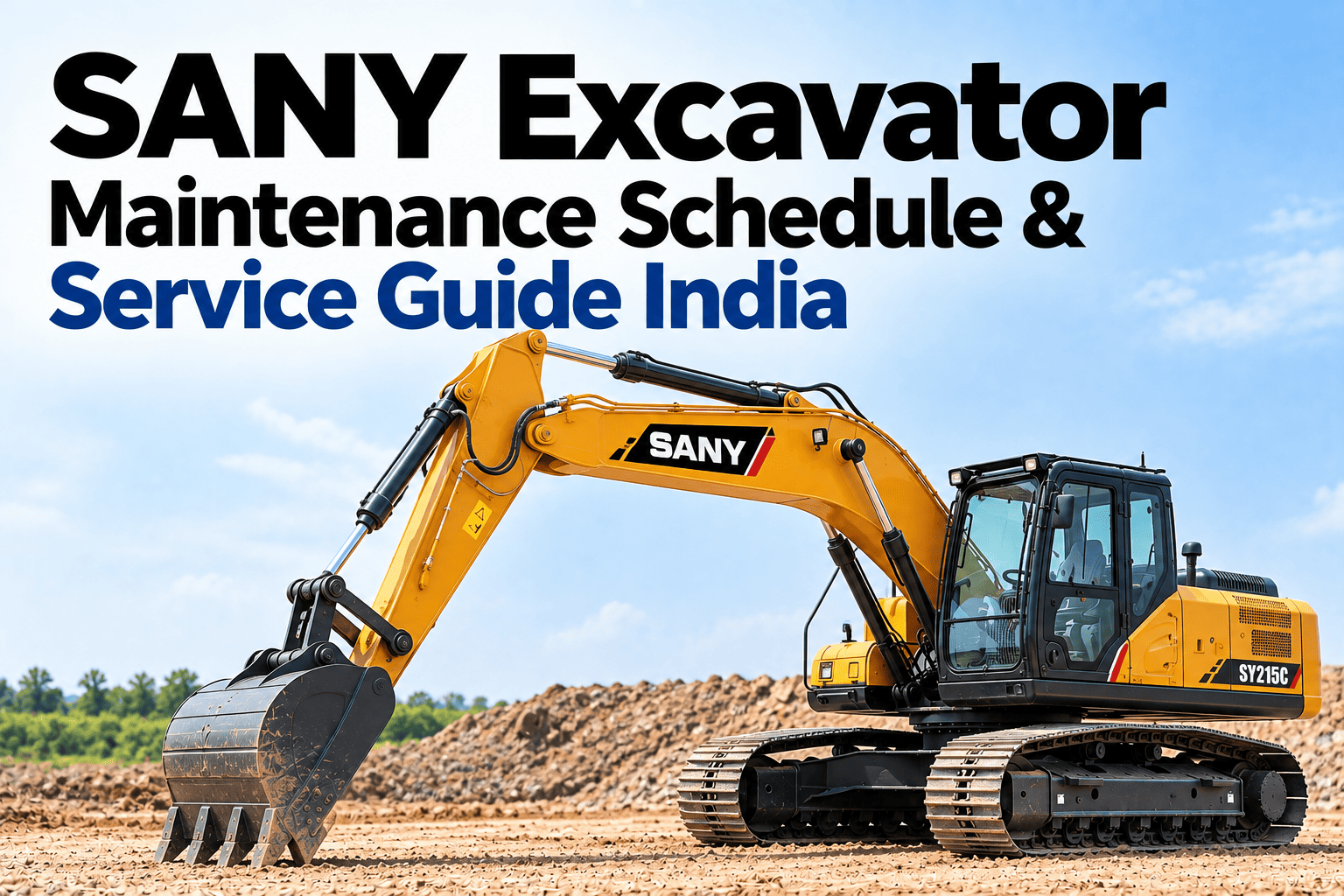
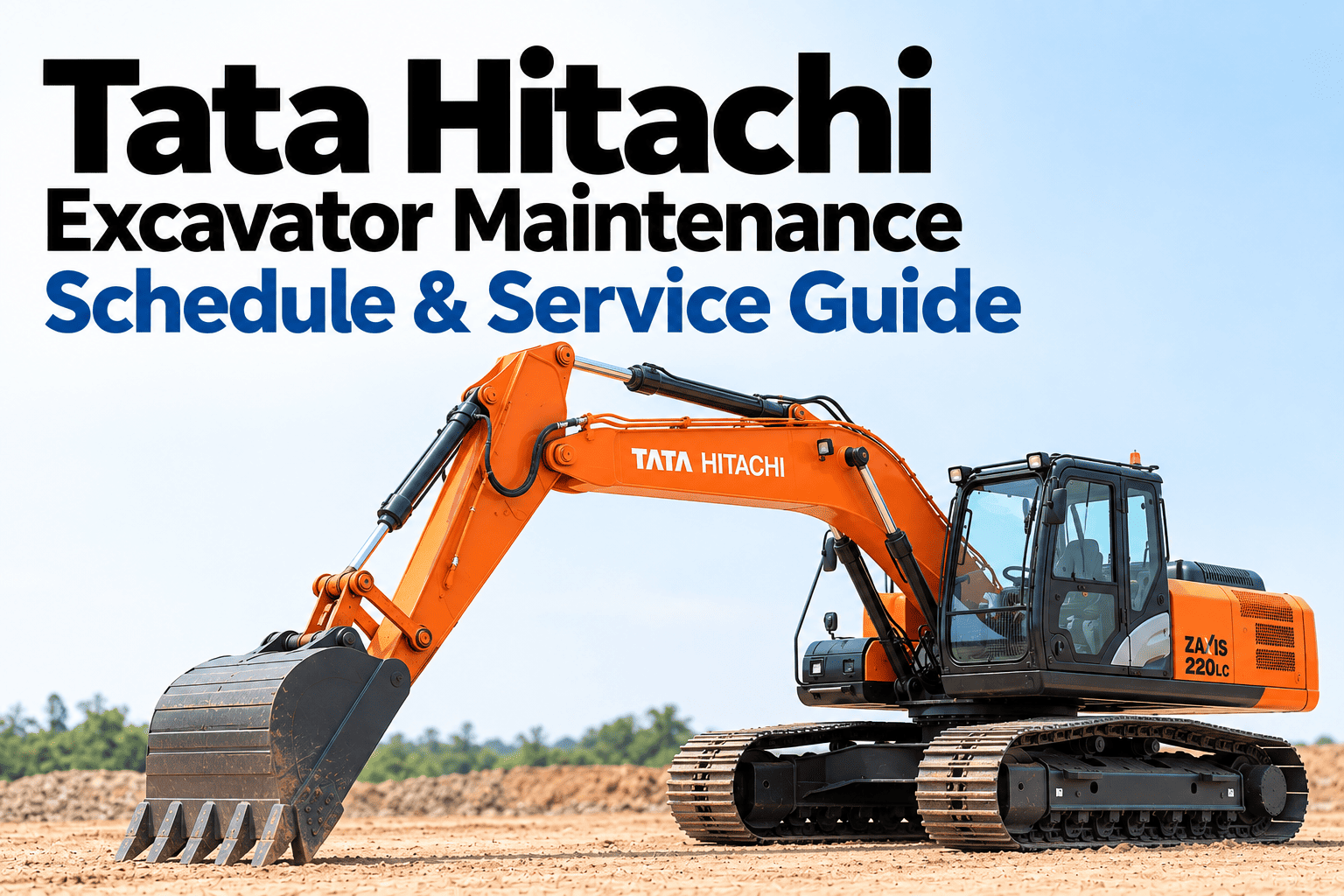
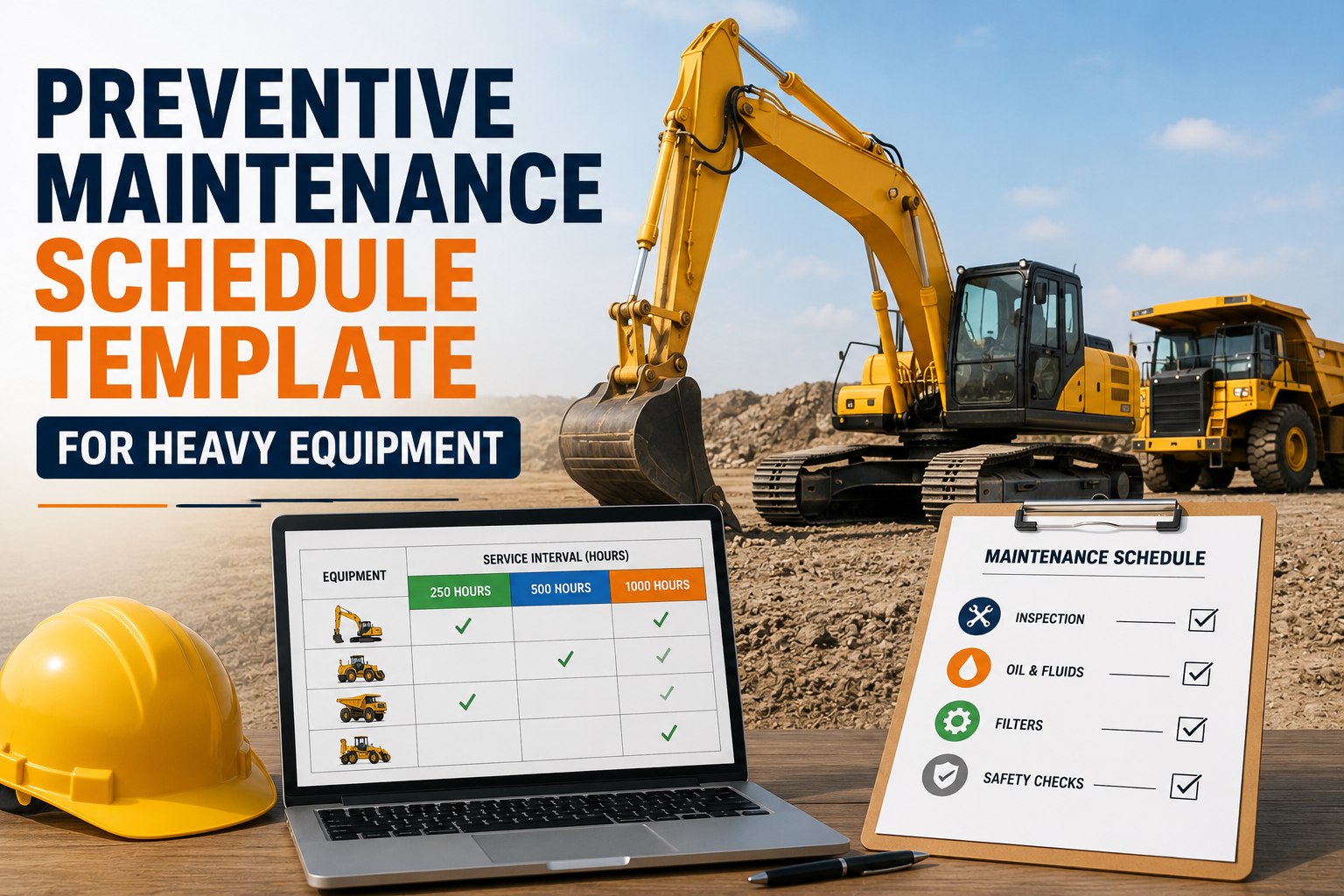
If you manage a JCB 3DX, Tata Hitachi EX200, CAT 320, or Komatsu PC210 on an Indian infrastructure project, you already know the cost of an unplanned breakdown — halted work, delayed milestones, and NHAI penalty clauses that add up fast. A structured preventive maintenance schedule is not a paperwork exercise. It is the single most reliable method to keep excavators and backhoe loaders earning hours instead of sitting in the yard waiting for parts. This guide covers every major service interval — 10-hour daily checks through the 1000-hour major service — for the most commonly used excavator and backhoe loader models on Indian highway, mining, and metro sites. If you want to digitise and automate PM scheduling across your fleet, start a free HVI trial and have your first PM alerts running today.
Complete 2026 Field Guide — JCB, Tata Hitachi, CAT, Komatsu
Preventive Maintenance Schedule for JCB & Excavators: India 2026
Every service interval, every critical check — from the 10-hour daily walkaround to the 1000-hour major overhaul — for the excavators and backhoe loaders running on Indian highway, mining, and metro projects.
Why PM Schedules Fail on Indian Project Sites
Most site managers know the maintenance schedule in theory. In practice, three things consistently go wrong. First, hourmeter readings are logged manually — or not at all — so the 500-hour service trigger is missed by 80 to 200 hours before anyone notices. Second, daily checks happen on paper at the gate, not at the machine, so the hydraulic seepage that started at 08:00 on Monday isn't caught until the hose blows on Wednesday afternoon. Third, there is no automatic reminder system — the workshop supervisor has to mentally track 30 machines across multiple service intervals simultaneously, which is not realistic at scale.
The result: Indian infrastructure projects report excavator unplanned downtime rates of 18 to 24 percent — two to three times the global benchmark for a well-maintained fleet. Structured digital PM scheduling, with hourmeter-triggered alerts and mobile pre-shift inspection records, cuts that number to under 8 percent within the first 90 days of deployment.
18–24%
unplanned downtime rate for poorly maintained excavator fleets on Indian projects
500 hrs
average missed service threshold when hourmeter tracking is manual or paper-based
3x
higher repair cost when a PM-detectable fault runs to failure vs. being caught in service
Under 8%
downtime rate achieved by fleets running digital PM scheduling with hourmeter alerts
The Full Service Interval Structure — Excavators and Backhoe Loaders
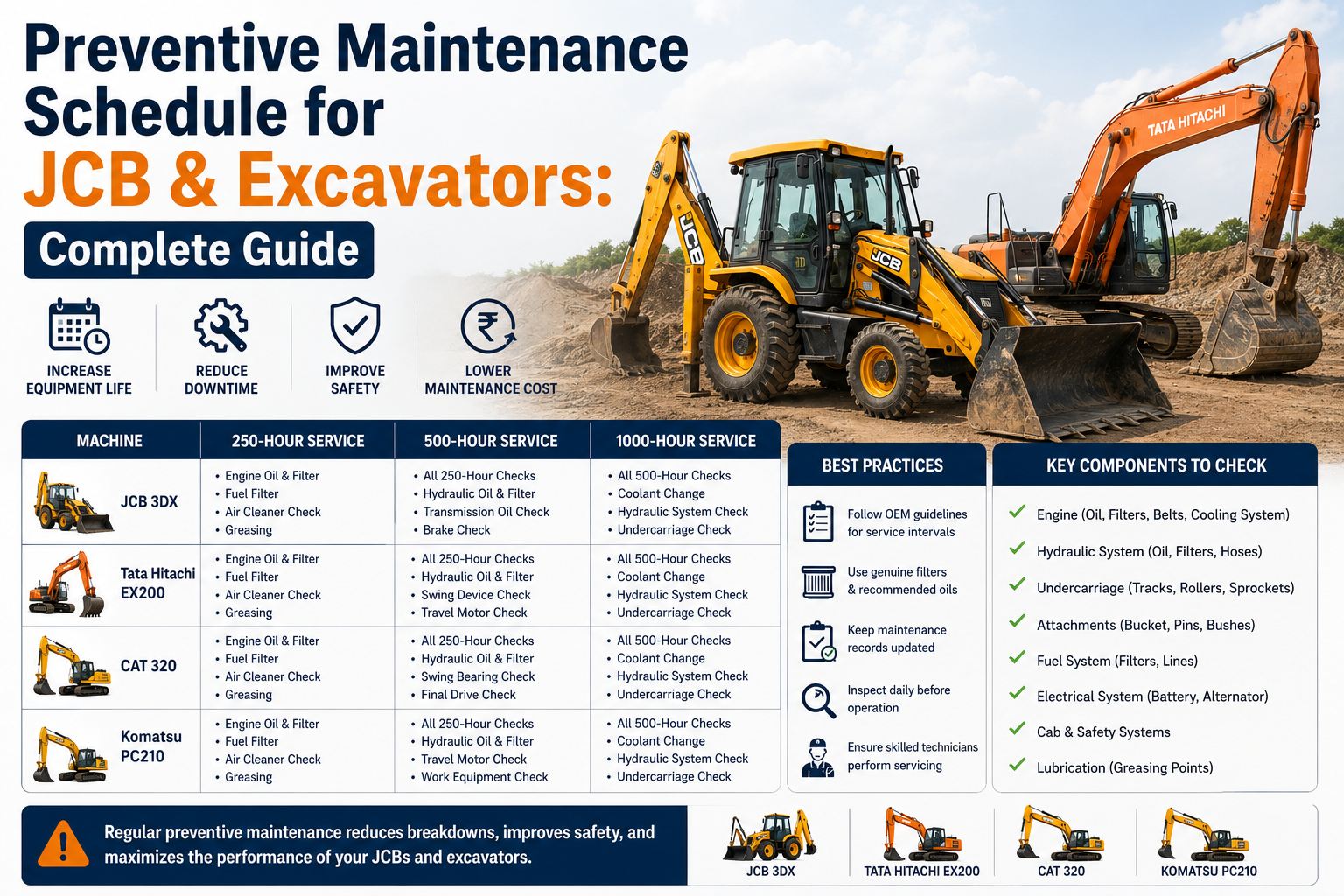
The table below maps the standard maintenance intervals used across JCB 3DX, Tata Hitachi EX200, CAT 320, and Komatsu PC210 models. While exact capacities and torque specs vary by manufacturer, the interval structure is consistent. Always cross-reference against the machine's operator manual for model-specific values.
| Interval | Calendar Equivalent | Primary Tasks | Critical Check Items |
|---|---|---|---|
| 10 Hrs | Daily / Pre-Shift | Engine oil level, coolant level, hydraulic oil level, fuel level | Hydraulic hose condition, leaks under machine, tyre pressure (BHL), track tension (excavator) |
| 50 Hrs | Weekly | Engine oil & filter change, hydraulic oil filter inspect, greasing all points | Battery terminals, air filter pre-cleaner, fuel lift pump clean, clutch oil pressure check |
| 250 Hrs | Monthly | Engine belt inspect, cooling hoses check, transmission oil & filter replace, axle oil level | Boom/dipper/bucket pins and bushes for wear, steering system leaks, air cleaner elements replace or clean |
| 500 Hrs | 3 Months | Engine oil & filter change, hydraulic oil & filter change, fuel filter replace | Hydraulic pump performance test, swing bearing grease, undercarriage inspect, cab safety glass condition |
| 1000 Hrs | 6 Months | All fluid filter replacement, cooling system flush & coolant replace, universal joints service | Hydraulic pump and cylinder strip-test, all critical fastener torque check, engine mount condition, A/C refrigerant check |
| 2000 Hrs | Annual | Full drivetrain service, hydraulic oil system flush, transmission overhaul inspect | MRV pressure settings (loader 183 kg/cm², excavator 210 kg/cm²), swing motor, final drives, full structural inspect |
10-Hour Daily Pre-Shift Checklist — What Every Operator Must Check
The 10-hour check is the most important interval in the entire schedule. It happens every shift, it is the operator's job to complete it, and it is the earliest warning system for developing faults. On Indian sites, this check is also the most commonly skipped or falsified. A 10-hour check that is genuinely completed at the machine — not filled in from memory at the gate — takes four to six minutes and catches the majority of defects before they become breakdowns.
Engine Area
- Engine oil level — dipstick check, correct grade
- Coolant level in radiator overflow tank
- Radiator/oil cooler matrix — clear of dust and debris
- Fan belt condition — cracks, fraying, tension
- Fuel level — actual gauge read, not assumed
- Exhaust smoke colour on startup — white/black signals a problem
Hydraulic System
- Hydraulic oil level in reservoir
- All hose connections — visual for seepage or weeping
- Cylinder rod condition — score marks indicate seal failure
- Ground below machine — oil puddles from overnight seepage
- Bucket, boom, dipper movement — correct speed and response
Undercarriage (Excavator)
- Track tension — correct sag per manufacturer spec
- Track pad condition and lug wear
- Sprocket and idler — cracks, missing teeth
- Carrier roller and track roller — leaks, binding
- Frame cracks — especially near swing bearing
Cab and Controls
- All levers return to neutral correctly
- Instrument panel — no warning lamps at startup
- Cab glass — cracks or obstruction to sightlines
- Seat belt functional and undamaged
- Horn and reverse alarm functional
- Lights and indicators (if night work planned)
500-Hour Service — The Most Overlooked Critical Interval
The 500-hour service is where most Indian fleet managers lose money. It is comprehensive enough to require workshop time, expensive enough to feel like a cost when cash flow is tight, and easy to defer because the machine is running fine right now. The problem is that the components that fail catastrophically — hydraulic pumps, swing motors, main bearings — fail because they were not serviced at 500 hours. A hydraulic pump replacement runs to ₹1.8–3.2 lakh depending on model. Proper 500-hour service costs a fraction of that and prevents it entirely.
JCB 3DX — 500 Hr Service
Engine oil and filter change (15L capacity, 20W50 diesel oil)
Hydraulic oil filter change — suction strainer and return line Filtromatic filter
Fuel filter replacement — upgraded interval to 1000 hrs on newer 3DX variants
Transmission oil filter replace, clutch pressure verification
All greasing points — 15 to 22 points depending on variant
Axle hub bearing and kingpin bush grease
MRV pressure check: excavator side 210 kg/cm², loader side 183 kg/cm²
Tata Hitachi EX200 — 500 Hr Service
Engine oil and filter change — check for metal particles in drain sample
Hydraulic oil filter (pilot filter, return filter, case drain filter)
Swing bearing grease — Molub Alloy 936 or equivalent, every 500 hours
Swing bearing ring gear grease — separate lubricant specification
Track adjuster grease — recheck track tension after greasing
Hydraulic pump performance check — output flow test under load
Boom, arm, bucket pin and bush wear measurement and record
CAT 320 — 500 Hr Service
Engine oil and oil filter — use CAT DEO or equivalent ACEA E9 grade
Hydraulic oil filter — CAT Advanced Efficiency filter recommended
Fuel system water separator — drain and inspect
S·O·S oil sample — send oil sample to CAT dealer for condition analysis
Final drive oil level check both sides
Bucket, stick, and boom cylinder rod inspect for scoring
HVAC filter clean or replace (if equipped)
Komatsu PC210 — 500 Hr Service
Engine oil and filter change — Komatsu recommends KDEO 15W40
Hydraulic oil filter element replacement — system and return filters
Swing circle bearing lubrication — specified grease quantity per point
Travel motor brake release oil level check
Bucket tooth adapter and side cutter wear check — replace if worn past 50% mark
Komtrax diagnostic data review — confirm no stored fault codes
All structural welds and boom foot pin area — visual crack inspect
1000-Hour Major Service — What Gets Missed and Why It Matters
The 1000-hour service is the most comprehensive PM event before the 2000-hour annual. At six months of normal site usage, the machine has accumulated enough heat cycles, load cycles, and contamination exposure that several systems need more than an oil change — they need a thorough inspection and functional test. The items below are specifically where Indian sites most commonly skip steps at this interval.
Indian summer conditions push radiator temperatures hard. After 1000 hours, coolant inhibitor depletion and silica gel contamination are measurable. Flushing with clean water and refilling with OAT (Organic Acid Technology) coolant at correct dilution — typically 33% antifreeze to 67% water for Indian conditions — prevents liner pitting that leads to expensive overhaul.
At 1000 hours, hydraulic pump efficiency typically drops 5 to 12 percent below new specification in hard-working machines. A bench test measuring output flow and case drain flow quantifies remaining pump life and allows a planned replacement instead of an emergency failure. Cylinder seals showing minor bypass at this stage are a sign-off to schedule replacement, not to ignore.
Vibration on Indian road and quarry conditions loosens bolts that are torqued correctly at manufacture. Swing bearing fasteners, boom foot pin retaining bolts, and counterweight mounting hardware are the three areas that cause catastrophic failures when they loosen undetected. A full torque check at 1000 hours takes two hours and prevents failures that cost 40 to 60 times as much to recover from.
Rubber engine mounts deteriorate faster in Indian temperature cycles than in temperate climates — 60°C ambient bay temperature is not unusual in Rajasthan and Gujarat summers. Cracked or collapsed mounts allow vibration transfer to the frame and accelerate fatigue cracks at weld joints. Replace mounts showing more than 20% rubber deterioration or visible cracking.
JCB 3DX and similar backhoe loaders have universal joints in the drive shaft that require lubrication and wear inspection at 1000 hours. A worn universal joint that fails mid-shift takes the entire drivetrain offline — typically a full shift of lost production plus parts lead time in India of two to five days for genuine parts.
Automate Your Excavator PM Schedule with HVI
Stop tracking hourmeter readings on spreadsheets. HVI logs every reading from pre-shift inspections, triggers PM alerts automatically at 250, 500, and 1000-hour thresholds, and sends the work order to your workshop before the service is overdue.
Common Failure Points by Machine Type — Indian Site Conditions
Indian operating conditions — dust, heat, unpaved haul roads, and high utilisation rates — create failure patterns that differ from temperate-climate operating environments. The table below lists the top failure points observed on Indian highway and mining projects, the PM interval that catches them, and the consequence of missing that service.
| Machine | Failure Point | PM Interval That Catches It | Missed-Service Consequence |
|---|---|---|---|
| JCB 3DX | Hydraulic seals — dipper and loader ram | 10-hour daily check | Ram collapse mid-dig, operator injury risk, ₹40,000–80,000 seal replacement |
| JCB 3DX | Torque converter clutch pressure drop | 50-hour check — pressure test | Transmission slip, accelerated clutch pack wear, ₹1.5–2.5L overhaul |
| Tata Hitachi EX200 | Swing bearing race wear | 500-hour bearing grease and inspection | Swing bearing failure, upper structure instability, ₹3.5–5L replacement |
| CAT 320 | Final drive oil seal failure | 250-hour visual inspect | Final drive seizure, ₹2–4L repair, 5–8 days downtime |
| Komatsu PC210 | Bucket tooth wear past working limit | 10-hour daily check | Tooth detachment into fill, damages downstream equipment, productivity loss |
| All Models | Air filter element choking — Indian dust | 50-hour pre-cleaner clean, 250-hour element replace | Engine overfuelling, black smoke, high EGT, injector damage |
How to Build a PM Schedule That Actually Gets Followed on Site
A maintenance schedule that lives in a PDF or a folder is not a schedule — it is documentation. A schedule that gets followed is one that is built into the daily workflow, visible to the people responsible for it, and connected to an alert when it is about to be missed. Here is the deployment sequence that works for Indian site conditions.
Step 01
Log every machine with its current hourmeter readingSet the baseline. Every machine needs a starting hourmeter and the date of its last service at each interval. This takes 15 to 30 minutes per machine and is a one-time task. Without this starting point, your alert thresholds are guesses.
Step 02
Assign operators and enable daily pre-shift inspectionEvery pre-shift inspection that an operator submits via the HVI mobile app logs a hourmeter reading. This reading automatically updates the machine's service countdown. No manual data entry, no spreadsheet update — the PM schedule updates itself from inspection data.
Step 03
Set service interval thresholds and alert recipientsConfigure alerts at 250, 500, and 1000-hour intervals. Set the alert trigger at 50 hours before the threshold — giving the workshop advance notice to order parts, schedule workshop time, and plan for the machine to be offline for a half day. The alert goes to the plant engineer and workshop supervisor simultaneously.
Step 04
Close the loop — record the service completionWhen the service is completed, the workshop supervisor logs the service event in the platform with the final hourmeter reading, parts used, and technician who did the work. The machine's service counter resets from that reading. The record is permanently available for NHAI compliance audits and insurance claims.
Expert Perspective: Plant Engineer on PM Scheduling in Indian Conditions
We run 34 machines across two NH packages in Madhya Pradesh and Gujarat. For three years, our 500-hour service compliance rate was around 55 percent — the rest were either late or not done at all. We had the schedule in a spreadsheet, but with multiple sites and operators moving between machines, the hourmeter tracking was always behind. The first year we moved to digital PM tracking with hourmeter-linked alerts, our 500-hour compliance went to 91 percent. More importantly, our hydraulic pump replacements dropped from 7 in that year to 2 the next year. That is a direct financial return. The machines run longer and the workshop is planned, not reactive. Indian site conditions are hard on these machines — dust, heat, unpaved haul roads, river crossings. The only answer is not running harder machines, it is servicing them more reliably at the right intervals.
Frequently Asked Questions
What is the correct engine oil change interval for a JCB 3DX on Indian highway projects?
The standard JCB 3DX engine oil and filter change interval is 50 hours (weekly under normal utilisation). On Indian highway projects with high dust and heat, many site engineers advance this to every 40 to 45 hours during summer months (April to June) when ambient temperatures exceed 40°C and engine bay temperatures can reach 55 to 60°C. Always use a 20W50 diesel engine oil meeting API CF-4 minimum specification, or the grade specified in the operator manual for your exact engine variant. Record each oil change in a maintenance log tied to the hourmeter reading — this record is required for warranty claims and NHAI inspection documentation. Digital PM tracking via HVI timestamps and stores every service event automatically.
How often should the hydraulic oil be changed on a Tata Hitachi EX200 or CAT 320?
On standard operating conditions, the hydraulic oil change interval for both the Tata Hitachi EX200 and CAT 320 is 1000 hours — but this assumes a correctly functioning return line filter and regular filter changes at every 500-hour service. If the machine is operating in extremely dusty conditions (stone quarries, crushing plants, or highway earthwork during dry season), hydraulic oil contamination accelerates. In those conditions, an oil sample test at 500 hours is advisable — send the oil to a CAT SOS lab or a Tata Hitachi authorised service centre for particle count and viscosity analysis. If contamination is above threshold, change the oil early rather than waiting for the 1000-hour interval. The cost of a hydraulic oil change is a fraction of the cost of pump or cylinder damage from contaminated oil.
What does a 250-hour service cover that the 50-hour service does not?
The 250-hour service extends beyond fluid and filter changes to include a systematic mechanical inspection of the major load-bearing components. On a JCB 3DX or excavator, this includes: transmission oil and filter replacement, axle oil level check, cooling system hose condition, engine belt tension and wear, and — critically — boom, dipper, and bucket pin-and-bush wear measurement. Pin and bush wear is cumulative and invisible from the cab. By 250 hours, measurable play begins to develop at these joints, and catching it at the 250-hour service with a bush replacement prevents the 500-hour failure where the pin itself wears and the repair cost multiplies. The 250-hour service takes approximately 3 to 4 hours of workshop time on most models and is the interval most frequently skipped under production pressure — which is why it causes disproportionate downstream damage.
How can I track PM schedules for a fleet of 20+ excavators across multiple sites?
The most reliable method is digital PM scheduling tied to live hourmeter data from daily pre-shift inspections. Each morning, the operator logs the hourmeter reading on the HVI mobile app as part of their pre-shift inspection. That reading automatically updates the machine's service countdown for every interval — 50-hour, 250-hour, 500-hour, and 1000-hour. When any machine reaches 50 hours before a service threshold, the system sends an automated alert to the workshop supervisor and plant engineer. This eliminates the need for a dedicated person to manually track service due dates across 20 or more machines. For a live walkthrough of fleet PM tracking, book a 30-minute demo with the HVI team.
What are the signs that a Komatsu PC210 needs its swing bearing replaced before the scheduled interval?
The Komatsu PC210 swing bearing typically lasts 3000 to 5000 hours with correct greasing. However, Indian operating conditions — heavy material, continuous swing cycles, and inconsistent greasing schedules — can reduce this significantly. Watch for these early warning signs between scheduled services: increased free play when rocking the upper structure by hand with the machine stopped (more than 1.5 to 2mm indicates measurable wear), grinding or knocking sound during swing cycle (especially at the beginning of swing movement), visible grease contamination mixed with metal particles at the bearing grease purge points, and oil seepage from the swing motor area. If any of these appear, schedule a bearing inspection immediately rather than waiting for the next PM interval. Catching swing bearing wear at 20 to 30 percent wear allows planned replacement; missing it results in bearing collapse, which damages the swing ring and the frame mounting, multiplying repair cost by four to six times.
Keep Your Excavators on Schedule — Start Digital PM Tracking Today
HVI tracks hourmeter readings from every daily inspection, triggers PM alerts at every service threshold, and stores complete service records for NHAI compliance audits — all without any additional hardware on your machines.
No hardware required. No credit card. PM alerts running from day one.