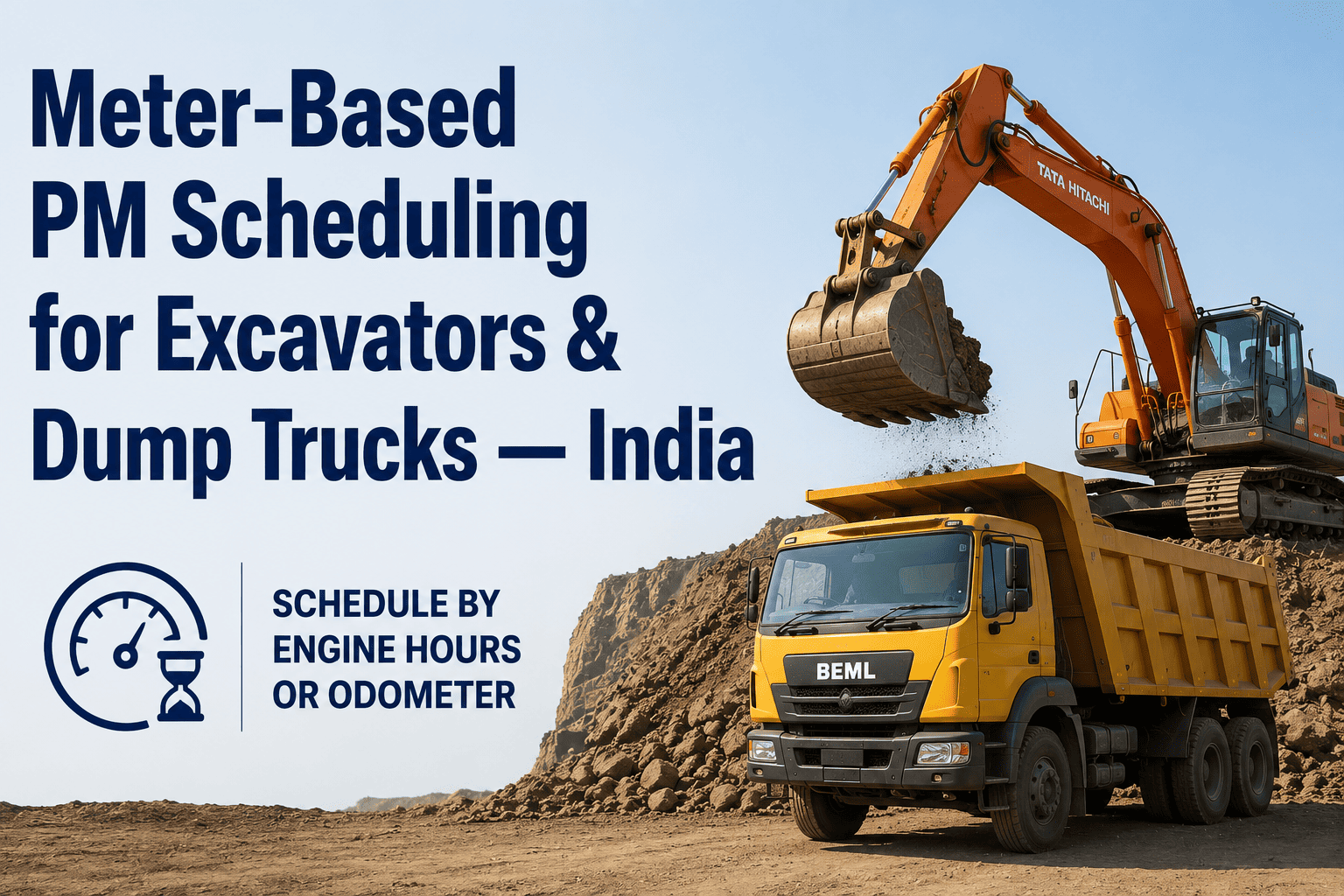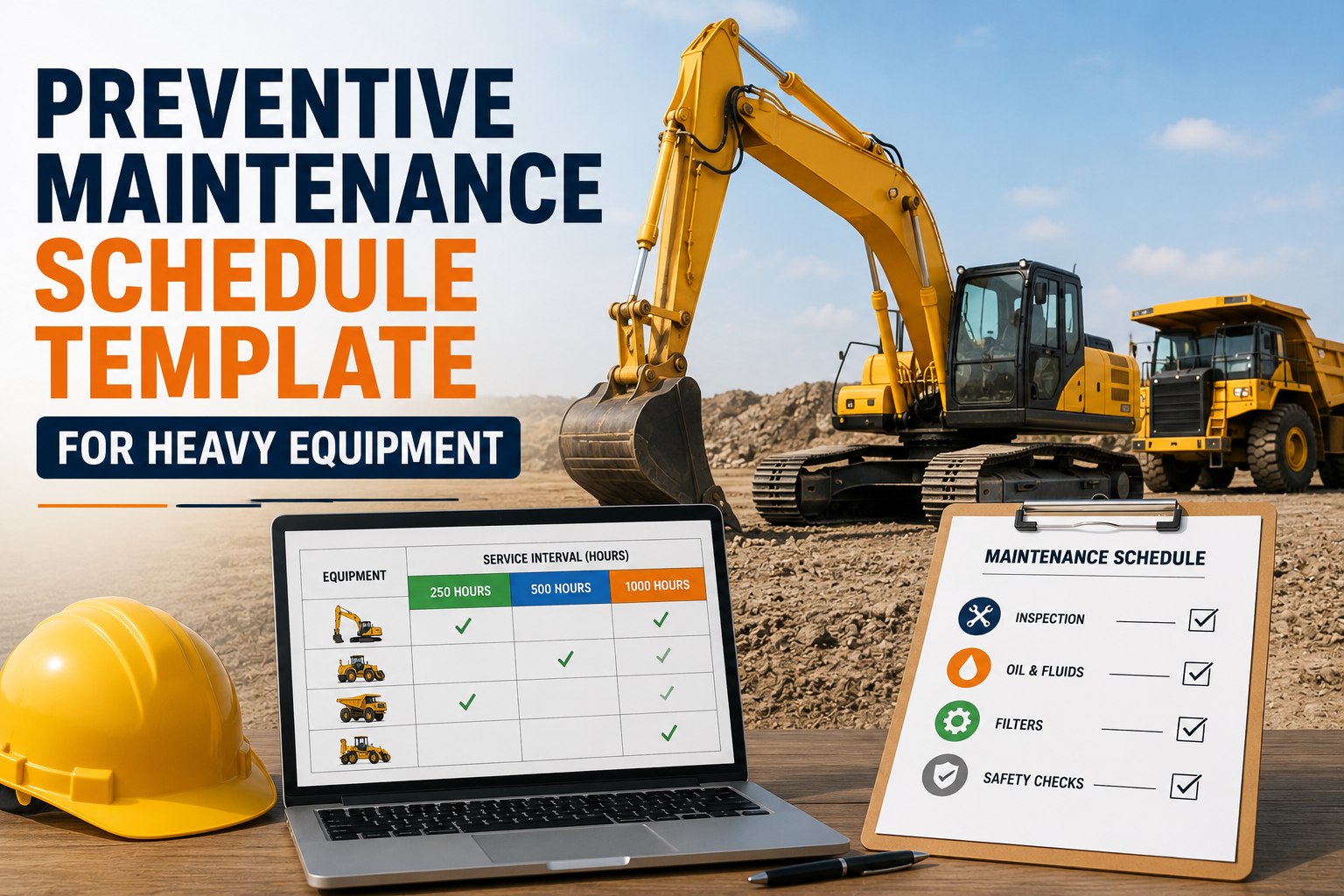
Every excavator brand publishes its own service schedule, but they all share the same backbone: service by operating hours, at 250, 500, and 1000 hour milestones. The difference is in the detail — a JCB 3DX backhoe, a Tata Hitachi EX200, a CAT 320, and a Komatsu PC210 each have their own intervals, filter parts, and quirks. Get the schedule right for each machine and you cut breakdowns, extend life, and protect resale value. This guide lays out the preventive maintenance schedule for the most common excavators on Indian sites — what to service at each interval, model by model, in simple terms. Start free with HVI to auto-schedule every service by hour meter.
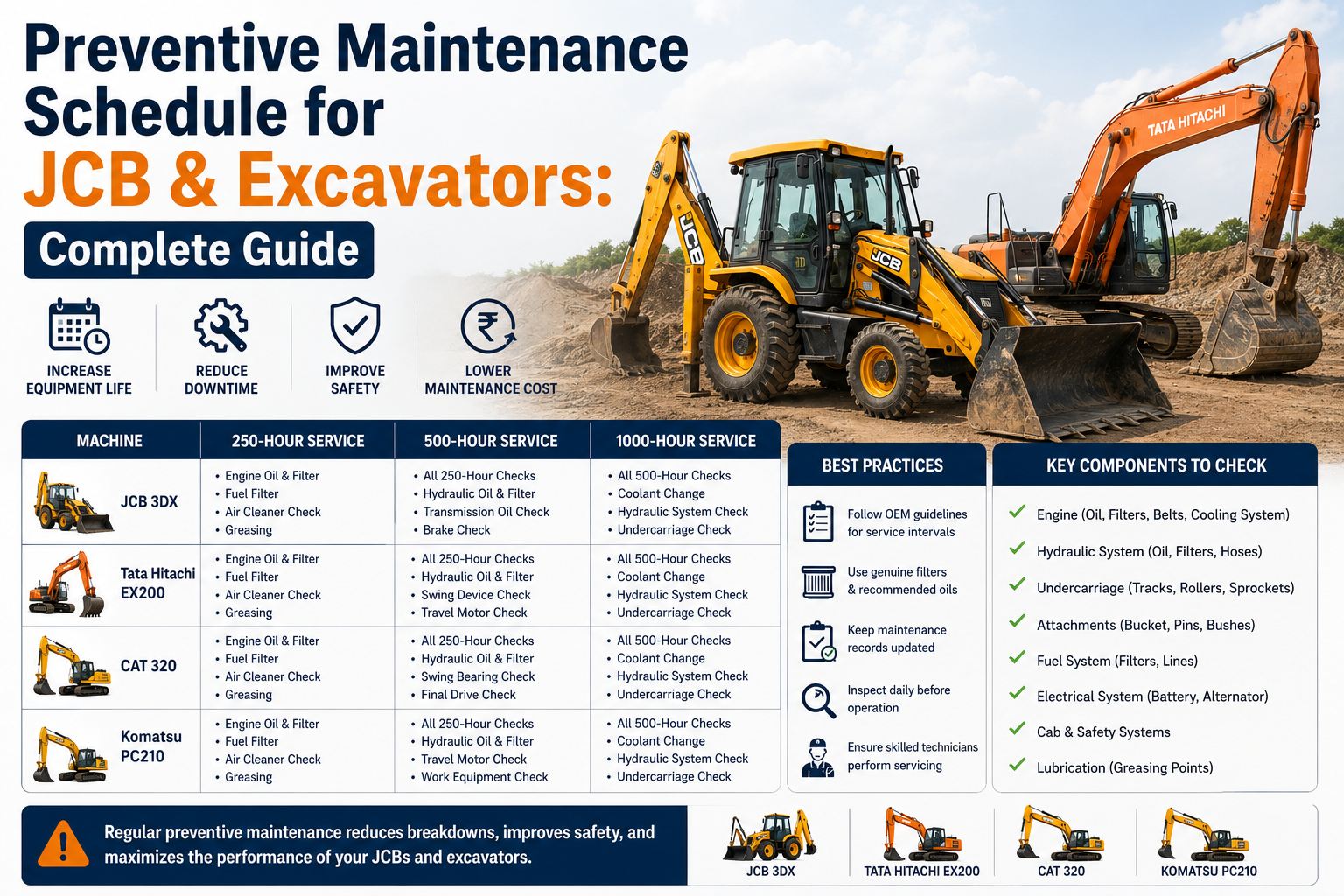
Preventive Maintenance Schedule for JCB & Excavators: Complete Guide
The hour-based service schedule for the machines that build India — JCB 3DX, Tata Hitachi EX200, CAT 320, and Komatsu PC210. What to do at every 250, 500, and 1000 hour interval, with the model-specific points that matter.
The standard hour-based service milestones used by JCB, Tata Hitachi, CAT, and Komatsu
OEM service schedulesMore that breakdown repairs cost versus following the planned service schedule
Maintenance cost benchmarksOf an excavator's operating cost is the undercarriage — serviced at the 1000-hour interval
Excavator cost dataHigher resale price for machines with a complete, documented service history
Equipment resale dataThe Rule Every Excavator Follows
Whatever the brand, the same three principles govern the schedule. Get these right and the model-specific details fall into place.
Service by Hours, Not Dates
A machine running two shifts wears twice as fast as one running half a day. The hour meter is the true clock — schedule on it.
Each Service Is Cumulative
The 500-hour service includes everything from 250h, plus more. The 1000-hour includes all of 500h, plus the big jobs.
The Manual Is the Baseline
Use the OEM schedule as your starting point, then tighten intervals for dust, heat, and heavy loads on Indian sites.
With these three rules and an hour meter, any excavator schedule becomes simple to run. Book a 30-minute demo to see HVI auto-schedule every machine by hour meter.
The Universal 250 / 500 / 1000 Hour Schedule
This is the common service backbone that applies to all four machines. The model cards further down show what is special about each brand. Remember: every larger service includes the smaller ones.
- Engine oil & oil filter change
- Primary fuel filter / water separator
- Clean / check air filter element
- Grease all pivot points
- Check coolant, leaks, belts
- Hydraulic oil filter replacement
- Secondary fuel & air filters
- Undercarriage & track inspection
- Test safety devices
- Hydraulic oil & tank breather
- Swing & final drive gear oil
- Coolant flush & replace
- Full undercarriage wear check
Get this schedule free on HVI — pre-built for JCB, Tata Hitachi, CAT, Komatsu, Volvo, and Hyundai.
Model-by-Model: What's Special About Each
The backbone is shared, but each machine has its own focus areas. Here is what matters most for the four most common excavators and backhoes on Indian sites.
- Engine oil: change around every 250–500 h per manual
- Both ends: service loader and backhoe hydraulics, not just one
- Transmission: check torque converter & gearbox oil
- Tyres & brakes: wheeled machine — check pressure & brakes, not tracks
- Grease: heavy daily greasing of loader and hoe pins
- Engine oil: 250 h; hydraulic filter at 500 h
- Undercarriage: track tension & rollers — high wear in Indian conditions
- Hydraulics: watch for leaks; the EX series is hydraulic-heavy
- Swing & final drive: gear oil check at 1000 h
- Breaker use: shorten hydraulic oil interval if rock-breaking
- CAT PM system: PM1 = 250h, PM2 = 500h, PM3 = 1000h, PM4 = 2000h
- S·O·S oil sampling: CAT recommends fluid analysis at each PM
- Genuine filters: PM kits bundle the right CAT filters per interval
- Hydraulic system: long-life, but follow PM3/PM4 for oil & screens
- DEF / emissions: newer 320s — check DEF on Stage-compliant engines
- Grouped intervals: Komatsu groups 100, 250, 500, 1000 h tasks
- Initial 250h: special first-service after the first 250 hours
- Cold weather: oil & filter interval shortens in cold-area operation
- Breaker work: hydraulic oil deteriorates much faster — service sooner
- Final drive: check swing machinery & final drive case oil
Whatever brands you run, HVI holds a separate, correct schedule for each one. Sign up free with HVI and load the right schedule for every machine. Book a demo to see model-specific schedules in action.
Adjusting the Schedule for Indian Sites
OEM intervals assume moderate conditions. Indian sites are rarely moderate — dust, heat, and heavy loads all accelerate wear. These adjustments keep machines healthy in real conditions.
| Condition | What It Affects | Adjustment |
|---|---|---|
| Heavy dust | Air filter, engine | Check / clean air filter far more often |
| Heat above 40°C | Engine oil, coolant | Higher-viscosity oil; watch coolant closely |
| Rock breaking | Hydraulic oil | Shorten hydraulic service interval |
| Heavy loading / 2 shifts | All systems | Shorten intervals by 20–30% |
HVI lets you set custom intervals per machine and condition, so the schedule matches your real site. Book a HVI demo to see condition-based scheduling.
Expert View from the Field
We run four different brands on one site, and that was exactly the problem. Each machine has a different schedule — the JCB backhoe, the Hitachi and Komatsu crawlers, the CAT with its own PM system. On paper, keeping four different schedules straight across dozens of machines was impossible. Services got mixed up or missed, and we had two engines fail in a year because the 250-hour oil changes slipped.
With HVI, each machine carries its own correct schedule. The system knows a CAT 320 is on PM intervals and a Komatsu PC210 has its own grouped service, and it reminds us before each one is due on every machine. We stopped guessing. Breakdowns dropped, and when we sell a machine, the complete service history gets us a noticeably better price. The schedule was never the hard part — keeping track of four brands at once was.
Mohan Reddy, Plant Manager, GR Infraprojects, Telangana — mixed fleet of JCB, Tata Hitachi, CAT, and Komatsu machines
Frequently Asked Questions
What is the service schedule for a JCB 3DX?
The JCB 3DX backhoe loader follows the standard hour-based pattern with engine oil and filter changes typically around the 250 to 500 hour range, a fuller service at 500 hours including hydraulic filters, and a major service at 1000 hours. Because the 3DX is a backhoe loader, not a crawler excavator, its schedule has a few differences: you service both the loader and the backhoe hydraulics, check the torque converter and transmission gearbox oil, and inspect tyres and brakes rather than tracks. The 3DX also needs heavy daily greasing of the loader and hoe pins because of the number of pivot points. Always confirm the exact intervals and parts against your machine's operator manual, as they can vary by engine and year.
How is the CAT 320 maintenance schedule organised?
Caterpillar uses a numbered planned-maintenance system: PM1 is every 250 hours, PM2 every 500 hours, PM3 every 1000 hours, and PM4 every 2000 hours. Each PM level is cumulative and comes with a specific set of genuine CAT filters and fluids, which CAT bundles into planned-maintenance kits for that interval. CAT also recommends S·O·S oil sampling — sending an oil sample for analysis at each interval — to catch internal wear before it becomes a failure. For the hydraulic system, follow the PM3 and PM4 intervals for oil and screen service, and on newer Stage-compliant 320s, keep an eye on DEF levels for the emissions system. As always, the machine's own manual is the final word on intervals.
Are Komatsu PC210 service intervals different from other brands?
The Komatsu PC210 follows the same broad 250, 500, 1000 hour pattern, but Komatsu groups its maintenance tasks at 100, 250, 500, and 1000 hour points and specifies that when a larger interval comes due, all the smaller-interval tasks are done at the same time. The PC210 also has a special initial service after the first 250 hours of a new machine. Two Komatsu-specific points matter on Indian sites: in cold-weather operation the engine oil and filter interval shortens to every 250 hours, and if the machine is used with a hydraulic breaker for rock work, the hydraulic oil deteriorates much faster and must be serviced sooner than the normal schedule. The swing machinery and final drive case oil levels should also be checked at the longer intervals.
Should I shorten service intervals for Indian conditions?
Often yes. OEM intervals assume moderate operating conditions, but Indian sites frequently involve heavy dust, ambient heat above 40°C, and continuous heavy loading, all of which accelerate wear. Air filters in particular need checking far more often in dusty quarry and road conditions. In summer heat, a higher-viscosity engine oil gives better protection and coolant needs closer watching. If a machine is rock-breaking with a hydraulic breaker, shorten the hydraulic oil interval significantly. As a general rule, machines working two shifts a day or under heavy continuous load benefit from shortening the standard intervals by 20 to 30 percent. Start with the OEM manual as your baseline and tighten from there based on how your machines actually wear.
How does HVI manage schedules for a mixed-brand fleet?
HVI holds a separate, correct service schedule for each machine regardless of brand, so a JCB 3DX, a Tata Hitachi EX200, a CAT 320, and a Komatsu PC210 each carry their own intervals on one platform. The system tracks every machine's hour meter and automatically schedules the next service — knowing that a CAT runs on PM intervals while a Komatsu has its own grouped schedule — and sends an alert before each one is due. When a service falls due it can open a work order, the technician completes the interval checklist on a phone with photos, and the full history is logged permanently against the machine. This removes the biggest real-world problem on mixed fleets: keeping four different brand schedules straight across dozens of machines without anything slipping.
Run Every Excavator's Schedule From One Place
HVI tracks each machine's hour meter and auto-schedules the 250, 500, and 1000 hour services per model — alerts before due, work orders on time, and a complete service history. Holds the right schedule for JCB, Tata Hitachi, CAT, Komatsu, and more. Built for Indian fleets.
No credit card. No hardware. Works on every excavator, any brand, any year.