For a lot of Indian fleets a SANY machine is the first one of its kind in the yard. The interval structure is familiar enough — daily checks, then 250, 500, 1000 and 2000 hours — but everything around it is new. Your technicians have not worked on this platform, your storekeeper has no feel for which parts move, and you have no history telling you what this model does at 3000 hours in your conditions. That is a manageable situation, and it is a different one from maintaining a brand you have run for fifteen years. Getting the first year right matters more than it does on familiar equipment. You can plan that in a free 30-minute session.
SANY Excavator Servicing, and the First Year With a New Brand
The 250, 500, 1000 and 2000-hour structure, plus what changes when the machine is new to your workshop rather than just new.
On sources. The intervals below describe the standard structure. Exact task lists, fluid specifications, capacities and part numbers vary by model, variant and serial range, and are revised over time — your machine's operator manual and your authorised dealer remain the authoritative sources. HVI is an independent maintenance platform, not affiliated with or endorsed by SANY Heavy Industry. Product names are used descriptively.
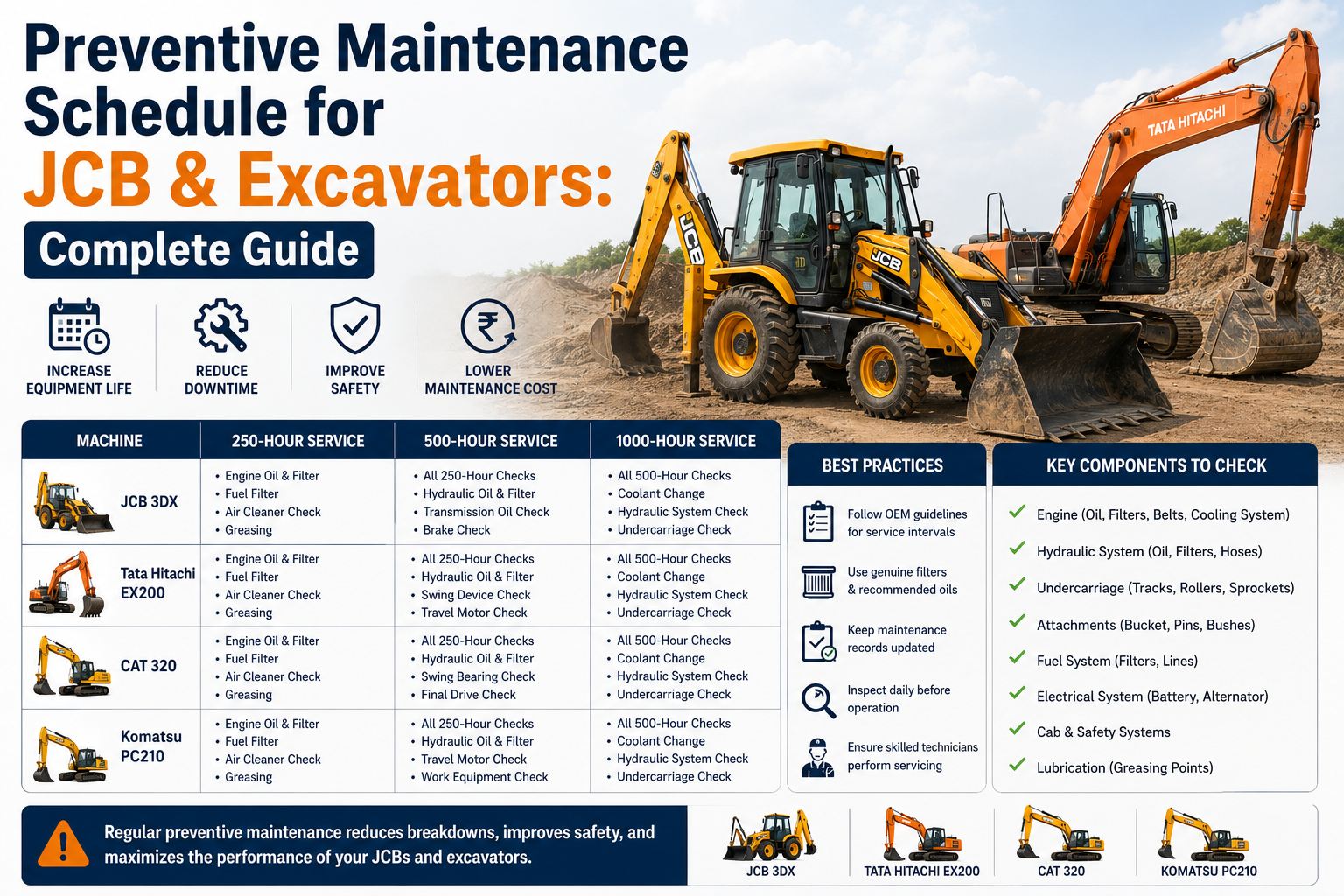
The Interval Structure
Daily, before start
Fluid levels, leaks, air restriction indicator, track tension and trapped debris, bucket and teeth, hoses, cab and safety items, and the hour reading recorded.
250 hours
Typically engine oil and filter, fuel filtration attention, greasing across the front attachment, and inspection of the fastest-wearing items.
500 hours
Adds air and hydraulic filtration, with inspection of swing and travel systems that do not need attention every 250 hours.
1000 hours
Larger fluid changes including swing and travel reduction gearboxes, cooling system attention, and measured inspection rather than visual.
2000 hours and beyond
Hydraulic oil change, component-level assessment, and structural inspection that informs longer-term planning.
Each tier includes everything below it. Heavy dust, high load factor or breaker work may put your machines on the manual's severe-duty guidance instead.
What Changes When the Brand Is New to You
On a familiar machine a good technician knows which noise matters and which fitting always weeps. On a new platform that instinct has to be rebuilt, which takes a year or so of actual work.
Do: record findings in more detail than usual during the first year, because those notes become the pattern recognition the team does not have yet.
You know how long a filter takes to arrive for the brands you have run for years. For a new one you find out the first time you need something urgently, which is the worst moment to learn it.
Do: order the first set of routine service parts early and record how long each took. That log is worth more than any assumption about the dealer network.
Normal fuel consumption, normal filter condition at interval, normal wear rate — you have no figures for this machine in your conditions, so you cannot tell whether a reading is fine or early warning.
Do: capture measurable values from the start rather than pass or fail, so a baseline builds itself over the first few services.
On an unfamiliar platform you depend more on the dealer for the first year than you will afterwards. Where their nearest facility sits relative to your sites is a maintenance fact, not a commercial one.
Do: establish before the machine arrives who attends, how quickly, and what they hold locally.
Start the History on Day One
Hour readings, findings and consumption captured from the first inspection, so the baseline you lack builds itself.
Why the Record Matters More on a New Platform
On equipment you have run for years, an incomplete record is recoverable because the knowledge sits in people. Your foreman knows the machine, the storekeeper knows the parts, and someone remembers what happened last time. None of that exists for a platform nobody has worked on before, so whatever is not written down is genuinely lost.
This is also when the record is easiest to build properly. There is no accumulated backlog, no half-remembered history to reconstruct, and every service from the first one onwards can be captured completely. A machine whose full life is recorded from hour zero is worth measurably more at resale and far easier to argue about under warranty.
The practical version is simple: capture readings rather than ticks, note what was found and not just what was done, and keep it against the asset rather than the service visit. By the second year you will have the baseline that experienced fleets have on their older brands.
Frequently Asked Questions
Where do I get the exact task list for my model?
From the operator manual for that model and serial range, or your authorised dealer. Contents differ across the range even where interval numbers match, and this matters more on a platform your team has not worked on before. We can load whatever your manual specifies on a call with our team.
Should we service a new brand more cautiously at first?
Following the manual carefully and inspecting thoroughly is sensible. Arbitrarily shortening intervals is not, since you have no evidence yet to justify it and it costs real money across a fleet.
How long before we have a useful baseline?
Several services, which for a working machine usually means a few months. Consumption trends become meaningful before wear trends do.
What should we hold in stock for a new platform?
Routine service items to begin with, and let actual consumption decide the rest. Stocking broadly on a machine you do not yet understand ties up capital in parts you may never use.
Does a complete record help at resale?
Yes, and more so on a brand with a shorter history in the market, where a buyer has fewer other ways to judge how the machine was treated. Start with a free trial.
Run the Manual, Build the Knowledge You Do Not Have Yet
Follow the interval structure from your own manual, record measured values rather than ticks so a baseline forms, log parts lead times the first time you order, note findings in detail while the platform is unfamiliar, and keep everything against the asset from hour zero.