An excavator does not wear out evenly. The engine follows its hour meter fairly predictably, the hydraulics depend on how hard the machine is worked, the swing system degrades with cycle count rather than running time, and the undercarriage answers almost entirely to the ground it sits on. Running everything off one interval treats those as the same problem when they are not, which is why two identical machines on the same schedule can end up in very different condition after a year. The interval structure gives you the framework; the systems tell you where to pay attention. You can work through your own Tata Hitachi fleet in a free 30-minute session.
Tata Hitachi Excavator Servicing, System by System
The daily, 250, 500 and 1000-hour structure, plus the five systems that age on different clocks and what shortens each one on Indian sites.
On sources. The intervals below describe the standard structure. Exact task lists, fluid specifications, capacities and part numbers vary by model, variant and serial range across EX and ZAXIS ranges, and are revised over time — your machine's own operator manual and your authorised dealer remain the authoritative sources. HVI is an independent maintenance platform, not affiliated with or endorsed by Tata Hitachi Construction Machinery. Product names are used descriptively.
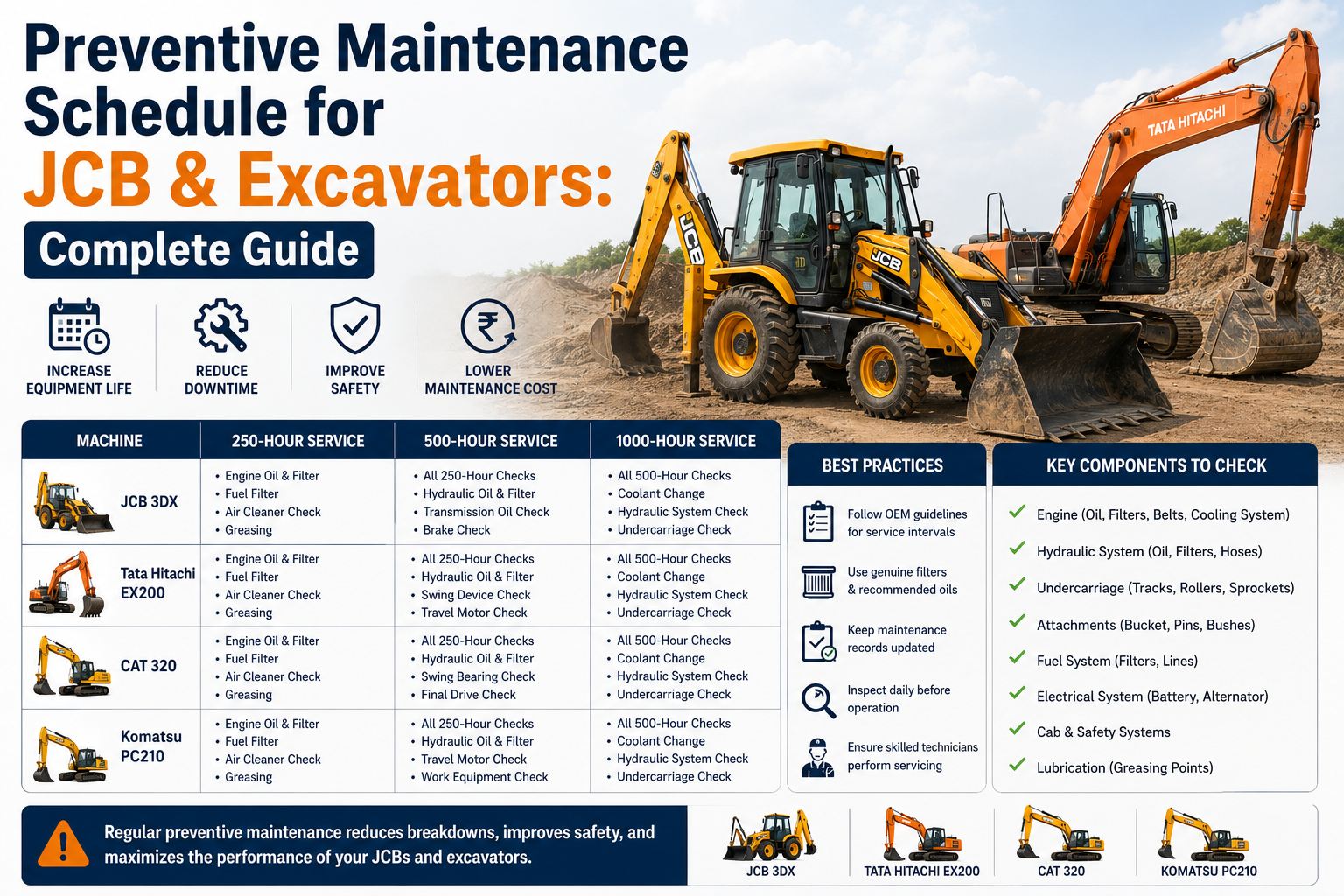
The Interval Structure
Daily, before start
Fluid levels, leaks, track tension and debris, bucket and teeth, hoses, air restriction indicator, cab and safety items, and the hour reading recorded.
250 hours
Typically engine oil and filter, fuel filtration attention, greasing across the front attachment, and a closer look at the fastest-wearing items.
500 hours
Adds air and hydraulic filtration, with inspection of swing and travel systems that do not need attention every 250 hours.
1000 hours and beyond
Larger fluid changes including hydraulic, swing and travel reduction gearboxes, cooling system attention, and measured inspection of undercarriage and structure.
Each tier includes everything below it, so the 1000-hour service is the longest day rather than a different kind of work.
Five Systems, Five Different Clocks
Follows the hour meter most closely, which is why it anchors the interval structure. Filtration is the variable.
Shortened by: dust. On quarry and opencast work the air side frequently needs attention well before the interval says so, and a restricted filter costs fuel continuously before it triggers anything.
Ages with load rather than hours. A machine working hard in rock puts far more through the pump and valves than one levelling soft ground for the same time.
Shortened by: contamination and heat. Both accumulate invisibly, which is why oil condition tells you more than the hour reading does.
Wears by cycle count, not running time. A machine loading trucks all day accumulates swing wear far faster than one trenching, at identical hours.
Shortened by: high-cycle duty. Watch swing bearing play, brake holding, and reduction gearbox oil condition on truck-loading machines specifically.
Answers to ground conditions above everything else, and typically represents the largest single wear cost over a machine's life.
Shortened by: abrasive material, packed mud, tracking over rock and reinforcement bar, and running at incorrect track tension.
A breaker or pulveriser changes the machine's duty completely, putting shock and continuous vibration through the boom, stick, pins and structure.
Shortened by: hours on the breaker. Structural inspection intervals should reflect attachment use, not just total machine hours.
Track Hours, Attachments and Condition Together
Hour readings captured in the daily check, with defect and condition history building per machine rather than per service visit.
The Undercarriage Deserves Its Own Attention
Over the life of a tracked excavator the undercarriage usually costs more than any other system, and almost all of that cost is influenced by things that are free to get right. Track tension is the clearest example: too tight accelerates wear on links, pins, sprockets and idlers simultaneously, too loose allows the chain to whip and derail. Neither condition announces itself, and both are checked in under a minute.
Packed material is the second. Mud, clay and fines left in the undercarriage overnight set hard, hold moisture against components, and add load the machine was not designed to carry. Cleaning out at the end of a shift in wet conditions is cheap and rarely done.
The third is how the machine is operated — tracking over rock and reinforcement bar, spinning tracks, and travelling long distances rather than being transported. None of these show as a defect on any checklist, and all of them shorten undercarriage life measurably.
Frequently Asked Questions
Where do I get the exact task list for my model?
From the operator manual for that model and serial range, or from your authorised dealer. Contents differ across EX and ZAXIS variants even where the interval numbers match, so a generic list is not safe to work from. We can load whatever your manual specifies on a call with our team.
Should breaker hours be tracked separately?
Yes where you can, because breaker work ages the structure and pins far faster than digging. A machine with heavy attachment use justifies more frequent structural inspection than its total hours suggest.
How often should track tension be checked?
Frequently, and to the figure in your manual rather than by feel, since correct tension varies by model and by ground conditions. It is one of the cheapest checks with the largest effect on cost.
Does missed servicing affect warranty or resale?
Both, potentially. Warranty terms depend on your dealer agreement, and a continuous service history carries real value at resale on widely traded models.
What if the hour meter is unreliable?
Fix that first, because every interval depends on it. Recording the reading daily makes drift or a replacement visible rather than silent. Start with a free trial.
One Schedule, Five Systems Watched Differently
Run the interval structure from your own manual, let dust drive filtration and oil condition drive hydraulics, treat swing wear as a cycle-count problem on truck-loading machines, record attachment hours separately, and check track tension and undercarriage cleanliness because they cost the most and are the cheapest to get right.