An operator notices a missing guard rail near the loading point and mentions it to the shift supervisor, who nods, means to raise it, and forgets by the time the shift ends. Three weeks later the same guard rail is still missing, because the observation lived in a conversation instead of a system with an owner and a due date. This is the most common way safety programs fail — not because nobody notices hazards, but because noticing and fixing are two different steps, and only one of them gets tracked. An observation without a closed loop isn't a safety record, it's a hazard with a witness. Here's how to close that loop, and how HVI assigns and tracks every observation to resolution instead of a conversation nobody follows up on.
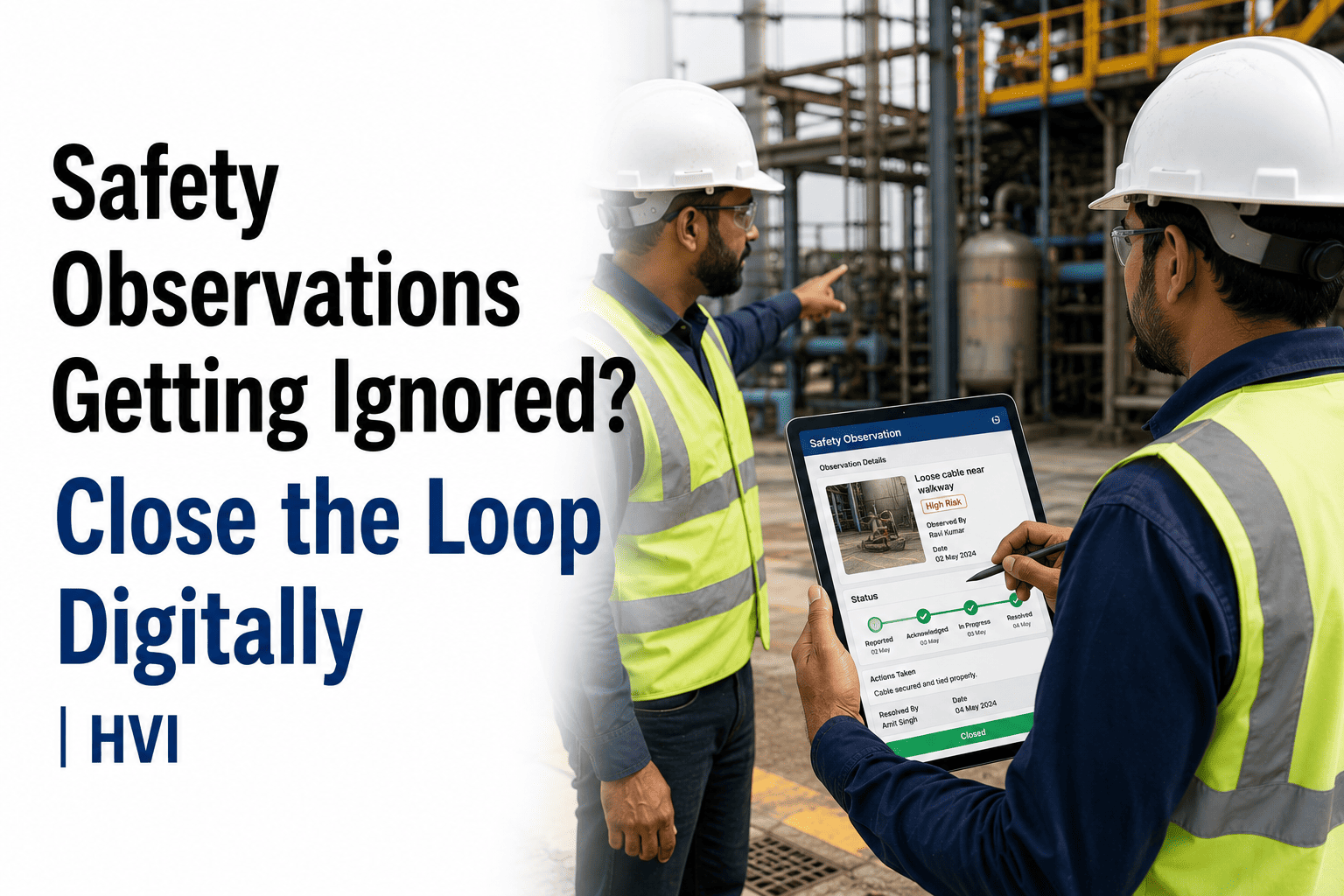
Safety Observations Getting Ignored? Close the Loop Digitally
Log safety observations in the field, assign corrective actions to a named person, and track closure — so every flagged hazard gets resolved, not just recorded.
The Gap Between Noticing and Fixing
Most safety programs are good at the first half of this cycle and quietly fail at the second.
Half That Works
Observation Is Made
A hazard gets noticed and mentioned — verbally, on a WhatsApp message, or written on a paper form. This part of the process is rarely the problem.
Half That Fails
Action Is Closed
Without an assigned owner, a due date, and a way to verify the fix actually happened, the observation sits open indefinitely — or gets forgotten entirely.
See how many of your own site's safety observations are still open, and for how long, once every one has an owner and a due date.
What a Closed Loop Actually Requires
A named owner, not a department
"Maintenance will handle it" assigns nothing. A specific person's name attached to the action is what makes follow-up possible.
A due date, not "soon"
An action without a deadline has no way to become overdue — which means it can sit open forever without ever technically being late.
Evidence of closure, not a status change
A photo or a verified check confirming the fix happened is different from someone marking an item "done" from memory.
Escalation when it goes overdue
An action that passes its due date without closure should surface to someone above the original owner, rather than quietly aging in a list nobody reviews.
Why Open Corrective Actions Are a Leading Indicator
Safety teams that track only one number tend to track this one — because a pile of open actions is one of the clearest predictors of an incident still to come.
| Signal | What It Tells You |
|---|---|
| Closure rate above 85 to 90% | Observations are generally converting into fixes within a reasonable window |
| Closure rate trending downward | The backlog is growing faster than it's being cleared — worth investigating before it compounds |
| Same hazard category reopening repeatedly | The fix is addressing a symptom, not the underlying cause |
| High-priority items taking longest to close | The most dangerous items are getting the least urgent handling — the reverse of what should happen |
Why Paper and WhatsApp Both Break This Loop
Nothing tracks ownership
A message sent to a group chat doesn't assign the action to any one person, so it's unclear whose responsibility it is to follow up.
Nothing tracks time
Without a due date attached, there's no way to distinguish an action that's two days old from one that's been open for two months.
Closure is self-reported, unverified
A message saying "fixed" isn't the same as a photo or inspection confirming the hazard is actually gone.
Nobody can see the whole picture
A safety head reviewing site-wide performance can't scroll through every chat thread to work out how many observations are actually still open.
Frequently Asked Questions
Will workers actually use a digital form instead of just mentioning a hazard verbally?
A quick mobile form that takes under a minute, with a photo option, tends to see higher genuine reporting than a verbal system, since it removes the friction of finding the right person and hoping they remember to act on it.
What happens when a corrective action goes overdue?
An overdue action can escalate automatically to a supervisor above the original owner, so a stalled item surfaces on its own rather than depending on someone remembering to check.
Does this work at sites with unreliable network coverage?
Yes — observations and closures are captured on the device first and sync once signal returns, so remote sites don't lose records to a dropped connection.
Can this feed into our DGMS or Factories Act audit documentation?
Yes — a structured record of observations, assigned owners, due dates, and verified closures gives auditors exactly the evidence trail these inspections expect, exportable on demand rather than assembled from scattered notes.
How quickly would we see our current closure rate?
Once observations start being logged through the system, a closure rate view is available within the first few weeks; sign up free to see where your site actually stands.
Noticed Isn't the Same as Fixed
A safety observation that never gets closed is a hazard your team already found and then lost track of. Start free and give every observation an owner, a deadline, and a verified close, or bring your current safety log to a 30-minute session with our India team.