A tipper is the one machine on site that must pass two inspections at once — a mining pre-shift for the haul road and a road-legal pre-trip for the public stretch to the dump — and it is also the machine most likely to hurt someone on a bad brake or a bad tip. This checklist is built around three tests a tipper must pass before it moves: the air-brake test, the hoist test, and the walkaround, with the DVIR record that proves all three. Ten minutes at the yard gate is the only place a soft brake or a weeping hoist gets cancelled cheaply; after that it gets cancelled by the haul road, at the haul road's price. Run it on paper, or in HVI where every fail carries a photo and critical items hold the truck — sign up free and put it in your drivers' hands this week.
Tipper Truck Pre-Trip Inspection Checklist — Brakes, Hydraulics & Tyres
Three tests before the first load — brakes, hoist, and walkaround — written for drivers and supervisors, with critical fails marked and the DVIR record that makes the inspection defensible.
Three Tests, Then the Truck Moves
The Brakes
Air pressure built, held, and warned on — then service and park brakes proven at walking speed. Forty tonnes downhill on a haul road has one argument with physics, and the brakes are it.
The Hoist
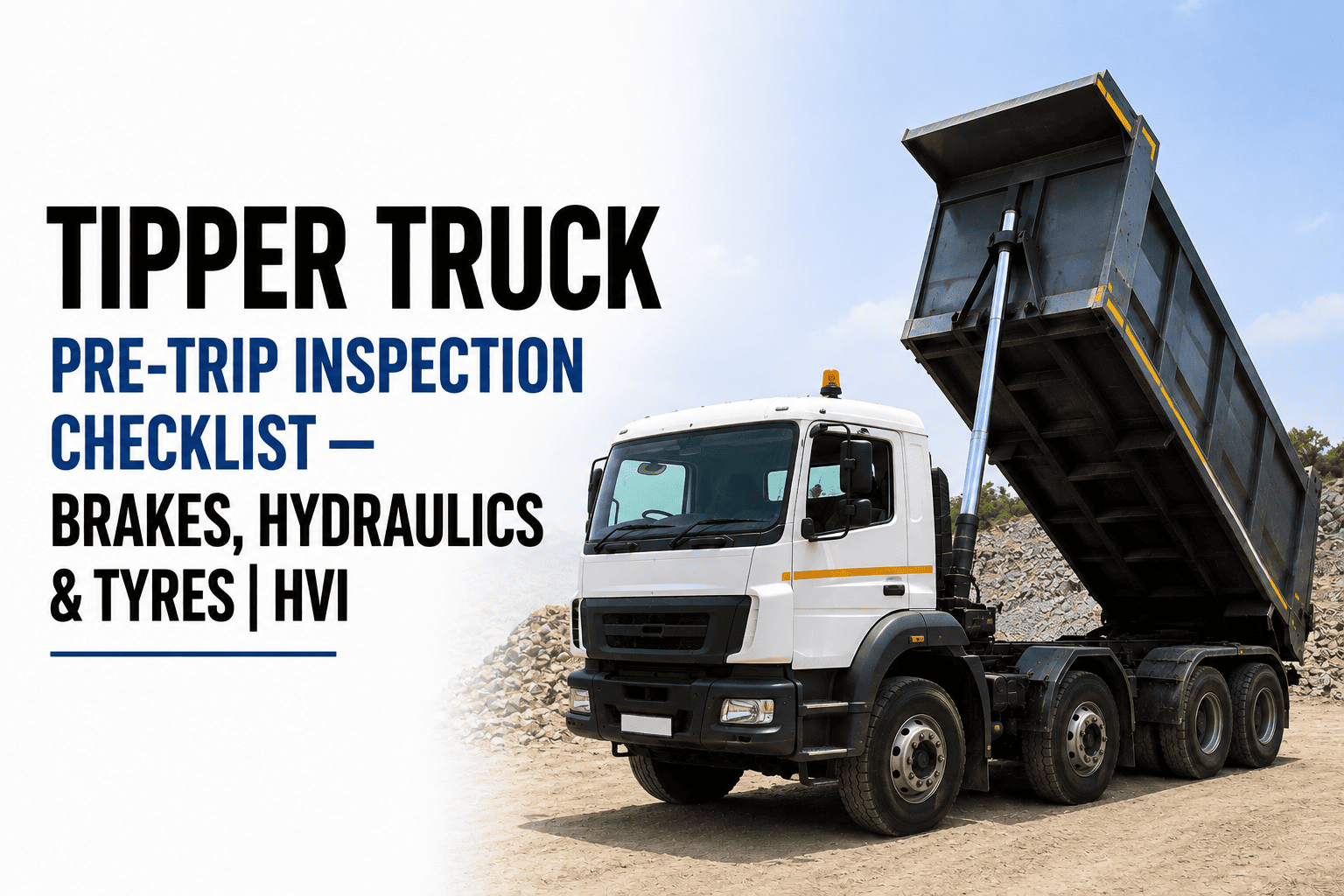
Body raised and lowered empty, PTO engaging cleanly, no cylinder weep, body-up warning working, tailgate latching — because the tip is where tippers roll, and the hoist is what decides it.
The Walkaround
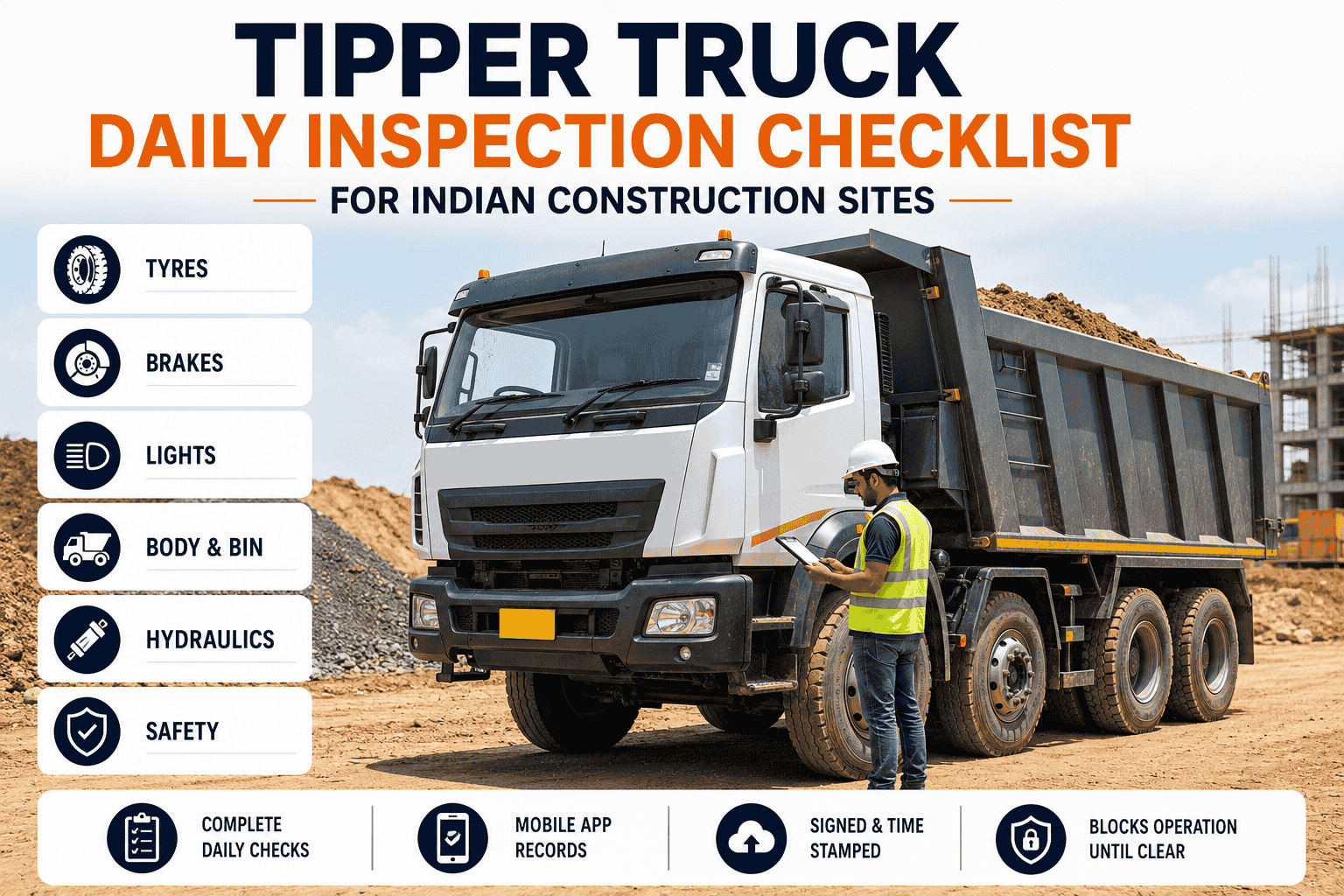
Tyres, wheels, lights, body, fluids, and documents in one circle of the truck — the road-legal half and the site half checked in the same five minutes.
The Air-Brake Test, Step by Step
Build-up — from low pressure, the gauges should climb to the working range within the OEM's stated time at fast idle; a slow build is a compressor or leak telling you early.
Leak-down, brakes released — engine off, park brake released and wheels chocked, watch the gauge for a minute; more than a small drop points at a leak worth finding before the road finds it.
Leak-down, brakes applied — full service application held for a minute; a faster drop than the released test is a chamber or valve issue.
Low-pressure warning — pump the pedal down and confirm the buzzer and lamp trigger before pressure falls to the spring-brake range; a silent warning means no warning at all.
Park and service brake hold — park brake on, gentle pull against it in low gear; then service brake at walking speed for pull, grab, or delay. Any doubt holds the truck.
Exact pressure and time figures follow your OEM manual and site standard — the sequence is what matters, and it takes under three minutes once it is habit. Add a visual on slack adjusters, drums, and hoses to complete the brake picture.
Put the Three Tests on Your Drivers' Phones
This checklist loads from HVI's template library and tunes to your models in minutes — your pressures, your site rules, Hindi or English, photos mandatory on the brake and hoist items. A critical fail holds the truck's status and alerts the workshop before it leaves the yard. Bring your current form to a 30-minute session and our India team rebuilds it live.
The Walkaround — Eight Stops in One Circle
The DVIR — What Makes the Inspection Defensible
| DVIR Element | Why It Matters | In HVI |
|---|---|---|
| Driver identity and signature | Establishes who inspected and accepted the truck that trip | Login and digital sign-off, time and GPS stamped |
| Defects listed, with severity | Separates "noted" from "unsafe to operate" | Severity tags with photos; critical holds the truck |
| Corrective action and certification | Proves the defect was fixed, or declared safe, by a named person | Work order closes with after-photo and technician sign-off |
| Carry-forward of open items | Stops a defect vanishing between drivers and shifts | Open defects show on the next pre-trip automatically |
| Retention and retrieval | Audits, incident inquiries, and client reviews ask for history | Per-truck history exportable in minutes, never lost to a cab file |
Whatever your site or client calls the form, the elements are the same — and an inquiry after an incident reads them in exactly this order. Paper can hold the words; it cannot hold the proof.
The Tip Is Where Tippers Die
Rollover on the Tip
A raised body on uneven or soft ground shifts the centre of gravity past the point of no return in seconds — the pre-trip checks the hoist and tailgate; the tipping rule checks the ground, the level, and the wind. Both belong on the driver's list.
Body Up, Truck Moving
Driving off with the body raised finds power lines, structures, and bridges — the body-up warning and the driver's habit of confirming body-down before every pull-away are the two defences, and the daily test of the warning keeps the first one real.
Frequently Asked Questions
How long does the full pre-trip take?
About ten minutes — three for the brake test, two for the hoist, five for the walkaround — and it replaces the twenty minutes a tipper typically spends queuing for its first load, so the time is already paid for by the site's rhythm.
Our tippers are owned by transporters. Whose checklist is it?
Yours — the incident on your haul road and the spill on the public stretch belong to the site, so transporter trucks run the same pre-trip under vendor-scoped access, and the history settles payment and safety disputes with evidence instead of argument.
Is this the same as the DGMS shift examination?
It covers the driver's part — the statutory examination and record formats follow the rules applicable to your mine, and HVI holds the prescribed registers alongside the pre-trip so the two never contradict each other at inspection time.
Drivers change trucks daily. Does the record follow the truck or the driver?
Both — each pre-trip is stamped with driver and truck, so the truck's history stays complete across drivers and the driver's record shows every truck they accepted; sign up free and see open defects carry forward to whoever climbs in next.
Does the library cover the rest of the fleet?
Yes — excavators, loaders, graders, cranes, DG sets, and plant machinery in the same plain-language, critical-items-marked format, each editable per site and model. See the full library in a 30-minute demo with our India team.
Three Tests. Ten Minutes. Every Trip Defensible.
Brake doubts, leaking hoists, or faulty tailgates can become road incidents. Run pre-trip tests in HVI so every trip creates a DVIR with the driver, truck, defects, and repairs documented. Start free or rebuild your current form in a 30-minute session.