Operators complete checklists properly when they know what each item is for. A line that says "check articulation area" gets a tick; a line that explains an unnoticed articulation problem ends with a machine that cannot be steered under load gets looked at. That is the difference between a form being completed and a machine being inspected, and it costs nothing to build the reason into the item. What follows pairs every check on a wheel loader with what happens when it is missed. You can adapt it to your own machines in a free 30-minute session.
Wheel Loader Daily Checks, With the Reason Attached
Every item paired with what it prevents — articulation, tyres, bucket and linkage, hydraulics and drivetrain, cab and safety.
Articulation and Steering
Articulation joint pins, bushings, and greasing
Wear here develops slowly and ends in steering play that becomes dangerous with a loaded bucket at height.
Steering cylinders and hoses for leaks or damage
A steering hose failure on a loaded machine is an immediate loss of control, not a gradual degradation.
Articulation lock present and correctly stowed
Needed for safe maintenance access. Missing locks mean the next person working in the joint area is unprotected.
Steering response through full lock, both directions
Hesitation or heaviness indicates pump or valve problems worth catching before they strand the machine.
Tyres and Wheels
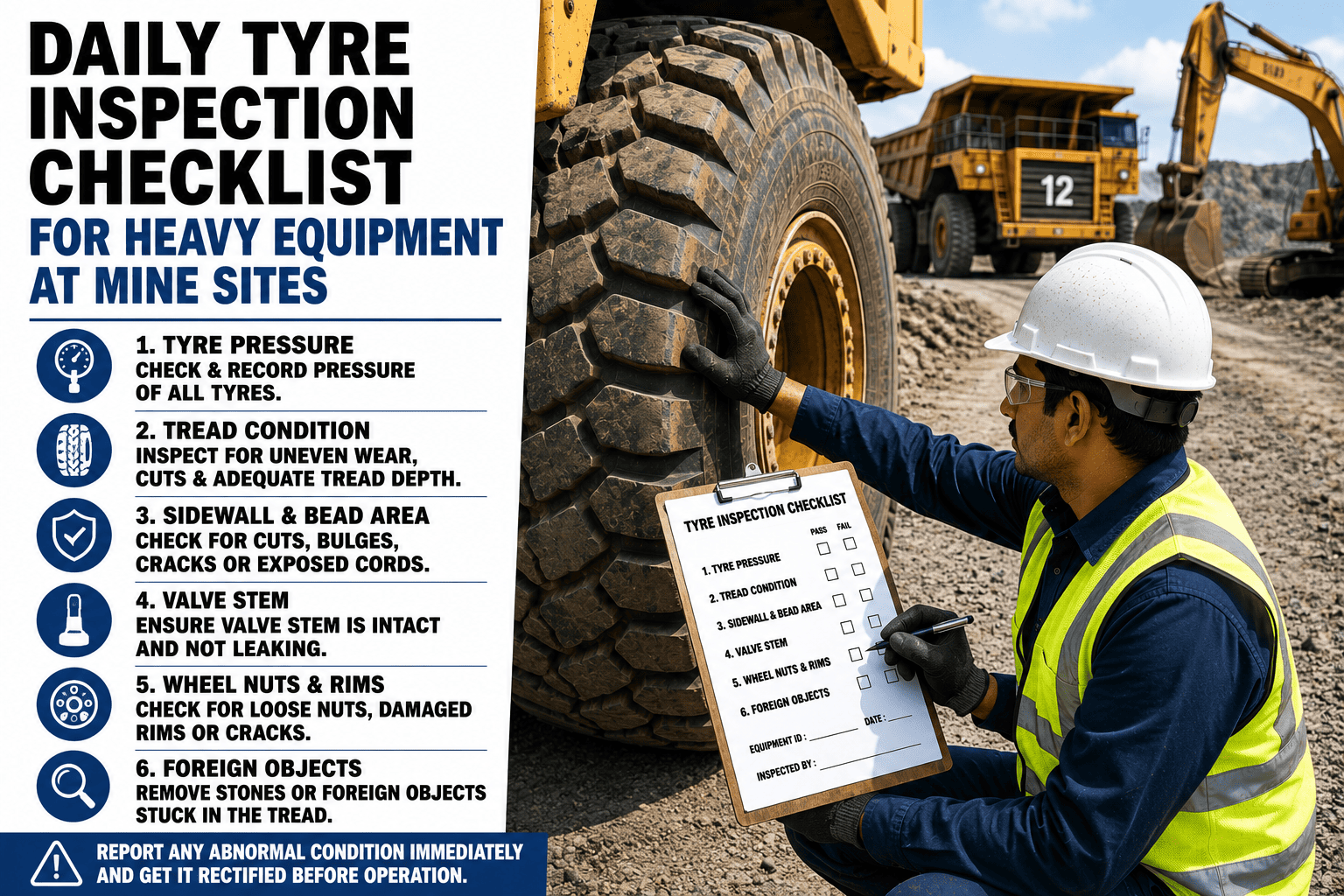
Pressure on all four, measured not judged
Under-inflation is the largest preventable cause of early tyre removal, and on a loader the cost of that is substantial.
Cuts, gouges, and exposed cord, especially on sidewalls
Loaders work in loading areas full of spillage and rock, which is where most sidewall damage originates.
Wheel nuts and rim condition
Loose nuts progress to stud failure quickly under the shock loading a loader generates.
Uneven wear between positions
Points at alignment, loading habits, or a mechanical fault, and replacing tyres without finding it repeats the cost.
Bucket, Linkage and Attachment
Cutting edge, teeth, and adapters
Worn edges increase cycle time and fuel per tonne long before anyone calls it a defect.
Linkage pins, bushings, and visible weld areas
Play here accelerates wear elsewhere in the linkage and eventually cracks the structure around it.
Quick coupler locking, confirmed engaged
The single most consequential item on this list. An attachment releasing under load is unrecoverable.
Bucket level and return-to-dig function
A drifting or mis-set position costs productivity every cycle and is easy to stop noticing.
Give Every Item a Reason
Checklists that explain themselves get completed properly, and failed items raise work orders immediately.
Hydraulics, Engine and Drivetrain
Fluid levels read cold and on level ground
Readings taken warm or on a slope are guesses, and topping up against a guess causes its own problems.
Leaks under the machine and around cylinders and valves
A small weep identifies the failing component while the repair is still cheap.
Lift and tilt cylinder drift on hold
Internal leakage that worsens, and a load settling unexpectedly is a safety matter as much as a performance one.
Air filter restriction and radiator or cooler condition
Restriction costs fuel continuously and raises temperatures across systems that then fail for apparently unrelated reasons.
Transmission behaviour through the gears and brake function
Loaders brake constantly in a short cycle, so degradation here accumulates faster than on most machines.
Cab and Safety
Seatbelt, seat condition, and parking brake
Basic protection items that get reported least often because they are assumed rather than checked.
Mirrors, cameras, glass, and visibility aids
Loaders reverse constantly in areas with people in them, which makes rear visibility a live risk rather than a comfort item.
Lights, horn, reversing alarm, and beacon
The warning others depend on. A silent alarm is invisible to the person it was meant to protect.
Steps, handrails, and access points
Falls from machine access are a persistent injury source and one of the easiest to prevent.
Frequently Asked Questions
Does explaining each item make the checklist too long?
The reason can sit behind the item rather than beside it, shown on tap for anyone who wants it. Experienced operators skip past; new ones learn from it without needing a training session. You can see how that is presented on a call with our team.
Which items should hold the machine?
Typically coupler engagement, steering faults, brake defects, and missing protective equipment. Confirm your own critical set with your safety officer, since it depends on your operation.
Why does bucket edge wear matter on a daily check?
Because it degrades gradually and the cost appears as slower cycles and higher fuel rather than as a breakdown. Nobody reports it because nothing has failed.
How often should tyre pressures be measured?
More often than most fleets do. Where a daily gauge check is impractical, a defined weekly measured check with daily visual comparison is a workable compromise.
Can the list be adapted per machine?
It should be, since attachment arrangements and monitoring systems differ across a mixed fleet. Start with a free trial to configure your own.
A Checklist That Explains Itself Gets Used Properly
Pair every check with what it prevents, measure tyre pressures rather than judging them, confirm coupler engagement every time, and treat rear visibility and reversing alarms as live risks rather than comfort items.