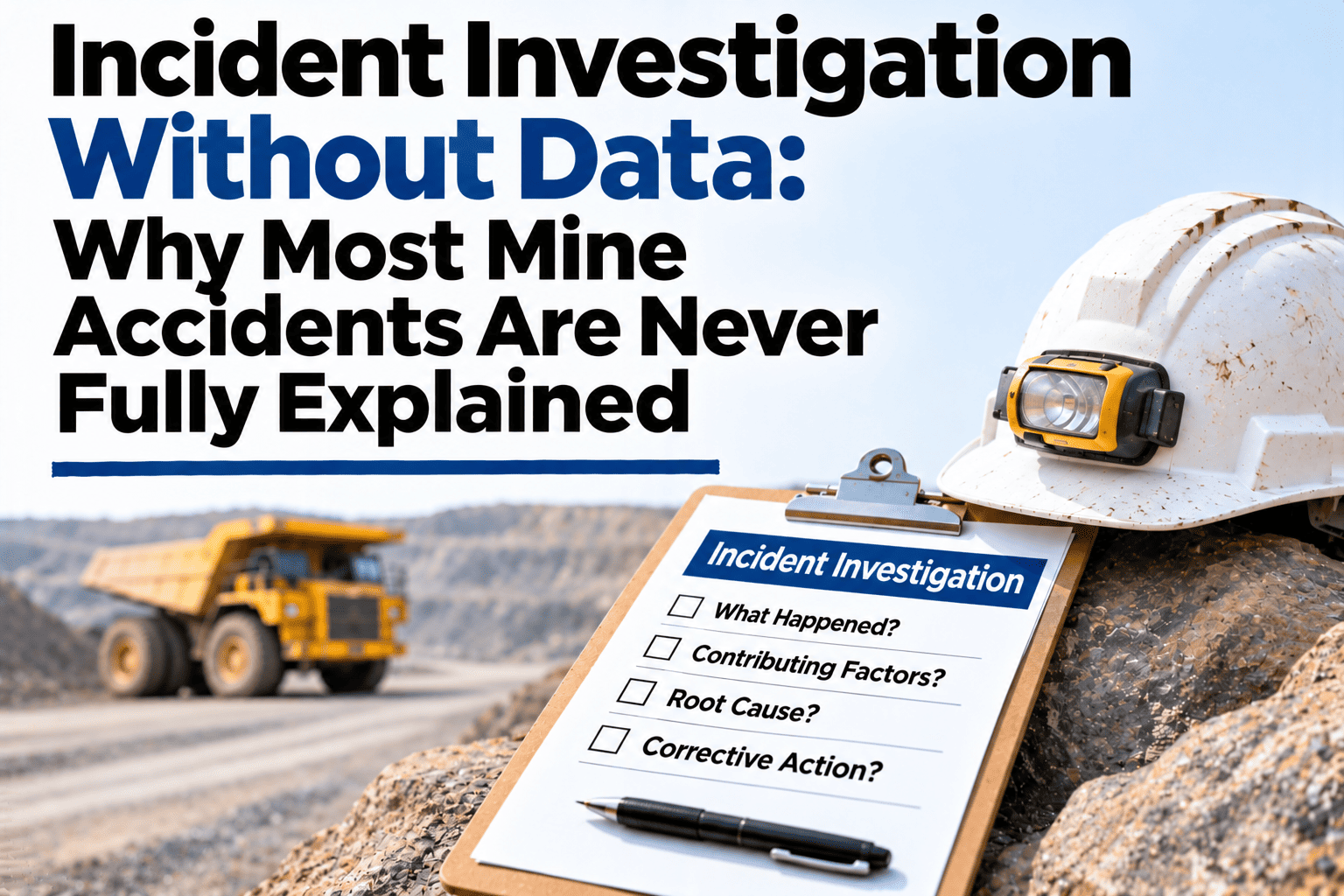
After a serious incident on a mine or project site, many investigations end with a short report that blames the operator. The deeper causes, such as a brake defect reported last week or a skipped pre-shift check, are never proved because the records do not exist. Without data from before the incident, investigators are left with memories and guesses. This guide shows which evidence matters and how to keep it, and how sites keep the records investigations need in HVI.
Incident Investigation Without Data: Why Most Mine Accidents Are Never Fully Explained
The records that explain an accident are created days and hours before it happens. Here is what to keep, how to investigate and how to make sure the actions stick.
Why Investigations Fall Short
The problem is rarely the investigator. It is the missing information and what happens after the report.
No records from before
Checks and defects were never written down, or only on paper that is lost.
Fix: record every check and defect dailyEvidence disappears
The scene is cleared and memories fade within days.
Fix: collect photos and statements earlyStops at the operator
Human error is named and the search ends there.
Fix: ask why the error was possibleActions not tracked
Recommendations sit in the report and are never done.
Fix: give each action an owner and dateThe Evidence That Explains an Incident
Much of the most useful evidence is created before anything goes wrong, which is why daily records matter so much.
| Evidence | Where it comes from | What it can show |
|---|---|---|
| Pre-shift checks | Operator's daily checklist | Machine condition at the start of the shift |
| Defect history | Reported defects and repairs | Whether a known fault was left open |
| Maintenance records | Work orders and services | Whether the machine was looked after |
| Area inspections | Haul road, bench and site checks | Ground and road conditions |
| Operator records | Authorisation, training and hours | Competence and fatigue |
| Scene evidence | Photos, measurements and statements | What happened at the moment of the incident |
The Records Investigations Need, Already in Place
HVI keeps pre-shift checks, defects, repairs and incident reports for every machine with names, dates and photos, so investigators can see what was known before an incident and track every action after it.
A Simple Investigation Process
Follow the same steps every time, scaled to how serious the incident was.
Make safe
Care for the injured and secure the area.
Collect evidence
Photos, records and statements early.
Build a timeline
Lay out events from days before to after.
Find root causes
Keep asking why until the causes are clear.
Act and follow up
Assign actions and check they work.
Serious accidents and dangerous occurrences must be reported as required under the Mines Act, its regulations or other rules that apply to your site, and the scene may need to be left undisturbed except to rescue people or make it safe. Follow the rules and DGMS directions for your site.
Look Beyond the Immediate Cause
The immediate cause explains what happened. The underlying causes explain why it was allowed to happen.
- Operator braked late on the ramp
- Dumper left the haul road edge
- Brakes did not hold as expected
- Bund was too low to stop the truck
- Was a brake defect reported and left open?
- Was the pre-shift check done properly?
- Was the road and bund inspected and kept up?
- Was the operator trained, rested and supervised?
Investigation Tracker in HVI
A sample view of open investigations and their actions across sites.
| Incident | Site | Root cause found | Actions | Status |
|---|---|---|---|---|
| Load dropped from crane | Plant A | Worn sling not removed | 3 of 3 done | Closed |
| Excavator struck parked car | Project B | No exclusion zone | 2 of 4 done | Actions open |
| Dumper left haul road | Mine C | Not confirmed, records missing | Investigation open | Evidence gap |
Incident Investigation FAQs
Why do many incident investigations stop at human error?
Because it is the easiest cause to see. Without records of checks, defects and conditions before the incident, the deeper causes behind the error are hard to prove.
What evidence should be collected after an incident?
Photos and measurements of the scene, statements from those involved and witnesses, and records of pre-shift checks, defects, maintenance, area inspections and operator training.
What is a root cause?
The underlying reason an incident was possible, such as a defect process that let known faults stay open. Fixing root causes prevents repeats, while fixing only the immediate cause rarely does.
How do I make sure investigation actions are done?
Give each action an owner, a deadline and proof of completion, and review progress until all are closed. Teams that track actions in HVI can see what is still open.
Can HVI help with incident investigations?
HVI keeps the daily checks, defects, repairs and incident records investigators rely on, with names, dates and photos. Book a demo to see how it fits your safety process.
Explain Every Incident, Prevent the Next One
Keep daily checks and defect records, collect evidence early, look past the immediate cause and track every action to closure in HVI. Investigations that find real causes and stop repeats.