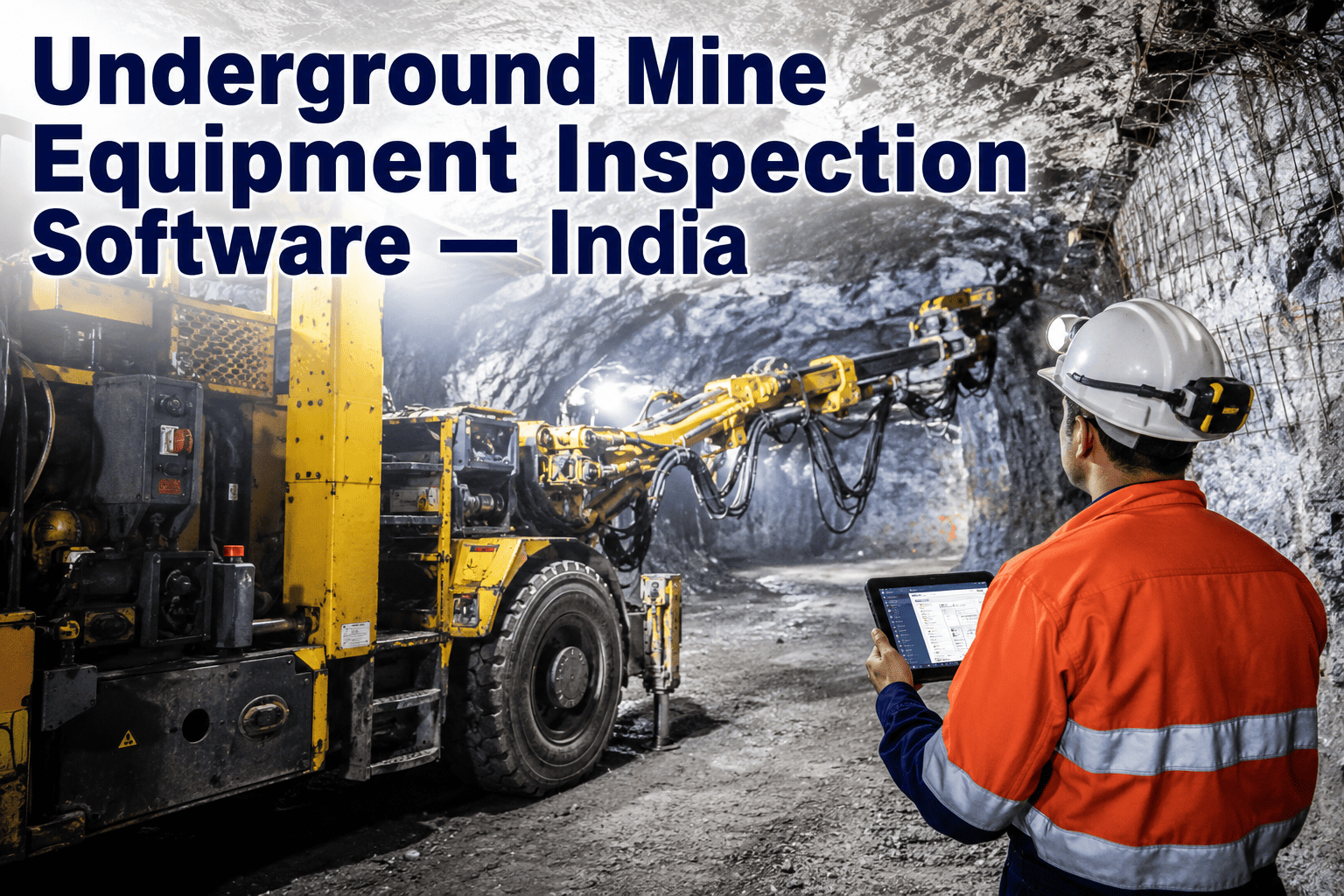
When a large coal mine in Jharkhand lost two workers in equipment-related incidents within a single quarter, the mine management knew paper-based inspection registers were no longer defensible. The DGMS had raised concerns. The workforce was shaken. And the mine's equipment fleet — 58 machines running across three open-cast blocks and one underground section — was being managed through handwritten shift logs that nobody trusted. This is the story of how that mine used HVI's digital inspection and safety management platform to reduce safety incidents by 45 percent in eleven months, pass a DGMS compliance audit without a single adverse finding, and rebuild workforce confidence in the safety system. Start your free HVI trial and see how the same platform works for your mine or fleet.
Case Study — Mining Safety & DGMS Compliance
Mining Site Safety Transformation: How a Coal Mine Reduced Incidents by 45% Using HVI
An Indian coal mine in Jharkhand replaced paper inspection registers with HVI's digital platform — achieving a 45% reduction in equipment-related safety incidents, zero adverse DGMS audit findings, and full pre-shift inspection compliance across 58 machines in under 90 days.
45%
Reduction in safety incidents
Zero
Adverse DGMS audit findings
58
Machines fully on digital inspection
<90 days
From paper to full compliance
Industry
Coal Mining — Open-Cast & Underground
Location
Jharkhand, India
Fleet Size
58 machines — dumpers, LHDs, drills, dozers
Regulatory Body
DGMS — Directorate General of Mines Safety
HVI Modules Used
Pre-shift Inspection, Incident Reporting, PM Scheduling, Compliance Dashboard
Deployment Time
Full fleet live in 18 days
The Situation: A Mine Running on Paper and Hope
The mine operates three open-cast blocks and one underground section in the Dhanbad coalfield belt. At the time of HVI deployment, the fleet consisted of 22 Komatsu HD785 dumpers, 12 underground LHD loaders, 8 drilling rigs, 7 BEML dozers, and 9 support vehicles. Three shifts ran daily — day, evening, and night — with 58 to 62 equipment operators across the three shifts combined.
Pre-shift inspections were supposed to happen before every machine movement. In practice, the mine ran on a system that most Indian mining operations will recognise immediately: the shift supervisor had a stack of paper register pages, operators would return them signed before their shift started, and the pages would be filed in a drawer in the shift office. Nobody read them unless something went wrong. The DGMS regional office in Dhanbad had raised informal concerns about record quality during a routine visit six months before the HVI deployment. Two months later, a dumper brake failure on the haul road caused one fatality. Eight weeks after that, a secondary incident involving an LHD loader in the underground section injured a worker seriously. The DGMS issued a formal show-cause notice and scheduled a full inspection of the mine's safety management systems.
According to DGMS Annual Statistical Reports, Jharkhand accounts for a significant share of India's mining fatalities year on year — the state's coal belt is one of the most intensively operated in the country. For this mine, the two incidents in a single quarter were not just a tragedy — they were a signal that the paper-based safety system was fundamentally inadequate.
Paper registers were signed at the gate — not at the machine. When the DGMS asked for inspection records for the dumper involved in the fatality, the register showed a clean pre-shift tick for that morning. There was no way to prove the inspection had actually happened.
Post-incident investigation revealed that two operators had verbally reported brake concerns on the same dumper during the previous week. Neither concern was formally recorded or escalated to the workshop. The machine continued operating.
The Mine Manager and Safety Officer had no real-time view of which machines had been inspected and which had not. Verification required physically walking to the shift office and reading through paper registers — which rarely happened during an active shift.
When the DGMS inspection team arrived, the mine could not produce complete inspection records for the preceding three months. Several weeks had gaps. The records that existed lacked detail, had no photos, and showed no mechanism for defect follow-up.
The Decision: Why the Mine Chose HVI
The mine management evaluated three options. The first was to strengthen the paper system — add a second sign-off requirement and make supervisors physically verify inspections. The team quickly concluded this would not work: it had been tried before, and the system would revert the moment supervisory pressure eased. The second option was a generic audit app, which the safety officer had used at a previous company. The concern was that it required significant template-building, had no maintenance module connection, and did not have a proven track record at underground Indian mine sites.
HVI was the third option, recommended by the safety director of a sister company operating an open-cast iron ore mine in Odisha who had deployed it 14 months earlier. The specific features that drove the decision were: machine-type-specific checklists for the exact equipment in the fleet (including underground LHD loaders, which generic apps did not cover well), GPS-verified photo capture that proved location at time of inspection, automatic defect-to-work-order escalation, true offline capability for the underground section, and an audit-ready PDF export that could produce any machine's full inspection history in under two minutes. The fact that HVI had been used in a DGMS compliance context and the Odisha mine had passed their annual inspection using HVI records as primary documentation was the deciding factor.
The Implementation: 18 Days from Paper to Full Digital Compliance
The deployment was led by the mine's Safety Officer with support from HVI's onboarding team. The timeline below shows exactly how the transition happened — a process that is replicable for any Indian mining operation of similar scale.
Day 1–3
The Safety Officer created the HVI account and loaded the 58-machine fleet — machine numbers, equipment categories, and site/block assignments. HVI's pre-built templates for Komatsu dumpers, underground LHD loaders, and drill rigs covered most of the fleet. Custom checklist items were added for the mine's specific DGMS-required examination points and company safety rules. Total setup time: approximately 9 hours across three days, done between shifts.
Day 4–7
Accounts were created for all 62 operators and 11 shift supervisors. Each operator was linked to their primary assigned machines. Login credentials were shared via WhatsApp — the communication channel already in use across the mine. The IT requirement was zero: no server, no workstation setup, no VPN. Every operator used their own Android phone, which the mine confirmed met the minimum HVI spec (Android 8+, 2GB RAM, working camera).
Day 8–11
Operators were briefed in groups of eight to ten at the beginning of each shift. The Safety Officer walked through the app on a projector screen, then each operator completed a practice inspection on their own phone. The underground team received additional training specifically on offline mode — demonstrating that the app works completely without signal, with records syncing automatically when they surface. No operator required more than 20 minutes to complete their first practice inspection independently.
Day 12–15
For four days, operators completed both the paper register and the digital inspection. This allowed the safety team to verify that digital submissions were arriving correctly, that offline sync was functioning for the underground section, and that the defect-to-work-order escalation was flowing to the workshop supervisor's dashboard. Any gaps identified in checklist coverage were corrected during this period.
Day 16–18
On Day 16, the paper registers were formally retired. The Mine Manager announced in the shift briefing that digital HVI inspection was now the only accepted pre-shift record. No machine would be authorised to move without a digital inspection submission for that shift. Within 48 hours, compliance was above 96 percent across all three shifts and all 58 machines.
Mining Site Safety Transformation: How a Coal Mine Reduced Incidents by 45% Using HVI
Replicate this mine's safety transformation on your fleet. HVI's pre-built mining inspection templates, offline capability, and DGMS-aligned compliance reports are ready from day one.
The Results: 11 Months of Measurable Safety Improvement
The results below are drawn from the mine's internal safety data comparing the 11-month period before HVI deployment against the 11-month period after full digital inspection was established. All figures are based on DGMS-reportable incident categories — machinery accidents, near-miss reports, and transport-related safety events.
45%
Reduction in equipment-related safety incidents
From 22 reportable incidents in the pre-HVI period to 12 in the post-HVI period. The largest category reduction was machinery transport accidents — from 8 to 3.
97%
Pre-shift inspection compliance rate
Up from an estimated 60–65% actual compliance under the paper system (based on post-incident audit findings). Digital submission rate reached 97% within 45 days of full deployment.
Zero
Adverse findings in the DGMS inspection
The DGMS inspection team visited 4 months after deployment. The mine produced complete inspection records for all 58 machines for the preceding 120 days in under 8 minutes using HVI's PDF export. The inspection closed without a single adverse finding on equipment inspection records.
318
Defects formally recorded and escalated in Month 1
Compared to near-zero formal defect records in the paper system. The majority were minor — tyre pressure, fluid levels, lighting — but 23 were classified as critical and resulted in machines being taken out of service for same-day repair.
23
Critical defects caught before incidents in Month 1 alone
Including 4 brake system defects on dumpers, 3 hydraulic system failures on LHD loaders, and 2 steering concerns on surface vehicles. Each generated a same-day work order and withdrawal from service.
18 days
From paper to full digital compliance
The entire 58-machine fleet was operating on digital-only inspection within 18 days of account creation. No hardware was purchased. No IT team was involved. The Safety Officer led the deployment.
How Each HVI Feature Contributed to the Safety Improvement
Every inspection submission includes GPS coordinates proving the operator was at the machine location when the checklist was completed. This single accountability mechanism was the most immediate behavioural change — operators could no longer submit from the gate or the canteen. Within a week of deployment, shift supervisors reported that operators were visibly changing their walkaround behaviour.
The brake concern that went unreported before the fatality was the most preventable failure in the mine's history. The automatic escalation system meant that any defect flagged by any operator was immediately in the workshop supervisor's dashboard — with a machine status lock preventing that machine from operating in the next shift until repair was confirmed. In the first 30 days, 23 critical defects were escalated and repaired that would previously have remained verbal reports.
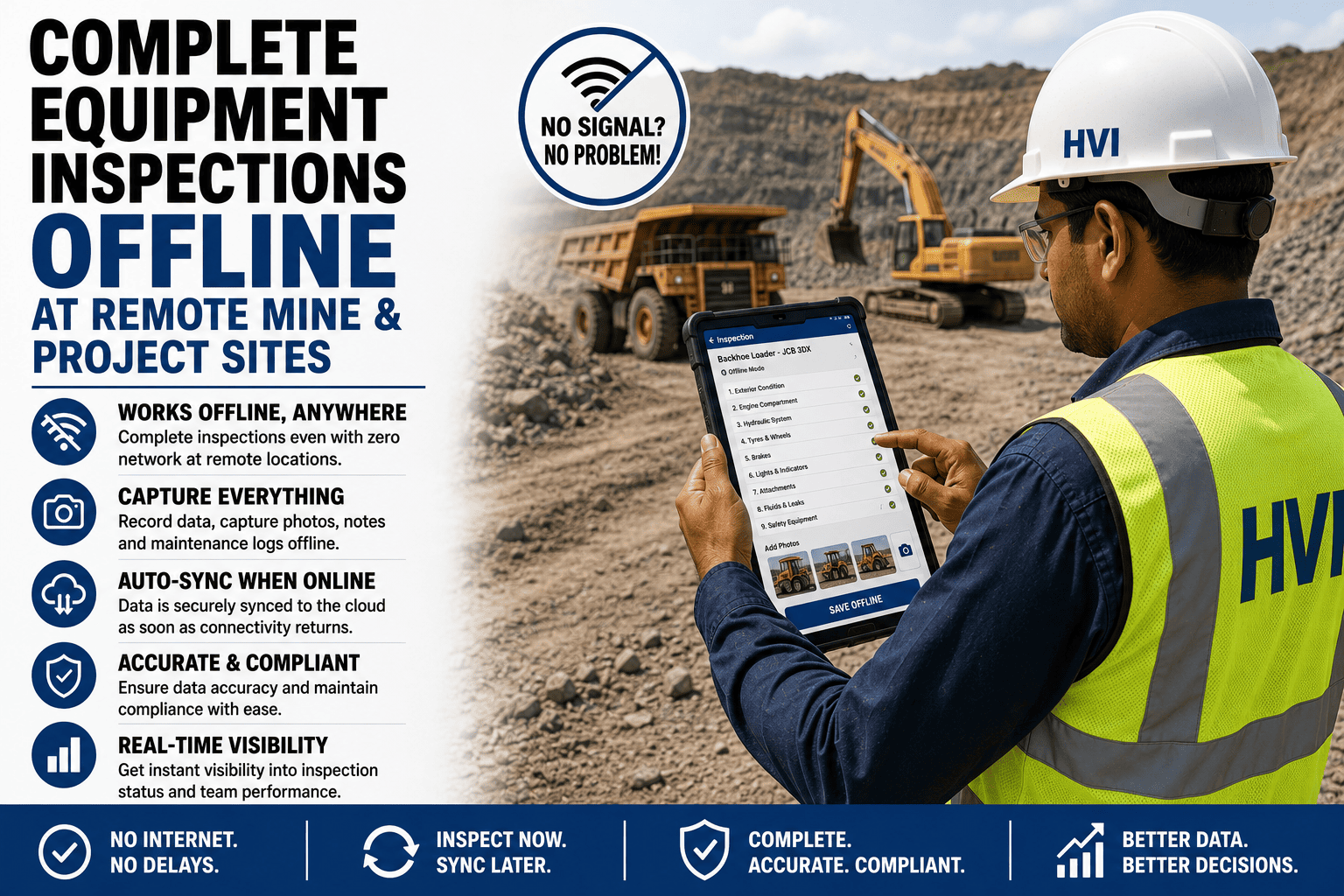
The underground LHD section was the hardest part of the fleet to digitise — no mobile signal below surface, machines operating up to 180 metres underground. HVI's offline-first architecture meant operators could complete full pre-shift inspections underground with photo capture, GPS tagging (using satellite hardware GPS), and digital sign-off. Records synced automatically when the machine or operator returned to surface. Underground inspection compliance reached 94% within 30 days of deployment.
The Mine Manager and Safety Officer set a daily routine of checking the dashboard at 6:30 AM before the day shift started. Any machine without a submitted inspection for that shift was visible immediately. The Mine Manager's direct daily engagement with the inspection compliance data — something impossible with paper registers — changed the culture around inspection seriousness faster than any policy announcement could have.
When the DGMS inspection team arrived four months post-deployment, the Safety Officer produced a complete inspection record for every machine — timestamped, GPS-verified, operator-signed, with defect photos and work order closure records — in 8 minutes. The inspectors reviewed records for 6 randomly selected machines in detail and found no gaps. The inspection closed without adverse findings. The safety officer later described this as "the first DGMS visit in five years where I was not nervous."
In Their Own Words
Before HVI, I would ask my supervisor every morning whether inspections were done and he would say yes, and I had no reason to doubt him and no way to verify it. The first week after HVI went live, I opened my phone at 6:30 AM and saw that 11 machines had not submitted their morning inspection. I had never known that before. It had probably been happening every day for years. That was the moment I understood what we had been missing.
The DGMS officer asked me to show him the inspection records for six dumpers going back to the beginning of the year. I opened HVI on my laptop, selected each machine, set the date range, and had six PDF reports on his desk in eight minutes. He looked at the photos, the timestamps, the GPS coordinates. He said this was the most complete inspection documentation he had seen from a mine this size in Jharkhand. That meant more to me than any audit score.
Key Lessons for Indian Mining Operators
This case study contains several lessons that apply directly to any Indian coal or mineral mine currently running on paper-based inspection systems.
01
Paper compliance is not real complianceA signed paper register that was filled in at the gate is not an inspection record — it is a piece of paper. The DGMS does not differentiate between a register that was completed genuinely and one that was filled retrospectively. But when an incident occurs, the gap between the two becomes legally significant. Only GPS-verified, timestamped digital records prove an inspection actually happened.
02
The defect-to-repair loop must be automaticVerbal defect reporting fails because it depends on human chain. If the operator tells the supervisor, and the supervisor tells the workshop, and the workshop forgets — the machine runs with the defect. Automatic escalation removes every human link from the chain except the operator's original flag. That is what changes the outcome.
03
Management visibility changes behaviour immediatelyWhen the Mine Manager checks the dashboard at 6:30 AM and can see exactly which machines have not been inspected, the culture changes within days — not weeks. Operators know the data is visible. Supervisors know gaps are visible. That visibility is more powerful than any safety memo or policy announcement.
04
Underground operations can be digitised without hardwareThe assumption that underground mines cannot use digital inspection tools because of no network is outdated. Offline-first apps that work on standard Android phones without any connectivity are available today. The underground section of this mine reached 94% inspection compliance within 30 days — on phones that operators already owned.
Frequently Asked Questions About This Case Study
QHow did HVI help this mine pass the DGMS inspection?
HVI produced complete, GPS-verified, timestamped, operator-signed inspection records for every machine across the full preceding period — including defect photos and work order closure documentation. The DGMS inspection team reviewed records for six randomly selected machines in detail and found no gaps or anomalies. The completeness and quality of digital records — compared to the incomplete paper registers that had raised concerns in the previous visit — was the primary factor in the clean audit outcome.
QHow does HVI work for underground mining where there is no mobile signal?
HVI is built on offline-first architecture — all inspection data, photos, and GPS coordinates are stored locally on the operator's device without any network dependency. Underground LHD operators in this mine completed full pre-shift inspections at depths of up to 180 metres with zero signal. Hardware GPS (satellite-based, independent of mobile network) provided location data. Records synced automatically when the machine or operator surfaced. There was no configuration required for offline operation — it works by default.
QHow long did it take for operators to learn the HVI app?
Most operators completed their first practice inspection independently within 20 minutes of the group orientation session. The checklist-driven flow — one item at a time, with pass/fail toggle and optional photo — is intuitive enough for operators with basic Android phone familiarity. The mine ran parallel paper and digital inspection for four days before switching fully to digital, which provided a safety buffer and confirmed that all operators were comfortable with the app before paper was retired.
QCan this result be replicated at other Indian coal mines?
Yes — the underlying causes of safety improvement in this case study are structural, not unique to this mine. Paper inspection registers across Indian mining are consistently plagued by the same four failures: no proof of inspection at the machine, no formal defect escalation, no management visibility, and inadequate DGMS documentation. HVI addresses all four with the same features available to every customer. The 45% incident reduction was driven by fixing these structural failures — the same improvement potential exists at any mine still running on paper.
QWhat equipment types does HVI support for mining fleets?
HVI supports all major mining equipment categories — open-cast dumpers and haul trucks (including Komatsu HD785, Caterpillar 777, BEML BH50), underground LHD loaders and shuttle cars, surface miners, drilling rigs, dozers, graders, and support vehicles. Checklists are customisable per equipment category, and the platform handles mixed fleets of on-road and off-road equipment under different inspection templates within the same account.
Ready to Transform Safety at Your Mine?
The same HVI platform that helped this Jharkhand coal mine reduce incidents by 45% and pass their DGMS audit without a single adverse finding is available to your mine today — with no hardware, no IT setup, and a full fleet live in under 18 days.
No credit card required. No hardware needed. Full fleet live in under 18 days.