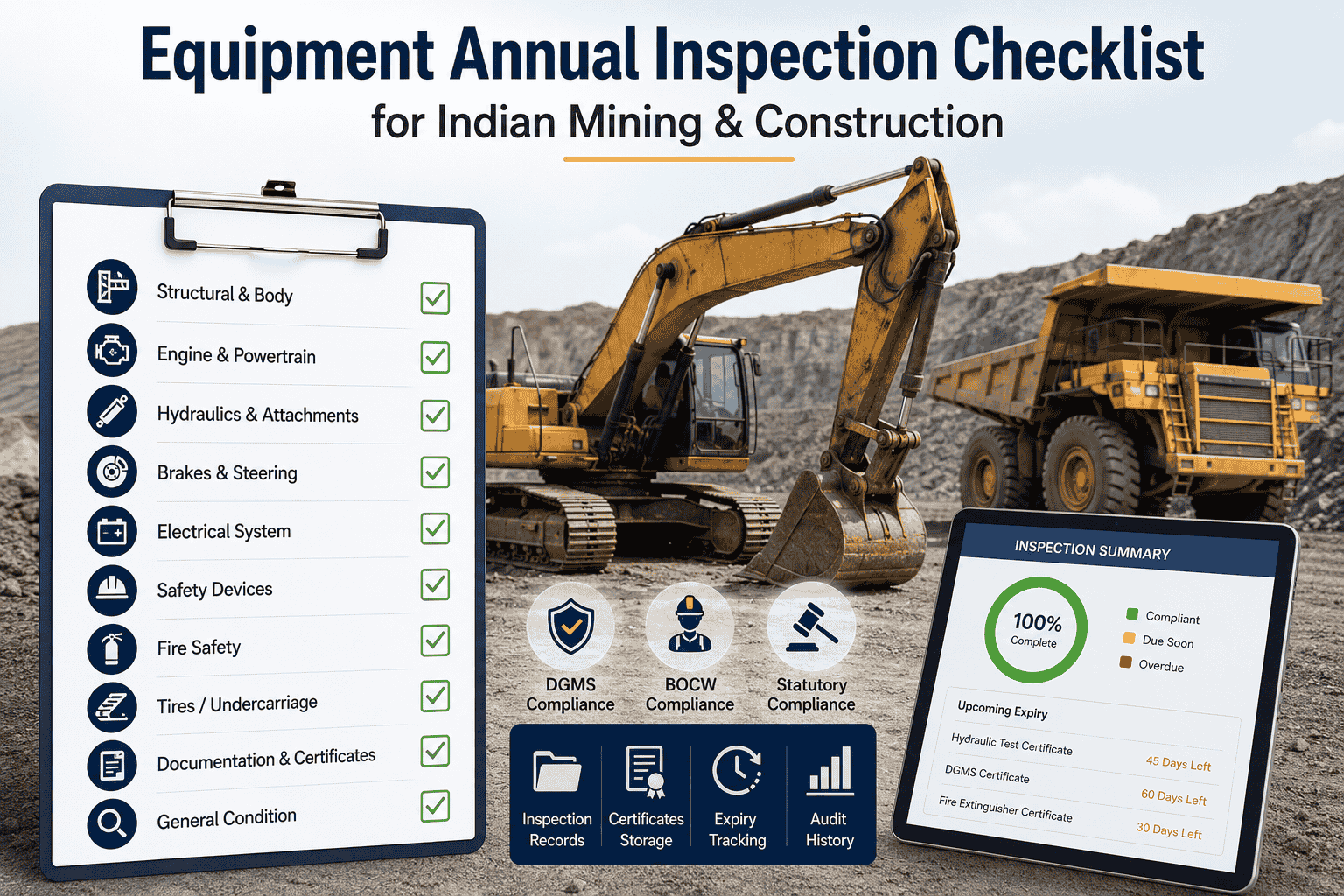
When a DGMS inspector walks onto a mine, the questions are predictable: who authorised this operator, when was this dumper last examined, where is the defect rectification record, and who signed it. What is rarely predictable is whether the site can answer from its registers — and under the Mines Act 1952 framework, "we do it but cannot show it" counts as non-compliance. The requirements themselves are scattered across the parent Act, the Coal Mines Regulations 2017, the Metalliferous Mines Regulations, and a stream of DGMS technical circulars covering everything from reverse alarms and seat belts to fire suppression and operator medicals — no single document hands a site the full equipment-side picture. This page consolidates them into one working checklist across four areas: operator authorisation and fitness, shift examination of machines, mandated safety fittings, and the records that must be producible on demand — for equipment operators, safety officers, and fleet managers at coal and metal mines alike. Every line maps to a digital workflow that builds the evidence automatically from daily work; sign up free and run it digitally from day one.
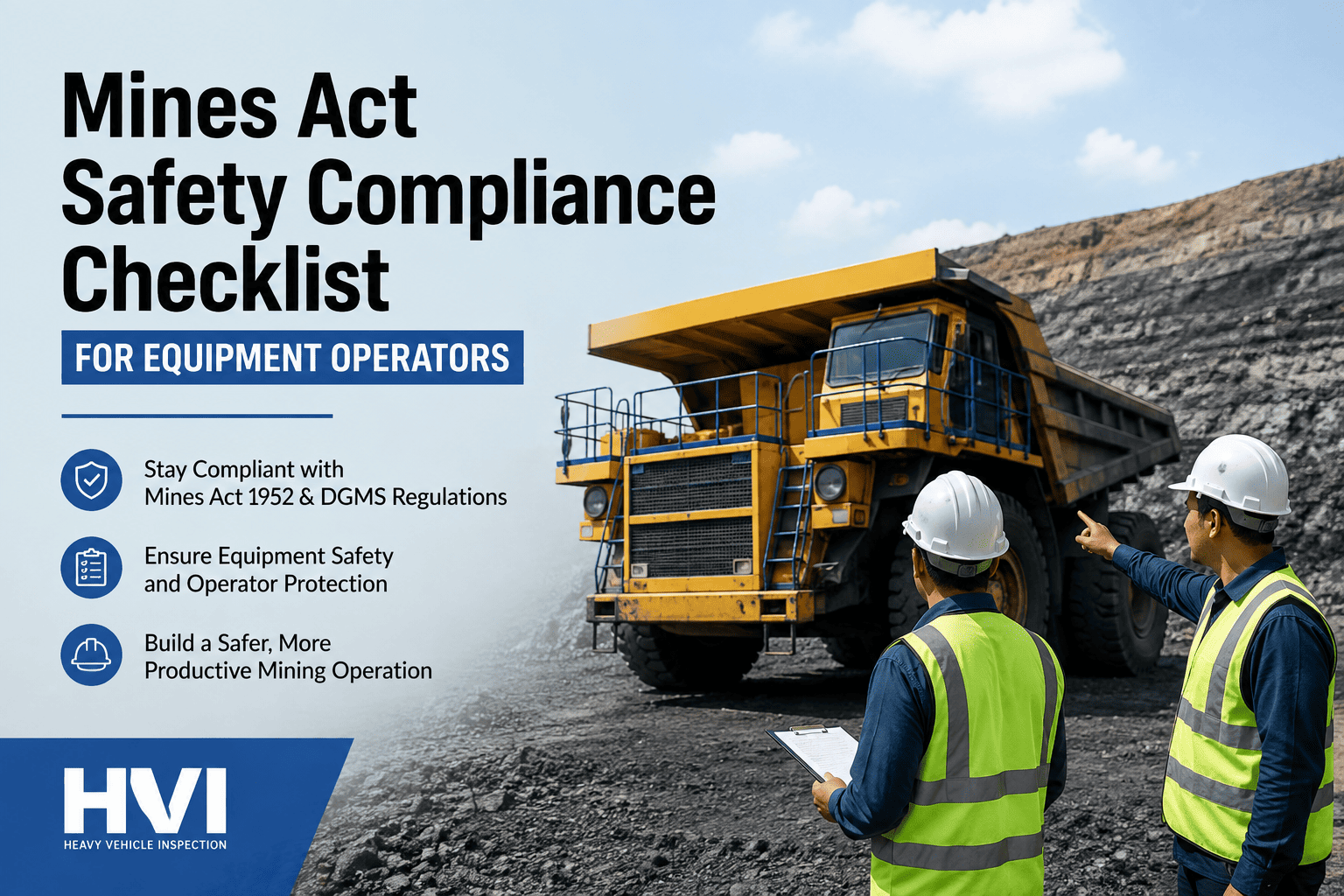
Mines Act Safety Compliance Checklist for Equipment Operators
The equipment-side requirements of the Mines Act 1952, Coal Mines Regulations 2017, Metalliferous Mines Regulations, and DGMS circulars — organised into a checklist your site can actually run every shift.
The Framework Behind the Checklist
Equipment compliance at Indian mines flows from four connected sources. The checklist below consolidates their operator-and-machine requirements into one view.
Mines Act 1952
The parent law — duties of owners, agents, and managers for safe machinery, competent supervision, and worker safety at every mine.
Coal Mines Regulations 2017
Detailed machinery rules for coal mines — examination of transport machinery, authorised operation, and maintenance record-keeping.
Metalliferous Mines Regulations
The parallel machinery and examination requirements for metal and non-coal mines, enforced through the same DGMS inspectorate.
DGMS Technical Circulars
Ongoing directives on HEMM safety — audio-visual alarms, rear-view arrangements, seat belts, fire suppression, brake testing, and operator cabins.
The Working Checklist
Four groups cover the equipment side of mine compliance. Use them as your audit self-check — every unticked line is a finding waiting for an inspector.
This Checklist Becomes Your Site's Daily System on HVI
Every line above maps to a digital workflow: operator profiles with authorisation and medical validity, shift examinations on mobile with sign-offs, defect-to-work-order rectification trails, and registers that build themselves. Configure it in days with our India team and run your next DGMS inspection from a dashboard.
What the Inspector Asks — and the Evidence That Answers
| Requirement Area | What DGMS Looks For | Evidence HVI Produces |
|---|---|---|
| Operator authorisation | Named authorisation per machine class, current medicals and training | Operator profile export: authorisations, medical validity, training certificates, machines operated |
| Shift examination | Signed examination for any machine on any date, with defects noted | Timestamped mobile inspections with GPS, photos, and competent-person sign-off, filtered in seconds |
| Defect rectification | Proof that reported defects were repaired before continued operation | Defect-to-work-order trail with parts, labour, closure photos, and grounding history |
| Safety fittings | Alarms, belts, suppression, and protective devices functional on inspection day | Fitting-wise check history per machine, with failure and rectification dates |
| Incident records | Accident and near-miss registers with investigations and actions closed | Incident files with statutory-format reports, root cause, and verified corrective actions |
Where Paper Compliance Fails the Inspection
The Register Gap
Shift examinations happen, but entries get batch-filled at week end — and one date mismatch against the diesel register unravels the whole record's credibility in front of an inspector.
The Retrieval Scramble
The inspector names one dumper and one date; the site spends a day hunting through bundles. Digital records answer the same question in a filtered search — while the inspector is still standing there.
The Orphaned Defect
A brake defect noted in the register with no repair record against it is worse than no entry at all — it is documented knowledge of a hazard, unactioned. Defect-to-work-order linkage closes that exposure permanently.
Frequently Asked Questions
Who counts as a "competent person" for equipment examination?
A person appointed in writing by the mine manager as competent for that duty — typically qualified fitters, foremen, or engineers for machinery examination, and trained operators for pre-shift checks. The appointment itself must be documented; digital systems attach the competency role to each user so every sign-off carries it automatically.
Do contractor-owned machines on our mine need the same compliance?
Yes — the mine owner and manager remain responsible for statutory compliance of all machinery deployed at the mine, contractor-owned included. Bringing contractor fleets into the same digital examination and record system is the practical way to hold them to identical standards with shared visibility.
Are digital records accepted for DGMS inspections?
Inspections centre on whether examinations happened, defects were rectified, and records are authentic and retrievable — timestamped, signed digital records with photos typically demonstrate this more convincingly than registers. Many sites maintain printed extracts alongside; HVI exports registers in printable statutory-style formats for exactly that purpose.
How do we cover operators' medical and training validity across sites?
Attach validity dates to each operator profile and let the system flag expiries ahead of time — an operator whose medical lapses shows up before the inspector finds it, across every site from one dashboard. You can set this up in an afternoon: sign up free and load your operator list.
Can we see this checklist running as a digital system before deciding?
Yes — bring your current examination register to a session and our India team will rebuild it as mobile shift checks with sign-offs, then show the machine-wise retrieval an inspector would ask for. Book a 30-minute demo and bring your safety officer along.
Run the Next Inspection from a Dashboard, Not a Storeroom
Every requirement on this page is answerable in seconds when examinations, defects, authorisations, and incidents live in one system — machine-wise, signed, and timestamped. Put your mine's checklist on HVI and let compliance become a by-product of daily work instead of a quarterly scramble. Start free with your first machines today, or bring your registers to a 30-minute session and watch them become a live compliance dashboard.