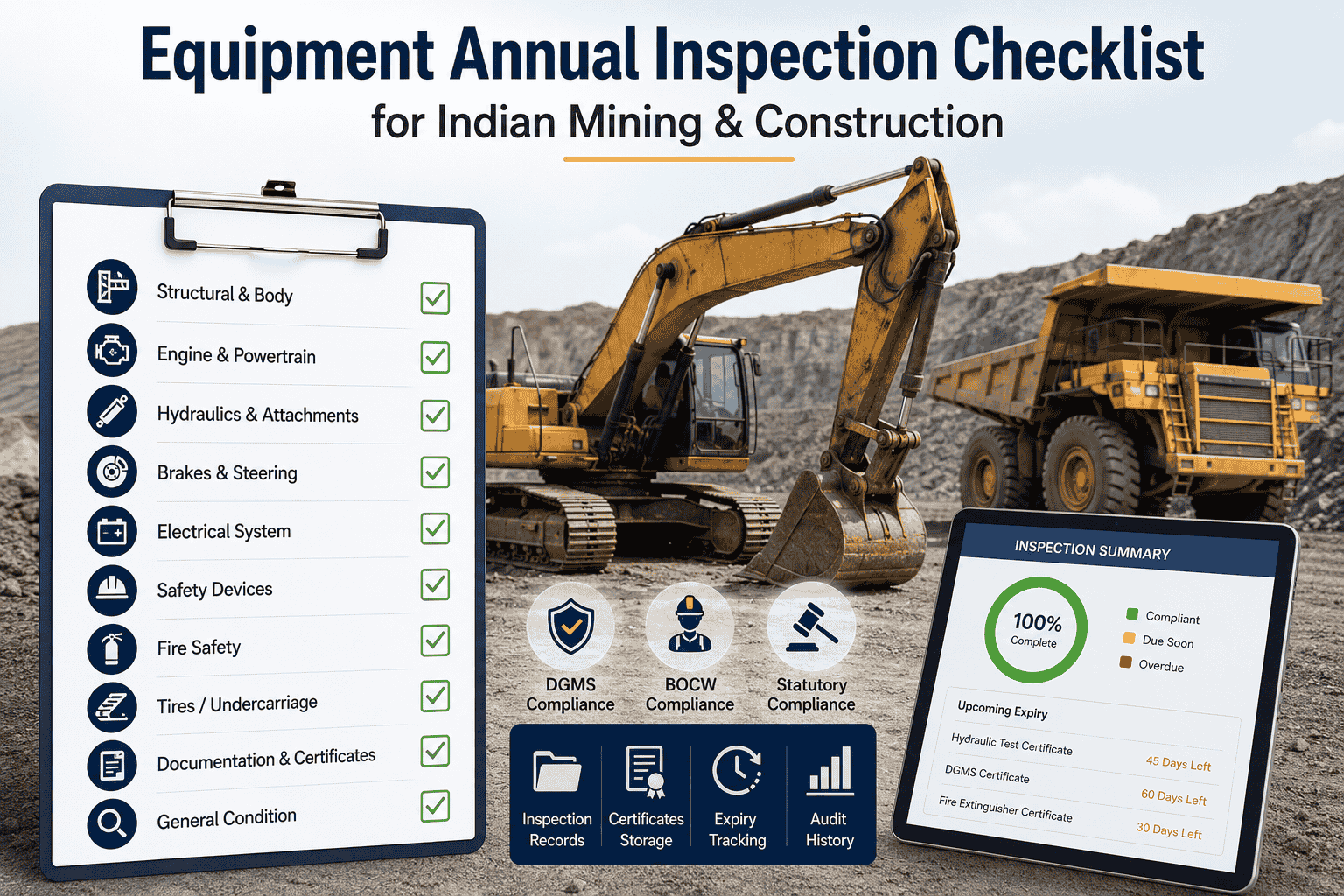
Annual statutory inspection is the most consequential compliance event in an Indian heavy-equipment operator's calendar. It is the moment a competent person — recognised by the Chief Inspector of Factories, or the DGMS Inspector for mining operations — physically examines every crane, hoist, lift, lifting tackle, pressure vessel, and machine on the site against legal codes (Factories Act 1948 Section 29, BOCW Act 1996, Mines Act 1952 + CMR 2017). The result is either a Form 9 / Form 10 / Form 11 certificate that lets the equipment operate for another year, or a non-conformance report that triggers stop-work until the defect is rectified. This checklist gives the EHS officer, plant maintenance head, and compliance officer a structured way to prepare for, run, and document the annual inspection across both regulatory tracks — DGMS for mining equipment and Factories Act + BOCW for construction equipment. Sign up free to keep every annual certificate's expiry, inspector report, and rectification status live on HVI.
ANNUAL STATUTORY INSPECTION · 2026
Equipment Annual Inspection Checklist · Indian Mining & Construction
For EHS officers, maintenance heads, and compliance officers preparing equipment for DGMS / Chief Inspector of Factories / BOCW competent person examination. Covers cranes, hoists, lifts, lifting tackles, pressure vessels, and HEMM.
The Two Regulatory Tracks · Mining vs Construction
Indian heavy equipment falls under one of two annual-inspection regulatory tracks depending on where it operates. Mining equipment is governed by DGMS under the Mines Act 1952 + CMR 2017 + MMR 1961; construction equipment by the Chief Inspector of Factories under the Factories Act 1948, with BOCW Act 1996 layering additional construction-specific requirements. The two tracks have different inspecting authorities, different forms, different validity periods, and different penalty structures. Knowing which track applies is the first compliance question on any site.
TRACK 1
DGMS — Mining
Applies to
All equipment used in mines (coal, metalliferous, oil) — HEMM, conveyors, electrical equipment, ventilation, winding
Governing Law
Mines Act 1952 · CMR 2017 (Coal) · MMR 1961 (Metalliferous) · Mines Rescue Rules 1985
Inspector
DGMS Inspector of Mines + Mine Manager's appointed Competent Person
Equipment Approval
DGMS prior approval needed before introduction · field trial up to 6 months
Inspection Frequency
Fortnightly (regulation-prescribed) + annual examination by competent person
Penalty Severity
Criminal liability on mine manager · imprisonment for repeat failures
TRACK 2
Factories Act + BOCW — Construction
Applies to
Construction equipment on registered factories (batching plants, casting yards) + BOCW-applicable construction sites
Governing Law
Factories Act 1948 · Section 28 (hoists/lifts) · Section 29 (lifting machines) · Section 31 (pressure vessels) · BOCW Act 1996
Inspector
Competent Person recognised by Chief Inspector of Factories / DISH (state)
Equipment Approval
No prior approval needed · IS / BIS standards conformity assumed
Inspection Frequency
Annual thorough examination · 6-month for lifting tackle on certain duties
Penalty Severity
Factories Act prosecution · ₹1 L+ fines · stop-work notice typical
Equipment-Type to Annual Inspection Matrix
Different equipment categories require different annual examinations against different codes. The matrix below shows the typical inspection requirements for each major equipment class — note that "Form" refers to the certificate issued at the end of the examination, "Code" to the technical standard the examination references, and "Frequency" to the legally-mandated re-inspection interval. Book a demo to track every equipment's next-inspection date on HVI's compliance calendar.
The 6-Stage Annual Examination Workflow
The annual examination is not a one-day event — it's a 6-stage workflow spread over 4-6 weeks, from initial scheduling to final certificate filing. Sites that treat it as a same-day event consistently fail because the equipment is not properly prepared, documentation is incomplete, or the rectification window for defects is missed. Sign up free to run all 6 stages as a structured workflow on HVI with stage-wise sign-off.
01
Schedule & Notify
T - 30 days
Identify all equipment due for annual examination. Engage recognised competent person (or DGMS Inspector for mining). Confirm date, scope, equipment list. Notify operations team for downtime planning.
02
Pre-Examination Preparation
T - 14 days
Clean equipment thoroughly. Compile previous year's examination report. Prepare maintenance history. Internal pre-check by maintenance team. Rectify any obvious defects before competent person arrives.
03
Physical Examination & Testing
T - 0 (Examination Day)
Competent person conducts visual inspection, mechanical checks, load test (where applicable), wire rope/chain inspection, NDT where required. Site engineer/operator present to demonstrate operation.
04
Report Generation & Defects List
T + 3-7 days
Competent person issues thorough examination report. Defects categorised: (a) immediate cessation, (b) repair within timeline, (c) monitor at next inspection. Defects-list to maintenance team.
05
Rectification & Re-Test
T + 7-21 days
All "immediate" defects rectified before further use. Repair-within-timeline defects closed within stipulated date. Re-inspection by competent person for safety-critical defects. Re-test report filed.
06
Certification & Records Filing
T + 21-28 days
Form 9 / Form 10 / Form 11 (or DGMS format for mining) issued by competent person. Identification tag affixed to equipment. Original certificate filed in compliance register. Next-inspection date entered into calendar.
Pre-Examination Readiness Checklist (T - 7 Days)
The single biggest reason annual examinations get extended, delayed, or fail outright is poor preparation. The competent person arrives, finds equipment dirty / inaccessible / missing documentation, and either issues an adverse report or returns later at additional cost. This 12-point readiness check should be run 7 days before the examination date. Book a demo to run the T-7 day readiness check as a digital workflow on HVI.
Complete equipment inventory list ready — Every asset due for examination is on the list with serial number, registration number, location, last examination date.
Previous year's examination certificate available — Original Form 9 / 10 / 11 from last year on file. Defects noted last year must show closure evidence.
Manufacturer test certificate / installation certificate — OEM original test certificate for the equipment available, especially critical for newer assets being examined first time.
Equipment cleaned and accessible — Grease, dust, debris removed from inspection points. Operator access to control panels, hydraulic systems, electrical cabinets clear.
Load test arrangements ready (cranes/hoists) — Test weights, load cells, water bags, certified counter-weights arranged on site. Test bed clear of obstructions. CRITICAL
Operator / driver present with valid licence — The competent person needs the equipment operated during examination. Licence/cert validity confirmed.
Maintenance log / service history available — All servicing, breakdowns, repairs since last examination logged. Defect register up to date.
Wire rope / chain inspection records (cranes) — Periodic rope/chain inspection records since last annual. Discard criteria per IS 3973 documented. CRITICAL
Safety devices functional — Limit switches, anti-two-block (cranes), overload limiters, emergency stops — all tested and working before competent person arrives.
SWL (Safe Working Load) plainly marked — Per Factories Act §29(b), SWL must be displayed on equipment. Identification number visible.
Pressure vessel records (compressors, accumulators) — Last hydrostatic test date, safety valve setting record, pressure gauge calibration certificate.
PPE for competent person provided — Hard hat, safety shoes, harness if working at height. Site safety induction completed before walk-through.
Common Annual Examination Failure Modes
Across hundreds of annual examinations on Indian construction and mining sites, certain failure modes appear repeatedly. Knowing the top failure modes lets the maintenance head close them out before the competent person arrives — turning a "fail/repair/re-test" cycle into a "pass first time" outcome. Sign up free to log every defect against equipment history so failure patterns get caught early on HVI.
Wire rope discard criteria exceeded
More than 5% wire breaks in any 8-diameter length, kinks, birdcaging, corrosion exceeding IS 3973 limits. Hidden inside reeving sheaves where periodic inspection missed it.
Safety device bypass found
Limit switch jumpered, anti-two-block disconnected, overload limiter calibration tampered. Bypasses done for "production convenience" surface during competent-person testing.
Brake test failure
Hoist brake holds load less than statutory requirement (typically 125% SWL hold test). Linings worn beyond limit. Adjustment not done since last service.
Structural defects in load-bearing members
Hairline cracks at jib base, boom-section weld defects, sling-attachment eye-bolt deformation. Picked up under NDT (DPT / MPT) during competent-person inspection.
Lifting tackle without identification tag
Slings, shackles, hooks without colour-coded tag showing last inspection date. Per IS 3938 every item must be individually tagged.
Pressure vessel hydrostatic test overdue
Air receiver hydrostatic test interval (typically 2 years) exceeded. Annual visual + thickness check missing for newer vessels.
Earthing resistance above 1 ohm
For electrical equipment under Chief Electrical Inspector. Earthing measured per IS 3043 — readings above 1 ohm fail examination outright.
Documentation gaps
Previous year's certificate missing, OEM cert lost, maintenance log incomplete, defect-closure evidence absent. Procedural failures get noted as adverse findings.
Forms Reference — Form 9 / 10 / 11
The three statutory forms under the Factories Act 1948 are the documents the competent person issues at the end of the annual examination. Each form maps to a specific equipment category. Knowing which form applies to which equipment avoids confusion when filing compliance records and avoids issuing the wrong form for an audit. Book a demo to see Form 9/10/11 templates pre-mapped to equipment classes on HVI.
Quick Reference Answers
Who is a "Competent Person" under the Factories Act 1948?
A Competent Person is an individual recognised by the Chief Inspector of Factories (or state-equivalent — DISH in Gujarat, Directorate of Industrial Safety & Health) for the purpose of conducting statutory examinations and issuing certificates. Recognition is area-specific and equipment-specific — a competent person recognised for cranes may not be authorised for pressure vessels. Qualifications typically include a degree in mechanical or electrical engineering, several years of relevant experience, NDT certifications (ASNT Level II), and access to calibrated test equipment. Recognition is renewable and revocable. For BOCW-applicable construction sites, the same recognition usually applies. The list of recognised competent persons is published by the State Factory Department.
What is the difference between annual examination and load testing?
The annual thorough examination is a complete inspection: visual, mechanical, electrical, structural, NDT where required. It includes operational testing under load but is broader than just load testing. Load testing is a specific test where the equipment is loaded to a specified percentage of SWL (typically 125% for proof load on commissioning, 100% for periodic) to verify safety margins. Load test results form part of the annual examination report. Some lifting tackle (slings, shackles) cannot be load-tested annually without proof-load damage — for these, visual + NDT examination substitutes. The competent person decides which tests are appropriate based on equipment age, duty cycle, and previous findings.
What is the difference between DGMS inspection and Factories Act inspection?
DGMS inspection applies to equipment used in mines (coal, metalliferous, oil) under the Mines Act 1952 + CMR 2017 / MMR 1961. The Directorate General of Mines Safety is the apex regulator. DGMS prior approval is needed before introducing new equipment to a mine — field trials lasting up to 6 months. Mine Manager appoints competent persons for fortnightly + annual examinations. Factories Act inspection applies to equipment in registered factories (and BOCW-applicable construction sites) under the Factories Act 1948 + state Factories Rules. The Chief Inspector of Factories is the authority; recognised competent persons conduct the actual examinations. Different forms, different penalties, different scope — though the technical examination methodology is similar.
Can the same equipment have both DGMS and Factories Act inspection requirements?
Yes — for equipment that operates in both contexts. A crane used in a mining-area cement plant adjacent to an active mine might fall under DGMS for parts of its duty and Factories Act for parts of its duty. The conservative approach is to obtain both certifications. More commonly, an equipment is classified one way or the other based on its primary location. Construction equipment hired to a mining operator becomes DGMS-applicable while on the mine premises. Site mobilisation paperwork should clarify which regulatory regime applies before equipment arrives — getting this wrong delays site clearance significantly.
How does HVI manage annual inspection records?
HVI maintains each equipment asset's inspection history as a continuous record — previous year's Form 9/10/11 certificate, defects raised, rectifications closed, photo evidence of each examination, competent person details, next examination date. The 60/30/15/7-day expiry alerts flag upcoming annual examinations to maintenance head + compliance officer. During an audit by Factory Inspector or DGMS Inspector, the entire inspection history for any asset surfaces in one tap — including the photo-evidence of defect closures. Sites running structured digital records typically reduce annual-inspection failure rates and shorten the rectification-to-recertification cycle significantly.