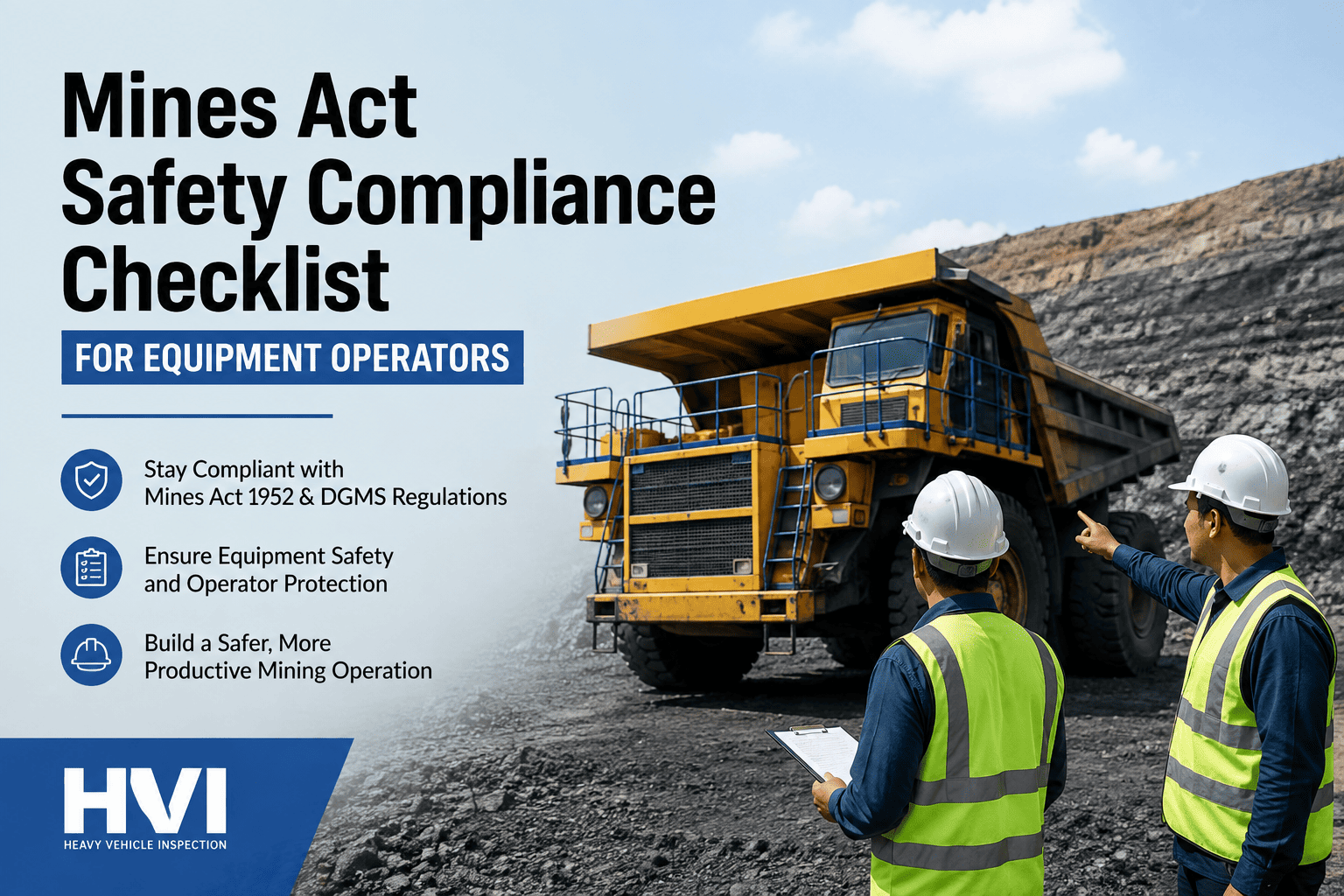
An inspector walks onto site with a checklist and asks for the mine's inspection register, the last three months of PPE issuance records, training certificates for every operator on the current shift, and evidence that every deficiency from the last visit has actually been closed. The safety head has all of this — somewhere. Some in a cupboard at the site office, some on a supervisor's phone, some in a register that hasn't been updated since the last inspection because everyone's been busy since. The records exist; the problem is nobody can produce them in the time an inspector is willing to wait. Here's what a DGMS or Factories Act inspection actually asks for, and how HVI keeps every one of these records exportable in minutes, not assembled the night before.
Facing a DGMS or Factories Act Inspection?
Digital safety records, incident reports, near-miss logs, and equipment inspection histories — all exportable for compliance audits in minutes, not the night before.
What an Inspector Actually Asks For
A DGMS or Factories Act visit follows a fairly consistent pattern — the same categories of record come up whether it's a routine visit or a follow-up after an incident.
Registration and appointments
Mine or factory registration status, and current Owner, Agent, or Manager appointment approvals on record.
Statutory returns
Confirmation that monthly and annual statistical returns have actually been filed, not just prepared.
Equipment inspection history
Evidence that mandatory inspections happened at the required frequency, by a competent person, for every relevant asset.
PPE and training records
Proof that workers were issued the right protective equipment and trained in its use, not just a general policy statement.
Incident and near-miss logs
A record of what was reported, when, and what corrective action followed — the trail that shows the site learns from what it finds.
Closure of previous findings
Whether deficiencies flagged in the last inspection have actually been resolved and verified, not just noted as planned.
See how quickly your own site could produce every one of these records if an inspector walked in today.
Minutes vs. the Night Before
| Record Requested | Paper-Based Site | Digitally Logged Site |
|---|---|---|
| Last three months of equipment inspections | Pulled from multiple site registers, cross-checked by hand | Filtered and exported by date range in minutes |
| PPE issuance and training records | Located across supervisor notebooks and HR files | Searchable by worker, shift, or site instantly |
| Status of previous findings | Requires someone to remember what was flagged and check manually | Shown as open or closed, with verification evidence attached |
| Near-miss and incident trail | Scattered across paper forms, WhatsApp messages, and memory | One searchable log, tagged by location and category |
Why the Records Exist but Can't Be Produced
Records live in different formats
A register here, a spreadsheet there, a folder of scanned certificates somewhere else — nothing is in a single place an inspector can be shown directly.
Nobody owns the compilation
Pulling everything together for an audit becomes a scramble assigned at the last minute, rather than something that's already assembled and current.
Closure status isn't tracked
A finding from the last visit might genuinely be fixed, but without a verified closure record, there's no way to prove it on the spot.
Records go stale between visits
A register that only gets updated when an inspection is imminent isn't a live record — it's a document reconstructed under pressure.
Frequently Asked Questions
Does this cover both DGMS mining requirements and Factories Act documentation?
Yes — the same underlying records, inspections, incidents, near-misses, and training logs, apply to both regulatory frameworks, since the categories of evidence they expect largely overlap.
Can records be exported in a format an inspector will accept on the spot?
Yes — records can be filtered by date range, site, or category and exported directly, rather than requiring someone to reformat data from multiple sources first.
Does this work at remote mine sites with limited connectivity?
Yes — records are captured on the device first and sync once signal returns, so a remote bench with patchy network coverage doesn't create a gap in the audit trail.
Can we track whether previous inspection findings have actually been closed?
Yes — each finding can be assigned an owner and a due date, with verification evidence attached on closure, so the status is always current instead of reconstructed from memory before the next visit.
How long would it take to get our site's records into this kind of shape?
Once inspections, incidents, and training records start being logged through the system, a usable audit-ready record typically builds within the first month; sign up free to see it start forming for your site.
Be Ready Before the Inspector Arrives
The records a DGMS or Factories Act inspection asks for already exist somewhere on your site — the only question is whether you can produce them in minutes or need the night before to assemble them. Start free and keep every safety record exportable on demand, or bring your current documentation process to a 30-minute session with our India team.