When inspection completion sits at forty or fifty percent, the instinct is to escalate — more reminders, a supervisor chasing signatures, completion added to someone's KPI. That approach treats a design problem as a discipline problem, and it rarely holds past the first busy week. Operators are not skipping inspections because they do not care about the machine they spend every shift on. They skip them because something in the workflow costs more time or friction than the exercise appears to be worth, and that something is almost always fixable. HVI was built around removing those specific friction points, and you can walk through where your own drop-off happens in a free 30-minute session.
Low Inspection Completion Rate? The Problem Is the Tool, Not the Team
Completion rates fall at predictable points in the workflow. Find out where yours drops, why operators abandon at that exact step, and what changes when the friction is removed.
Where Completion Actually Drops Off
Every inspection that never gets submitted was abandoned at a specific step. These are the four where it usually happens.
The inspection exists on the schedule and is expected of the operator.
Drop-off begins here when the app is slow to load or the right form is hard to find.
More drop-off when the form is long, wordy, or demands typing on a site phone.
The final loss, where a completed inspection fails to sync and the operator gives up on it.
What You Hear vs What's Actually Happening
Find Your Own Drop-Off Point
See completion rates by site, by crew, and by equipment type, so the gap stops being a general complaint and becomes a specific fix.
What Changes at Each Stage
Scanning the machine loads its own checklist directly, so no one searches for the right form.
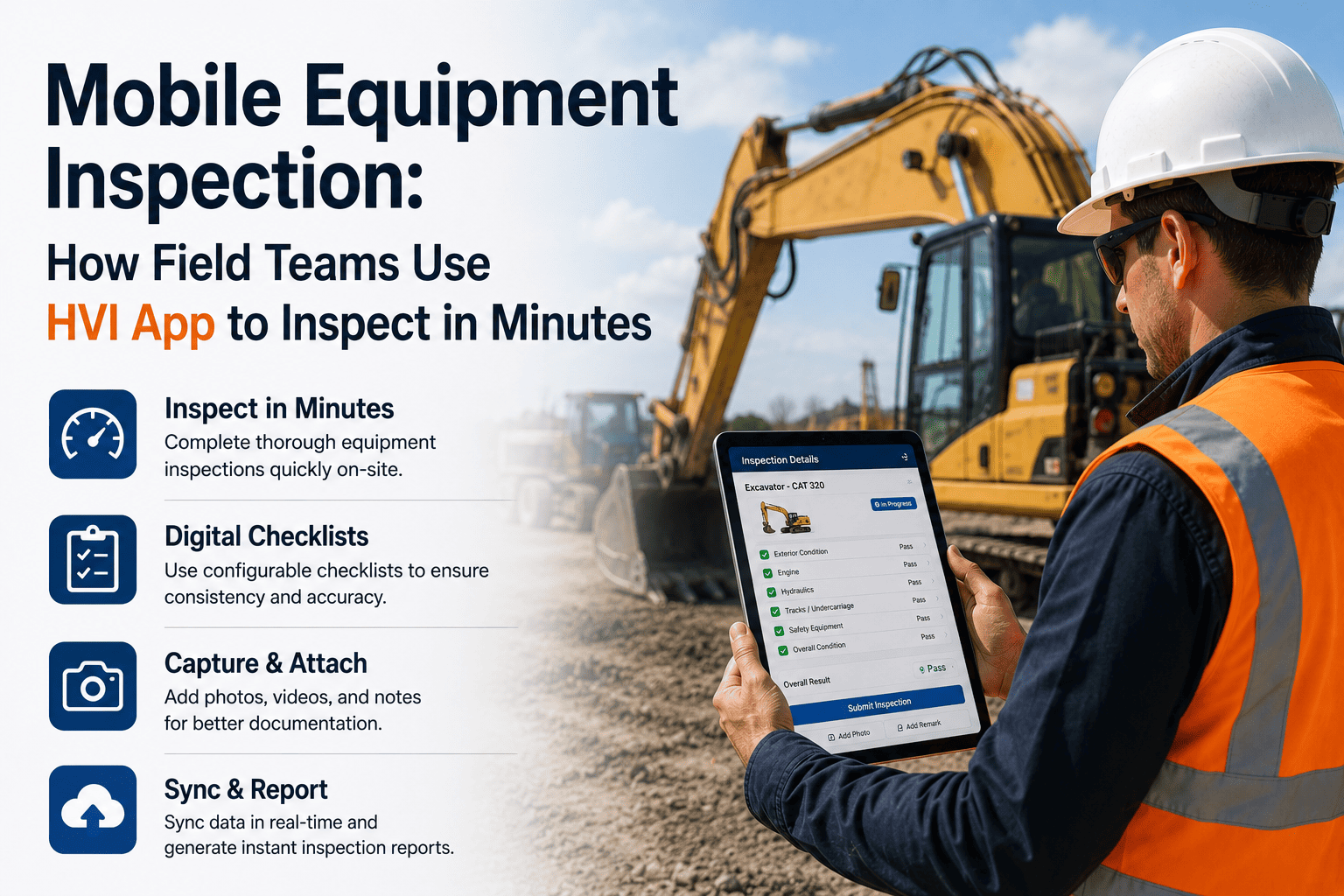
One decision per line, cleared by tap, with photo and voice note replacing every free-text field.
The whole inspection completes offline and syncs on its own once the device reaches coverage.
A failed item raises a work order immediately, so operators see that reporting produces action.
Frequently Asked Questions
Can we see completion rates broken down by site or crew?
Yes. Completion can be viewed by site, crew, and equipment type, which usually shows the problem is concentrated rather than fleet-wide. You can review this on a call with our team.
What completion rate is realistic to aim for?
Fleets that remove the friction points above typically see completion climb substantially, though the achievable rate depends on shift patterns, site conditions, and how consistently follow-up actually happens.
Does adding more reminders improve completion?
Reminders help only when the underlying workflow is already easy. If the form itself is the obstacle, reminders raise frustration more than completion.
How do we know an inspection was genuinely completed at the machine?
Submissions carry a timestamp and the operator who completed them, and photo evidence on failed items ties the record to the actual equipment.
How long before completion rates start improving?
Most of the gain comes quickly, since it follows directly from removing friction rather than from changing behaviour over time. Start with a free trial to measure your own baseline first.
Stop Chasing Completion. Remove What's Blocking It.
Find the exact step where your inspections are being abandoned, and fix the workflow rather than escalating to the people using it.