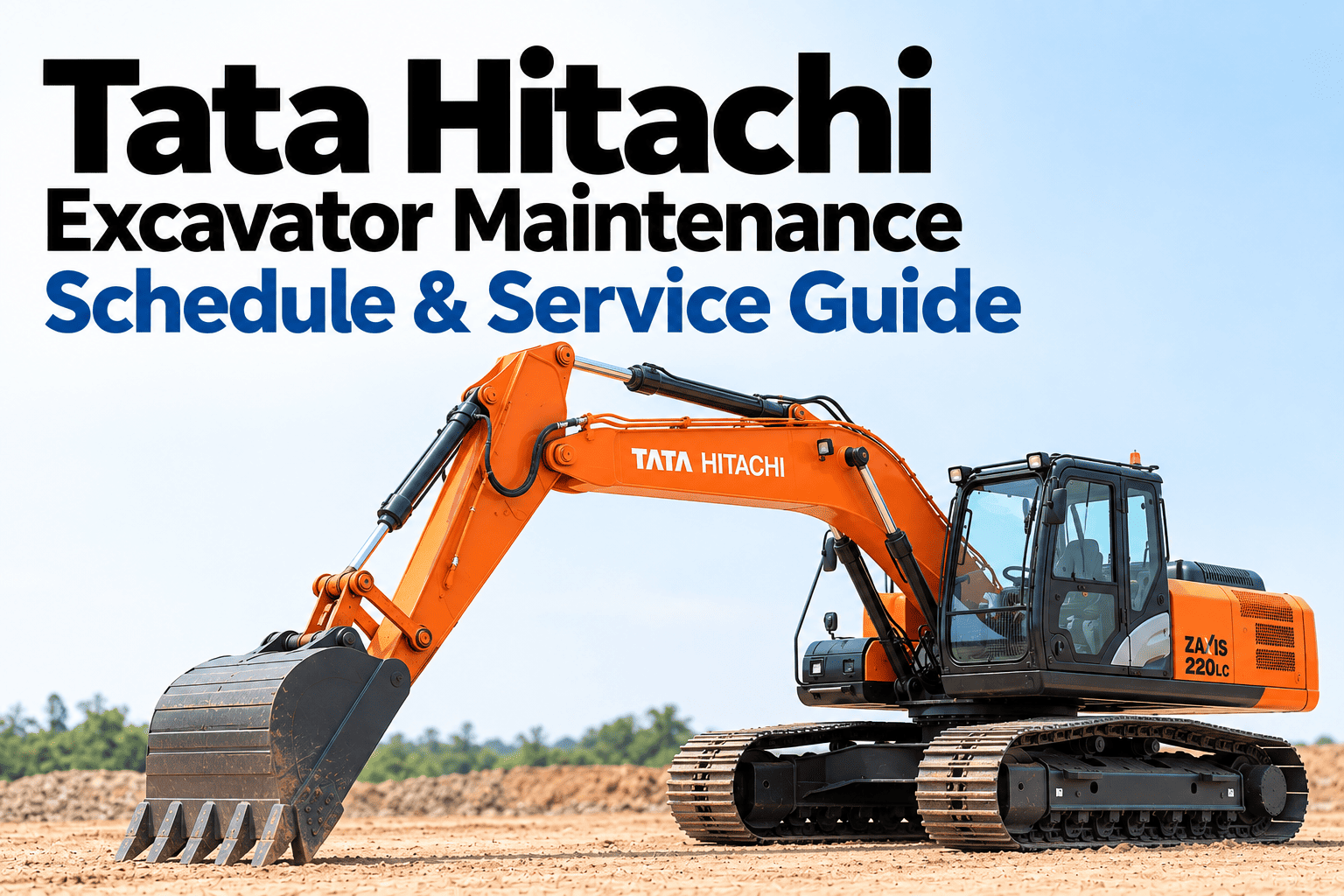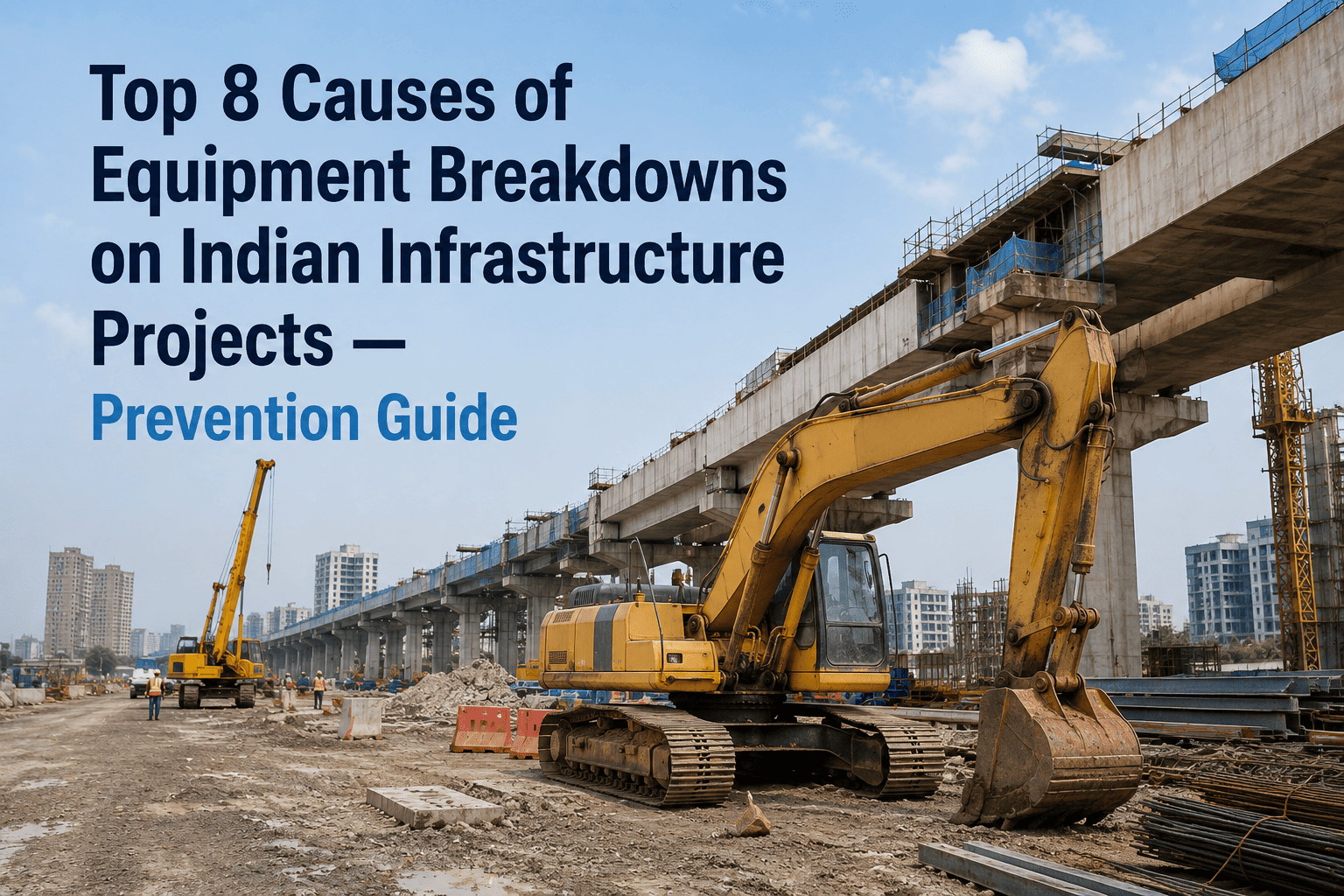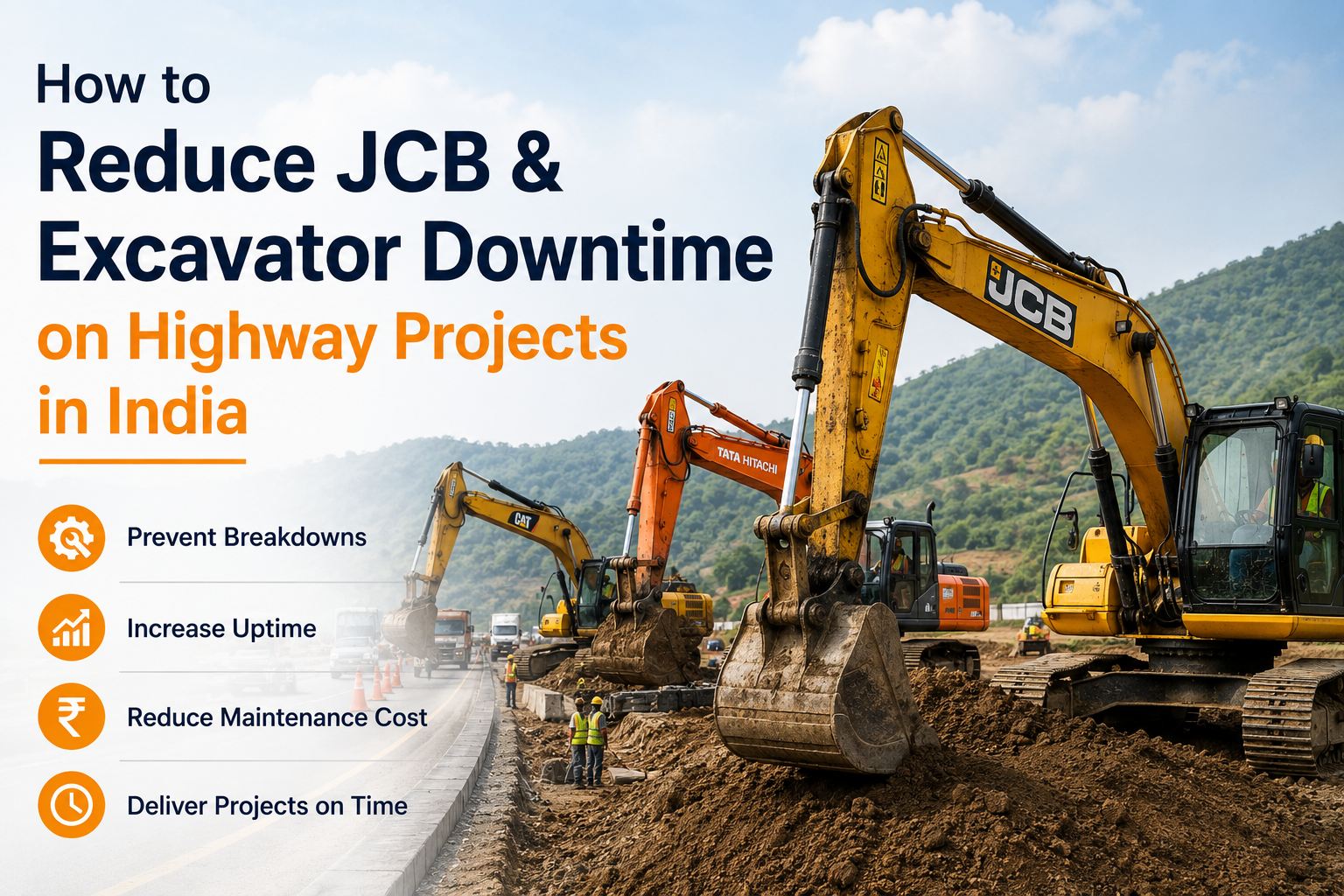
On any NHAI highway package in India, 3 to 5 excavators run 14 to 18 hours a day during the dry season. When even one of them stops working — a JCB 3DX, a Tata Hitachi EX210, or a CAT 320 — the whole earthwork chain freezes. Dump trucks wait, the foreman scrambles, and the project loses ₹40,000 to ₹1.5 lakh per machine per day. Most contractors think breakdowns are bad luck. They are not. They are predictable, preventable, and almost always caused by the same 5–6 issues. This guide shows you how Indian EPC teams are cutting excavator downtime on Bharatmala and state highway projects by 40–60% — without buying new machines. Want to see this on your own fleet? Book a 30-minute demo with our team.
How to Reduce JCB & Excavator Downtime on Highway Projects in India
A practical playbook for site managers, project engineers, and equipment heads running NHAI, Bharatmala, and state PWD packages — with real causes, real fixes, and the digital tools Indian EPC teams use to keep machines running 90%+ of the time.
Why Excavator Uptime Is the #1 KPI on Indian Highway Projects
India is building highways faster than ever. Under Bharatmala Pariyojana, NHAI has already delivered 18,926 km of the 34,800 km target, and the National Infrastructure Pipeline has earmarked over $1.4 trillion for upcoming projects. Every kilometre of that asphalt sits on top of earthwork done by an excavator. According to ICEMA data, the 20–23 ton segment — JCB NXT 205, Tata Hitachi EX210LC Prime, CAT 320, SANY SY215C — does the bulk of NHAI highway earthwork in India. These machines move 150–200 m³ of earth per hour. When one stops, you do not just lose digging — you lose the productivity of 4 to 6 dump trucks, the operator, and the entire shift's billable progress. Sign up free to see how leading EPC contractors track this lost time in real-time.
Excavators deployed per 10 km highway package by typical NHAI contractors
Earth moved per hour by a single 20-ton excavator on a normal site
Idle dumpers waiting when one excavator goes down mid-shift
Daily loss per idle excavator on highway packages (lease + crew + LD risk)
The 6 Real Causes of Excavator Downtime on Indian Highway Sites
After analysing breakdown logs from contractors running JCB, Tata Hitachi, CAT, Komatsu, and SANY excavators on highway projects, the same 6 issues show up again and again. None of them are random. All of them give early warning signs 7 to 14 days before the actual breakdown — if anyone is looking. Open your free HVI account to start tracking these signals on your own fleet from the next shift.
Hydraulic System Failures
Hose leaks, contaminated oil, cylinder seal failure. The single biggest cause on dusty Bharatmala sites — especially in Rajasthan, MP, and Maharashtra. Fine dust enters the hydraulic system and slowly destroys the pump. Warning signs: slow boom movement, oil temperature rise, white smoke at startup.
Undercarriage & Track Issues
On long highway packages, excavators move daily over uneven, rocky terrain. Track tension, idler wear, sprocket damage, and roller seal failure show up first. Most operators ignore this until the track snaps. Warning signs: abnormal noise, uneven track wear, track sag.
Engine Cooling & Overheating
India's summer at 45°C+ on a Rajasthan or Telangana site, combined with dust-clogged radiators, kills excavator engines within 2 to 3 weeks if not cleaned. JCB and Tata Hitachi service teams call this their #1 summer warranty claim. Warning signs: coolant temperature spikes, fan running constantly, fuel consumption rising.
Missed Preventive Maintenance
Engine oil at 250 hrs, hydraulic oil at 1,000 hrs, fuel filter at 500 hrs. On paper logbooks and Excel sheets, these almost always slip. By the time the site engineer realises, the machine is already running on degraded oil. Warning signs: none — until the breakdown happens.
Electrical & Sensor Failures
Loose connections, ECM faults, alternator issues. Common on older JCB 3DX backhoe loaders and 8–10 year old Tata Hitachi machines on second-tier highway packages. Warning signs: intermittent dashboard warnings, hard starts, telematics dropouts.
Operator-Induced Damage
Wrong attachment use, over-stressing the boom, hitting underground rocks at full speed. Especially common with new operators on 20–22 ton machines. Often hidden in WhatsApp messages instead of a real defect log. Warning signs: hidden by the operator until the next shift.
Catch All 6 Issues 7–14 Days Before Breakdown
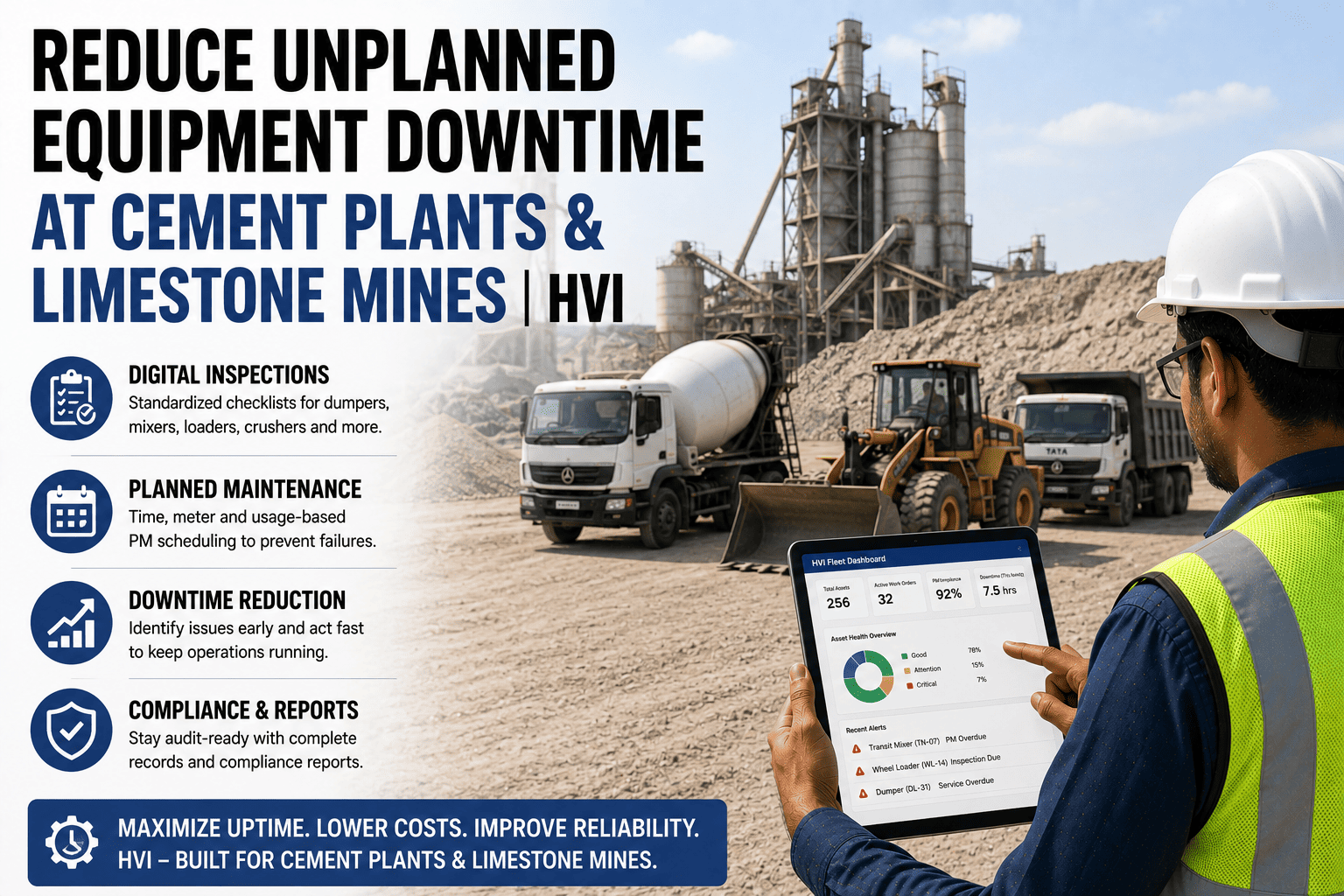
HVI's photo-verified daily inspections, automated PM tracking, and operator-friendly defect logging are designed exactly for these 6 causes. Live in 10 minutes — no hardware, no IT setup.
A Real Excavator Breakdown Timeline — and How HVI Catches It Early
Here is what actually happens with a Tata Hitachi EX210LC operating on a 4-lane highway package — first without HVI, then with HVI catching the early signal. Same machine, same operator, two very different outcomes. Book a demo to see this timeline mapped to your actual fleet.
The 5 Habits That Cut Excavator Downtime by 40%+
Across highway, mining, and metro projects, the EPC teams with the highest uptime follow the same 5 habits. None of them require new machines or expensive sensors. They just need a system that makes these habits easy and verifiable.
Daily 5-Minute Pre-Start Inspection
Operator checks engine oil, coolant, hydraulic level, track tension, and cab controls before starting. With photos. Catches 60% of issues before they grow.
Hour-Based PM Scheduling, Not Calendar
Excavators run irregular hours during monsoon vs dry season. Track PM by engine hours and km — never by date alone. JCB recommends 250-hr/500-hr/1,000-hr cycles.
Defect-to-Work-Order in Under 1 Hour
The longer a defect waits, the costlier it gets. Best teams convert every operator-flagged defect into a mechanic work order within 60 minutes — automatically.
Spare Parts Planned 7 Days in Advance
Predictive alerts mean spares arrive at dealer rate, not panic-emergency rate. This single habit alone cuts spare cost by 20–30% on most highway packages.
Cost-Per-Running-Hour Visibility
Project Manager tracks ₹/hour for every machine. The 1–2 worst performers reveal themselves immediately and get focused intervention.
Doing all 5 of these manually with paper logbooks and WhatsApp is impossible on a 50-machine project. Book a 30-minute demo to see how HVI automates all 5 habits in a single mobile app — even for operators with basic English.
Excavator Service Checklist — Daily, Weekly & Monthly
This is the inspection checklist used by leading Indian EPC contractors on JCB NXT 205, Tata Hitachi EX210LC Prime, and CAT 320 excavators on NHAI projects. Print it, laminate it, and keep it in the cab — or even better, run it digitally on HVI for free with photo proof and auto-tracking.
- Engine oil level
- Coolant level & radiator clean
- Hydraulic oil level
- Fuel level & water trap
- Track tension visual check
- Hoses for leaks
- Boom & bucket greasing points
- Operator cab controls
- Air filter clean / replace
- Battery terminals & voltage
- Track tension adjustment
- Pin & bushing greasing
- All hydraulic hose check
- Bucket teeth condition
- Lights, beacons, reverse alarm
- Fire extinguisher
- Engine oil + filter (if 250 hrs)
- Hydraulic oil sample test
- Fuel filter replacement
- Idler & sprocket inspection
- Cylinder seal condition
- Cooling system flush
- Pivot pin wear measurement
- Telematics data download
Expert View — From a Highway Project Site Engineer
We had 6 excavators on a 28 km highway package — JCB NXT 205, two Tata Hitachi EX210LC, two CAT 320, and one SANY SY215C. Before we started using HVI, we were losing 4 to 6 days every month to unplanned breakdowns. The biggest issues were always hydraulic and undercarriage. After we put the operators on HVI for daily photo inspections, we caught 80% of the issues during the morning check itself. Spare parts cost dropped by almost 28% because we stopped buying at emergency rates. The project finished 22 days ahead of schedule.
Conclusion — Excavator Uptime Is a Process, Not Luck
Every Indian highway project — Bharatmala, NHAI EPC, state PWD — is won or lost on equipment uptime. JCB, Tata Hitachi, CAT, and Komatsu all build excellent machines. But machines do not maintain themselves. The contractors finishing ahead of schedule are not the ones with the newest excavators — they are the ones with the best inspection discipline, the fastest defect-to-work-order chain, and clear cost-per-running-hour visibility for every machine. That discipline used to require massive paperwork. Today, it requires just one app on your operator's phone. HVI is built exactly for this.
Cut Your Excavator Downtime Starting on the Next Shift
Whether you run JCB, Tata Hitachi, CAT, Komatsu, or SANY excavators on a Bharatmala stretch or a state PWD package — HVI catches the breakdown signals 7 to 14 days early. Operators use it in Hindi or regional language. Mechanics get auto work orders. Project Managers get live cost-per-hour. All in one app.