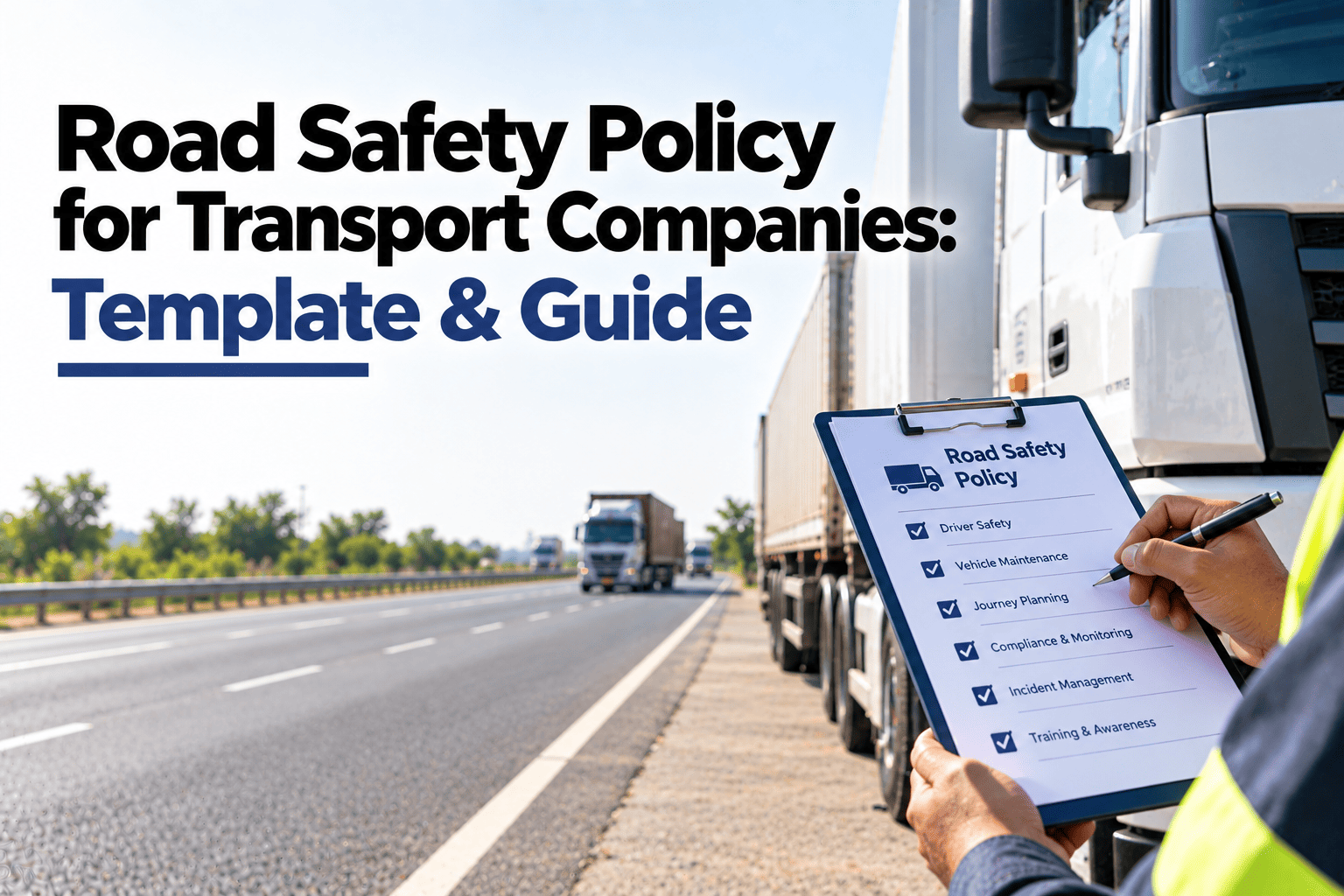
When a large customer sends a vendor safety questionnaire, one of the first questions is usually simple: does your company have a written road safety policy? Many Indian transporters run safe operations but have nothing on paper to prove it, and lose contracts or face tough audits as a result. A good policy is short, clear and actually used. It tells drivers, supervisors and managers exactly what is expected on every trip. This guide gives you a practical template and shows how HVI keeps the records behind each part of the policy.
Road Safety Policy for Transport Companies: Template and Guide
Build a road safety policy your drivers understand, your customers accept and your records can prove, with a ready template you can adapt today.
Why a Written Policy Matters Now
A policy is not just paperwork. It protects people, contracts and the business.
Customer audits
Large shippers, oil companies and infrastructure clients often ask for a safety policy before awarding work.
Fewer accidents
Clear rules on speed, phones and rest reduce the most common causes of crashes.
Stronger position after incidents
Records show the company took reasonable steps to keep drivers and the public safe.
Lower costs
Fewer crashes mean less repair cost, downtime, claims and lost cargo.
Road Safety Policy Template
Copy these sections into your own policy and adjust them for your fleet, routes and customers. Have it reviewed by your safety or legal adviser before issuing.
Purpose and scope
This policy applies to all company and contracted vehicles, drivers and staff who plan or manage journeys.
Responsibilities
Management provides resources, supervisors enforce the rules and every driver follows them on every trip.
Vehicle standards
Vehicles are inspected before each trip, serviced on schedule and kept with valid fitness, permits and insurance.
Driver selection and training
Drivers hold a valid licence for the vehicle class, pass induction and receive refresher training every year.
Speed
Drivers obey legal limits and any lower company limits set for routes, loads and road conditions.
Seat belts
Seat belts are worn by the driver and every occupant whenever the vehicle is moving.
Mobile phones
No handheld phone use while driving. Calls are taken only when safely parked.
Alcohol and drugs
Zero tolerance. No driving under the influence of alcohol, drugs or impairing medicines.
Fatigue and hours
Driving and rest follow legal limits, with breaks after every few hours and night driving minimised.
Journey management
Long or high-risk trips have an approved plan covering route, timing, rest stops and contacts.
Incident reporting
All accidents and near misses are reported the same day and investigated to prevent repeats.
Monitoring and review
Safety performance is reviewed monthly and this policy is reviewed at least once a year.
Who Does What
A policy only works when each role knows its part. Put a simple responsibility table like this next to the policy.
| Activity | Management | Supervisor | Driver |
|---|---|---|---|
| Pre-trip vehicle inspection | Reviews | Checks | Does |
| Servicing on schedule | Approves budget | Plans | Reports defects |
| Driver licences and training | Approves | Tracks | Attends |
| Journey plans for long trips | Sets rules | Approves | Follows |
| Incident reporting | Reviews | Investigates | Reports |
Back Every Clause of Your Policy With Real Records
HVI records daily inspections, defects, driver documents, incidents and audits, so you can show customers and auditors that your policy is followed every day.
Roll Out the Policy in Five Steps
A policy that sits in a file changes nothing. These steps turn it into daily practice.
Write and sign
Adapt the template and have the top manager sign it.
Explain
Brief every driver in a language they understand.
Equip
Give checklists, training and reporting tools.
Check
Supervisors verify inspections and journeys daily.
Review
Monthly KPI reviews and a yearly policy update.
Road Safety KPIs to Track
Leading measures show whether the policy is being followed. Lagging measures show the results. Track both.
- Pre-trip inspections completed on time
- Drivers with valid licences and current training
- Journey plans submitted for long trips
- Speeding and harsh braking events per 1,000 km
- Near misses reported
- Accidents per million kilometres
- Injuries to drivers and the public
- Vehicle damage cost from incidents
- Days lost to accident repairs
- Insurance claims raised
Larger operators can go further with ISO 39001, the international standard for road traffic safety management systems. A clear policy and good records are the starting point for it.
How HVI Supports Each Part of the Policy
Every clause needs evidence. These are the records that HVI helps you keep.
Road Safety Policy FAQs
What should a road safety policy for a transport company include?
At minimum it should cover vehicle inspections and maintenance, driver licensing and training, speed, seat belts, mobile phones, alcohol and drugs, fatigue and driving hours, journey planning and incident reporting. It should also say who is responsible for each part and how often the policy is reviewed.
Do customers really ask for a road safety policy?
Many large shippers, especially in oil and gas, chemicals, cement and infrastructure, include road safety in vendor assessments. They often ask for the policy, inspection records, training records and incident data. Having all of this ready makes onboarding much faster.
How long should a road safety policy be?
Short enough that drivers can understand it, usually two to four pages for the main policy. Detailed procedures, such as inspection checklists and journey plans, can sit in separate documents that the policy refers to.
How do I prove the policy is being followed?
Keep dated records: daily inspections, defects and repairs, driver licences and training, journey plans and incident reports. Review them monthly and keep the review notes. Teams that keep these records in HVI can share them with customers and auditors in minutes.
What is ISO 39001 and do I need it?
ISO 39001 is an international standard for road traffic safety management systems. It is not required by law, but some large customers value it. Most transporters start with a strong policy and good records, then consider certification later. Book a demo to see how HVI supports safety records.
Turn Your Road Safety Policy Into Daily Practice
Write the policy, then prove it with daily inspections, driver records, incident reports and monthly reviews in one place. Win more contracts, pass audits with confidence and keep your drivers and the public safer.