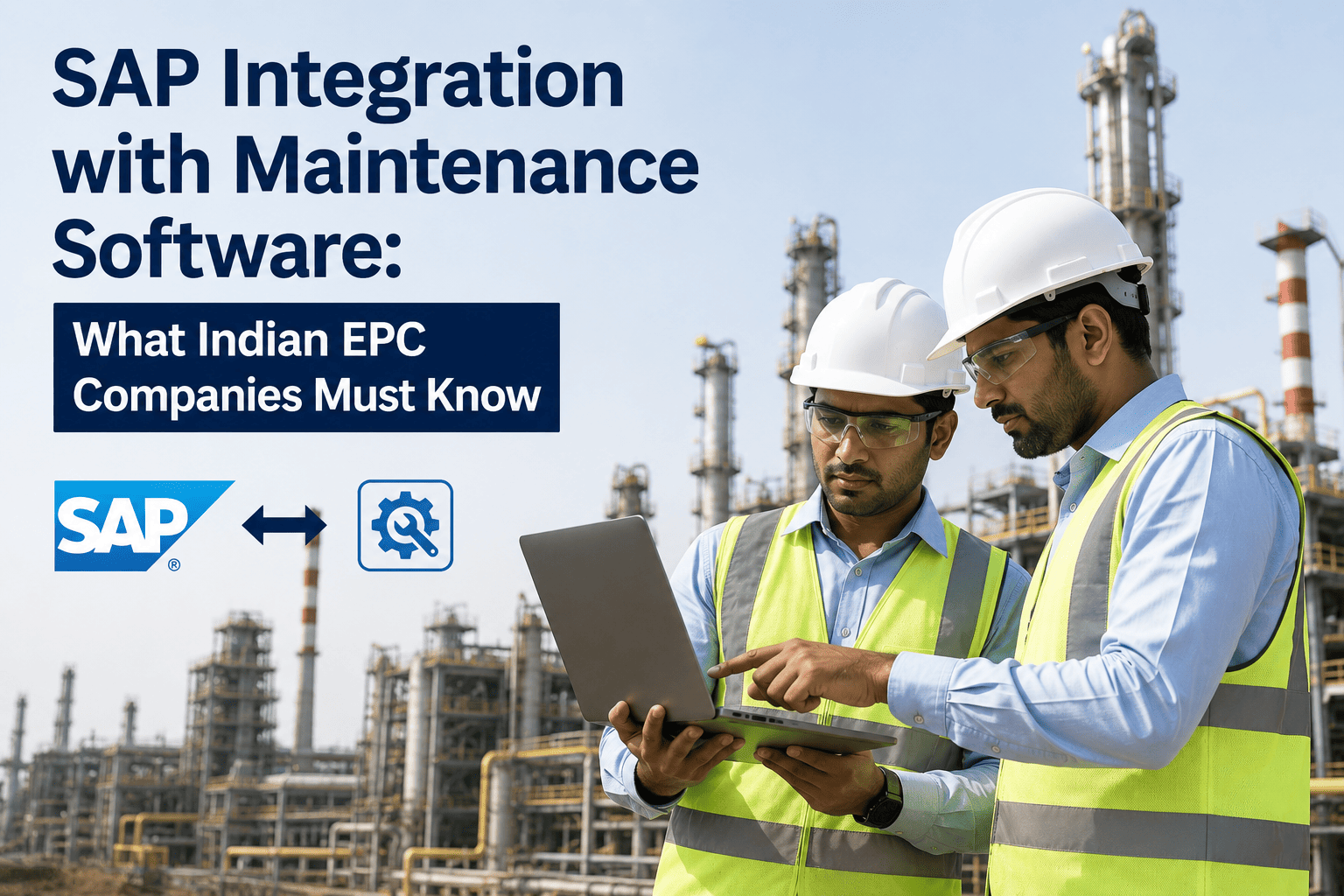
India's EPC sector — L&T, Dilip Buildcon, NCC, Afcons, IRB — runs on SAP. Purchase orders, asset depreciation, cost centre reporting, vendor payments: all of it lives in SAP ERP. But SAP was never built for the maintenance yard, the highway site at 2 AM, or the foreman who needs to raise a breakdown work order on his phone. The result is a gap that costs Indian EPC companies crores every year in duplicate data entry, missed PMs, and field teams working off records that are weeks out of sync with the ERP. This page explains exactly where that gap sits, what a SAP-integrated maintenance platform solves, and what L&T, Dilip Buildcon, and mid-size EPC contractors should evaluate before buying. If you are on SAP ECC, there is a 2027 deadline bearing down on you that makes this decision more urgent than it looks.
SAP Integration with Maintenance Software
What Indian EPC Companies Must Know Before the 2027 Deadline
The Core Problem: SAP Is Your Financial Spine, Not Your Field Brain
Most large Indian EPC companies treat SAP as the single source of truth — but only for finance. The moment you ask SAP PM to handle field-level maintenance execution, three problems appear that no SAP consultant will put in the proposal.
SAP PM Is Built for Planners, Not Technicians
SAP PM work orders require desktop access, transaction codes, and data entry skills your site mechanics do not have. On a highway bridge project in Rajasthan, the result is simple: the mechanic fixes the compactor, the foreman logs it on paper, the planner enters it into SAP three days later with missing fault codes. The maintenance history in SAP is 72 hours stale by design.
Mobile Access on Site Is an Afterthought
SAP Fiori improved mobile UX but requires a licensed SAP infrastructure that most Indian EPC project sites — especially remote highway or bridge sites — cannot consistently support. Offline-first field execution, photo capture with GPS tagging, and QR-based asset scans are not native to SAP PM without expensive add-ons.
Duplicate Entry Is the Hidden Tax
When SAP and your field maintenance system run disconnected, every work order exists twice: once in the field log, once in SAP. Every spare part consumption is entered twice. Every PM completion is manually reconciled. Aberdeen Research data shows mid-market manufacturers lose 3+ hours per planner per day to this reconciliation — a cost that is invisible in P&L but very visible in project delivery delays.
How SAP Integration with a Maintenance Platform Actually Works
Integration is not a switch you flip. It is a data flow architecture with four distinct sync points. Understanding these tells you exactly what to ask any vendor — including HVI.
Asset Master Sync
Equipment IDs, functional locations, and asset hierarchies created in SAP flow automatically into the CMMS. Technicians work on the correct asset record — no mismatched equipment numbers.
Work Order Writeback
Field technicians close work orders in HVI on their phone. Labour hours, fault codes, and spare part consumption automatically post back to SAP PM — no re-entry, no lag.
Inventory and Parts Sync
When a part is consumed in HVI, the SAP MM inventory is decremented in near real time. Reorder triggers fire from SAP. No more manual stock count reconciliation at month end.
Cost Centre Posting
Labour costs, parts costs, and contractor charges captured in HVI post to the correct SAP cost centre automatically. Finance gets accurate maintenance cost data without waiting for month-end reconciliation.
HVI connects with SAP at all four sync points — out of the box
Pre-built SAP PM, MM, and FI/CO connectors. No 6-month integration project. No custom ABAP. Get your field teams on mobile work orders within weeks, not quarters.
SAP ECC End of Life 2027 — The Deadline Every Indian EPC CIO Must Map
Last Window to Plan
S/4HANA migrations take 18–36 months. Companies starting after mid-2026 face near-impossible timelines before December 2027 support cutoff. SAP consultant demand is already rising — day rates will surge as deadline approaches.
SAP ECC Mainstream Support Ends
No more security patches, compliance updates, or bug fixes from SAP. Companies still on ECC face cybersecurity risk, regulatory compliance gaps, and rising custom support costs through third-party providers.
Extended Maintenance (Paid)
SAP offers extended maintenance for ECC until 2030 — at an additional cost on top of standard fees. Third-party support providers like Rimini Street offer alternatives. Neither option is a permanent solution.
Three Integration Architectures — Which One Fits Your EPC Setup
Not all SAP maintenance integrations are the same. Large Indian EPC companies typically fall into one of three architecture patterns, each with different cost, complexity, and risk profiles.
SAP Add-On (Extend SAP PM)
- 100% of users have SAP licences
- Stable network at all sites
- Dedicated SAP support team
- Remote sites with poor connectivity
- Field technicians need offline access
- SAP licences cost too much per field user
Bidirectional API Integration (Recommended)
- Field teams need mobile-first tools
- Mixed connectivity (online + offline)
- EPC spans multiple project sites
- API credentials from SAP BASIS
- Data mapping for equipment IDs
- One-time integration setup (4–8 weeks)
File-Based / Scheduled Sync
- Real-time sync is not critical
- IT resources are limited
- As a transitional approach
- Breakdown maintenance requires instant cost posting
- Inventory accuracy is business-critical
- Audit trails require timestamped records
What Indian EPC Field Maintenance Needs That SAP Cannot Deliver Alone
| Field Requirement | SAP PM Alone | HVI + SAP Integration |
|---|---|---|
| Raise work order on mobile at remote highway site | Requires SAP Fiori + live connectivity | Offline-capable mobile app, syncs when connected |
| Capture photo proof of breakdown with GPS tag | Not native to SAP PM | Built-in photo + GPS capture per work order |
| QR code scan to pull up equipment history | Not available without add-on | Native QR asset scan in HVI field app |
| PM checklist with digital sign-off by engineer | Manual form, scanned PDF at best | Digital checklist, timestamp, engineer sign-off |
| Cost auto-posted to SAP cost centre on WO close | Native to SAP PM | Automatic writeback via API integration |
| Real-time asset availability dashboard for site manager | SAP reports require planner to run manually | Live dashboard, accessible on mobile |
| Multi-site PM compliance report for head office | Complex SAP query, usually Excel-based | Automated cross-site report, schedulable |
| S/4HANA compatibility for post-2027 migration | Native — it is SAP | HVI supports both ECC and S/4HANA connectors |
Your SAP Keeps the Books. HVI Keeps the Equipment Running.
Indian EPC companies using HVI get SAP-connected field execution without SAP licence costs for every technician. Work orders, PM schedules, breakdown history, and cost postings — all flowing bidirectionally between site and SAP in real time.