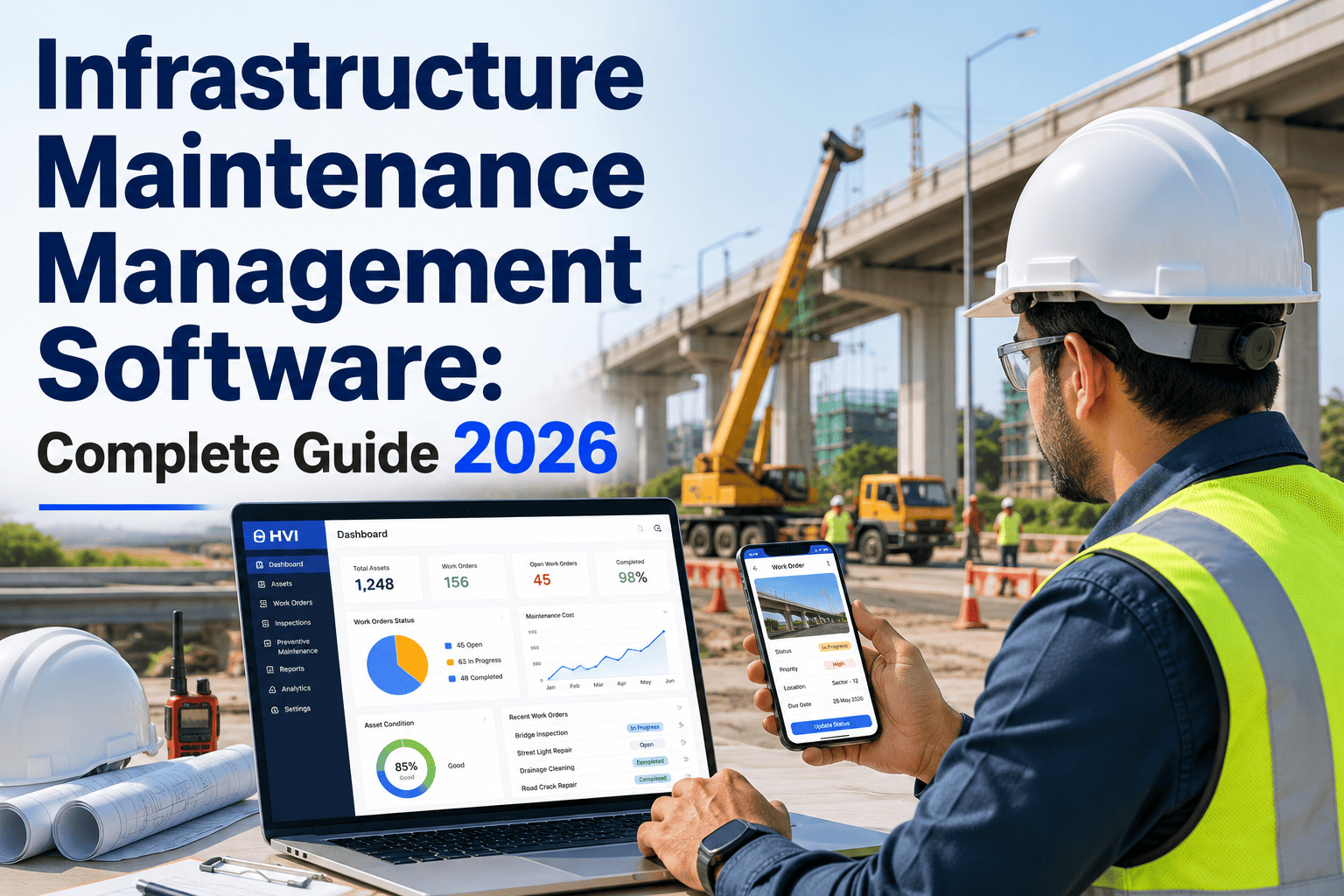
India's EPC sector is in the middle of a quiet but irreversible shift. The site diary, the pre-shift inspection register, the daily progress report — all of it is moving off paper and onto mobile devices. The companies leading this shift are not doing it for compliance optics. They are doing it because paper-based field operations cost them money, delay decisions, and expose them to audits they cannot survive. This guide breaks down exactly how India's top EPC companies are going paperless, which field workflows are being digitised first, and what it means for equipment operations, maintenance records, and regulatory compliance. If you are still running any part of your infrastructure project on paper, this will show you what your competitors are already doing — and what you can start replacing today with HVI.
Digital Transformation — Infrastructure India 2026
How India's Top EPC Companies Are Going Paperless
Real workflows, real numbers, and a step-by-step implementation guide for infrastructure companies ready to eliminate paper from field operations.
Why Paper Is a Liability in Modern Infrastructure Projects
Every paper register on a construction or mining site is a liability. It can be lost, filled retroactively, misread, or simply not filled at all. When an NHAI auditor requests the last 90 days of equipment pre-shift inspection records, a stack of partly-legible site registers is not an answer. When a machine fails mid-shift and the equipment head needs to understand the maintenance history, paper offers nothing fast enough to matter.
Operators fill registers at the site office after the shift ends. The inspection that never happened gets documented as complete. This is not fraud — it is an inevitable outcome of a paper system with no timestamp enforcement.
A project manager in Delhi has no idea what the equipment status is at a site in Arunachal Pradesh until someone physically scans and emails a register — which usually means the next morning, or never.
When a machine breaks down, the paper inspection history tells you what an operator chose to write. A digital system tells you what was actually recorded, when, with a photo attached, GPS tagged, and a timestamp that cannot be altered.
DGMS inspections, NHAI maintenance audits, and third-party lender site visits can request inspection records with 24 hours notice. Paper archives from 6 months ago in a remote project site cannot be retrieved and organised that fast.
The 5 Field Workflows EPC Companies Are Digitising First
Not every company digitises everything at once. The most successful transitions start with the workflows that carry the highest risk or cost when paper fails. Here are the five areas where India's leading EPC companies are making the switch first, and why each one matters.
This is the highest-leverage workflow to digitise. Every excavator, dumper, paver, and crane must be inspected before it operates. On a paper system, this check takes 15 minutes and produces a register entry that no one reads until something goes wrong. On a mobile app, the same check takes 8 minutes, produces a timestamped record with GPS and photos, and instantly flags any defect to the workshop supervisor. Companies switching to digital pre-shift inspection consistently report a 30 to 40 percent reduction in equipment breakdowns within the first three months.
Paper-based PM schedules are calendar-driven: every 250 hours, every month, every quarter. Digital PM systems are usage-driven and defect-triggered. When an operator flags a hydraulic warning during inspection, a PM work order generates automatically, assigned to the workshop, with the photo evidence and machine history already attached. The maintenance team does not wait for a manager to read the paper form and manually create a job card.
Fuel is the second-largest cost after labour on most infrastructure sites. Paper fuel issue registers are easily manipulated and impossible to cross-check in real time. Digital fuel issue logging — linked to machine IDs, operator IDs, and hour meter readings — creates an immediate reconciliation trail. Companies implementing digital fuel tracking report shrinkage reduction of 12 to 18 percent in the first quarter.
Site PMs and regional equipment heads need to know how many machines are available versus down versus under repair at 7 AM. A digital system aggregates this automatically from the previous shift's inspection data and maintenance logs. A paper system requires a site executive to compile records from multiple registers and make phone calls — a process that takes 45 minutes and is often inaccurate.
NHAI, DGMS, and state PWD inspection requirements mandate documented pre-shift inspection records for specific equipment categories. Digital records with GPS, timestamp, and operator sign-off satisfy these requirements in a format that can be produced in seconds during an audit — compared to a paper archive search that can take hours and still produce incomplete results.
See How Digital Inspection Works — Live
HVI digitises pre-shift inspection, defect tracking, and maintenance records for equipment fleets across highway, mining, and infrastructure projects. No paper. No retroactive filing. No audit risk.
Paper vs Digital: A Side-by-Side Comparison
The difference between paper and digital field operations is not just convenience. It is a fundamental difference in data quality, response speed, and risk exposure. Here is how the two approaches compare across the workflows that matter most on an active infrastructure project site.
| Workflow | Paper System | Digital System |
|---|---|---|
| Pre-shift inspection | Register filled at machine; no timestamp enforcement; photos impossible | Mobile checklist with GPS, photo, and locked timestamp; auto-syncs to dashboard |
| Defect reporting | Handwritten note passed to foreman; may sit for hours before action | Instant work order raised from inspection app; workshop notified in real time |
| Maintenance history | Stored in site diary; often incomplete; lost if register is misplaced | Full searchable history per machine ID; accessible from any browser |
| Fuel tracking | Issue register; no real-time reconciliation; manipulation risk high | Digital issue log linked to machine and operator; daily reconciliation automated |
| Audit readiness | Stack of registers to search; incomplete for older periods | Full record retrievable by machine, date, or operator in under 60 seconds |
| Manager visibility | Morning call to site executive; information is 12+ hours stale | Live dashboard; inspection results visible within minutes of sync |
| Remote site operation | Paper works anywhere; but records cannot reach HQ without physical transfer | Offline-first mobile app works without network; syncs automatically on reconnect |
The ROI of Going Paperless: Real Numbers from Infrastructure Projects
The case for digital transformation in infrastructure is not theoretical. The cost of paper-based operations is real and measurable. Here is what the numbers look like across the key cost centres on a typical mid-size infrastructure project with 40 to 80 machines.
Defects caught and actioned faster due to real-time inspection data and auto-generated work orders
Digital issue logging with machine-hour reconciliation eliminates the grey zone in fuel accountability
All records searchable by machine, operator, date, and defect type — exportable to PDF in seconds
Timestamped mobile submissions eliminate retroactive filling — every record proves it happened at the machine
Step-by-Step: How EPC Companies Are Implementing Digital Field Operations
The companies that successfully go paperless do not flip a switch. They follow a structured implementation sequence that starts with one high-value workflow, builds operator confidence, then expands. Here is the approach that works consistently across Indian infrastructure and mining projects.
List every paper register, form, and report used in field operations. Classify each by frequency, risk level, and how often the records are actually used after filling. This gives you a prioritised list of what to digitise first. Most companies find that pre-shift inspection and fuel registers are the top two by both frequency and risk.
Choose your most active site with a fleet of 15 to 30 machines. Deploy digital pre-shift inspection for 30 days alongside the paper register — not replacing it yet. Compare compliance rates, defect detection rates, and manager response times. The data from this pilot makes the internal case for full rollout without needing to ask anyone to take it on faith.
Do not train operators in a classroom. Walk to the machine with them, hand them the phone, and run the checklist together at the equipment. Most operators on Indian infrastructure sites are comfortable with smartphones for WhatsApp but unfamiliar with structured data entry apps. Two or three training sessions at the machine is all it takes for most operators to reach full competence.
Once your pilot shows stable digital compliance rates above 85 percent, remove the paper register from that workflow entirely. The dual system is a crutch that operators will always default to if paper remains available. The fastest implementations pull the paper register the moment the digital system proves itself — not six months later.
With pre-shift inspection running digitally and operators trained, add the next workflow — typically preventive maintenance scheduling or fuel issue tracking. Then expand the same process to your other sites, using operators from the pilot site as peer trainers. This peer-to-peer model consistently outperforms vendor-led training in rural and remote site contexts.
Common Objections — And What the Data Shows
Every EPC company considering digital transformation encounters the same set of internal objections. Here is what the objections look like, and what the evidence from actual implementations shows in response.
Frequently Asked Questions
What does digital transformation in infrastructure actually mean for a project site?
It means replacing paper-based field records — inspection registers, maintenance logs, fuel issue forms — with mobile apps that capture the same data digitally, with GPS, timestamps, and photos attached. The records sync to a cloud dashboard accessible to managers anywhere. It does not require major IT infrastructure or expensive hardware — a basic Android smartphone and an app like HVI is the complete setup.
Which field workflow should an EPC company digitise first?
Pre-shift equipment inspection delivers the fastest return. It is the highest-frequency field documentation task, directly linked to breakdown prevention, and the one that carries the most regulatory risk if records are incomplete. Companies switching pre-shift inspection to digital first consistently see equipment downtime reduction within 60 to 90 days of rollout.
How does digital inspection software work on remote sites without internet?
Offline-first apps like HVI store all checklists, machine data, and records locally on the device. Operators complete full inspections with photo capture and GPS tagging without any network connection. The moment any connection is available — even briefly — all queued records sync automatically to the cloud dashboard without any action from the operator.
Does digital inspection data satisfy NHAI and DGMS compliance requirements?
Yes, provided the system captures the required elements. HVI records include operator identity, machine number, GPS location, inspection timestamp, all checklist responses, and photo evidence. After sync, these generate PDF reports meeting NHAI maintenance compliance standards and DGMS pre-shift inspection documentation requirements under the Mines Act 1952.
How long does it take to deploy digital inspection across a fleet of 50 machines?
With a structured rollout — device setup, operator training at the machine, and a 2-week pilot alongside paper — most EPC companies complete full deployment across a 50-machine fleet within 30 days. Book a demo with HVI and we will walk through a site-specific deployment timeline for your project.
Your Competitors Are Already Making This Shift
HVI is built specifically for heavy equipment fleets on Indian infrastructure and mining sites. Offline-first, works on basic Android phones, and active from your first login. Start your free trial today — no credit card, no hardware, and your first inspection is ready in under 10 minutes.