Infrastructure equipment management is undergoing its most significant transformation in decades. Across Indian highway corridors, metro construction sites, mining zones, and tunnelling projects, the tools that keep fleets running have moved from paper registers and radio calls to AI-driven platforms that predict failures before they happen. Sign up free on HVI to see how these trends already work on your fleet, or book a 30-minute walkthrough with the team.
Why 2026 Is the Turning Point for Indian Infrastructure Teams
For years, infrastructure fleet management in India meant paper inspection forms collected at shift end, WhatsApp photos for breakdown alerts, and spreadsheets submitted days after the fact. That window is closing. NHAI packages now demand digital records. EPC companies running SAP face mounting pressure to eliminate manual re-entry. And with skilled technicians harder to retain, teams need systems that guide decisions — not just record them.
AI-Driven Predictive Maintenance
AI systems now predict equipment failures 30 to 90 days in advance with accuracy rates between 80% and 97%. Instead of scheduling a service every 250 engine hours regardless of condition, predictive models analyze vibration patterns, fuel consumption trends, and historical fault data to flag the specific machines that actually need attention. Infrastructure fleets using AI maintenance scheduling report 30% lower maintenance costs and a 25% extension in asset service life.
IoT Sensors and Real-Time Equipment Monitoring
Wireless IoT sensors — vibration accelerometers, temperature monitors, and engine diagnostic readers — now attach to excavators, compactors, and motor graders in under an hour. They stream condition data continuously so the first sign of a bearing fault or oil temperature spike reaches a maintenance planner's dashboard before the operator notices anything wrong. Municipalities and infrastructure operators using IoT monitoring report 50% reductions in unplanned downtime as a direct result.
Mobile-First Inspection Platforms Replacing Paper
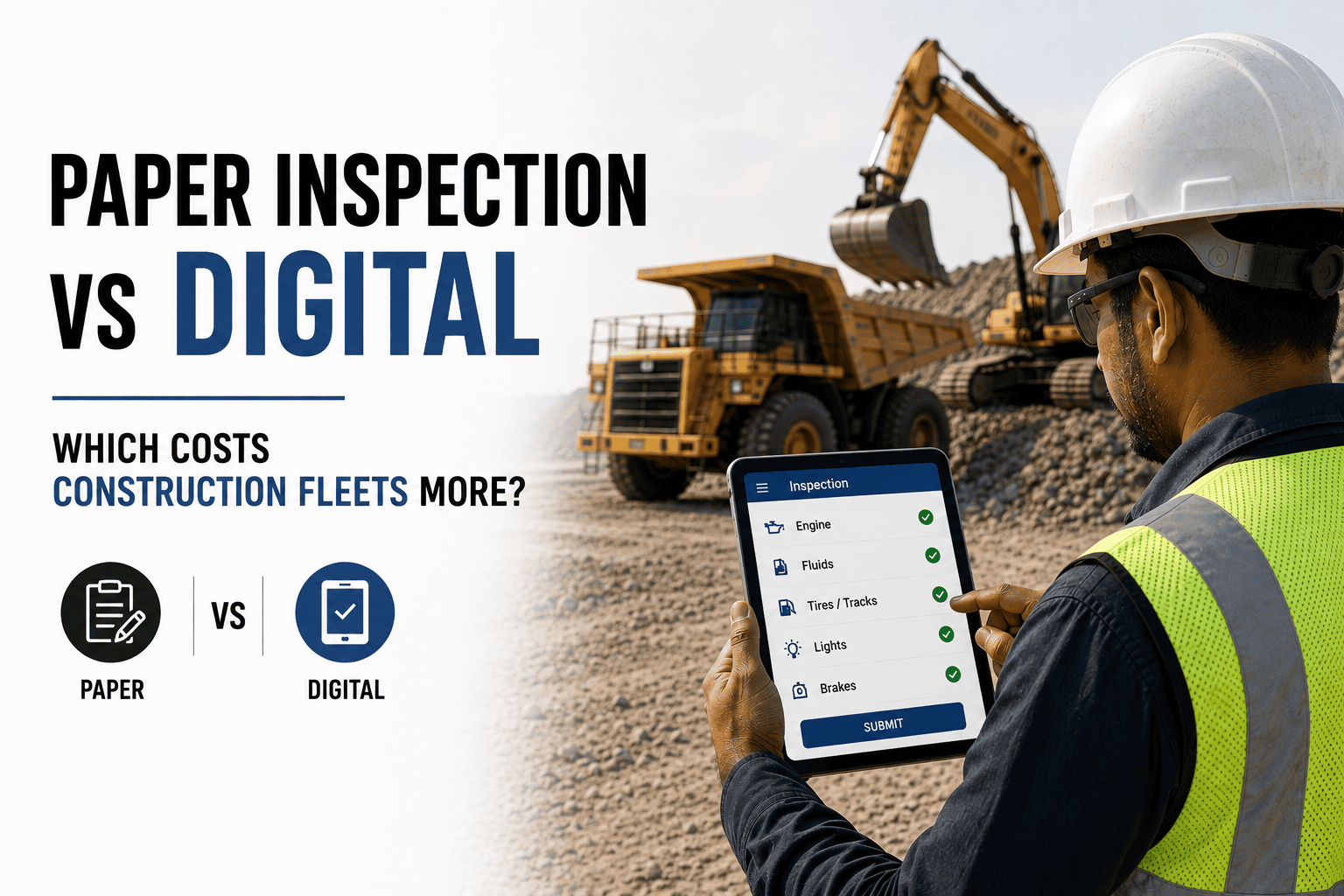
Paper checklists and end-of-day logbooks have a fatal flaw — by the time a defect is recorded on paper and reaches a planner, the machine has often run another full shift on a developing fault. Mobile inspection apps with photo capture, GPS stamping, and instant work order creation cut defect-to-repair cycle time from days to under four hours. Fleet teams using mobile inspection platforms report up to 85% reduction in inspection reporting time and reach 99% audit readiness as a baseline — not a target.
Prescriptive Maintenance — Beyond Just Knowing What Will Fail
Predictive maintenance tells you a motor will fail. Prescriptive maintenance — the frontier emerging in 2026 — tells you exactly what to do about it: reduce load by 15% for four hours, schedule the replacement during Sunday's planned downtime, and assign Technician A because she holds the hydraulics certification. The system doesn't just raise an alert — it builds the action plan. For highway and mining fleets managing hundreds of assets across multiple sites, this shifts maintenance management from reactive problem-solving to systematic forward planning.
Offline-First Architecture for Remote Sites
IoT and AI are only useful if field teams can actually use them. A highway package in Rajasthan or a tunnelling site in the Western Ghats does not have reliable 4G. The technology trend that often gets overlooked is offline-first design — platforms that capture full inspection data, work orders, and fuel logs on the device, queue them locally, and sync to enterprise systems the moment connectivity returns. Without this architecture, digital adoption stalls at remote sites regardless of how capable the central platform is.
Enterprise System Integration Without Middleware
Field operations and enterprise systems have always run in parallel, connected by data-entry clerks re-typing information between platforms. In 2026, direct API-based integration between mobile maintenance platforms and SAP PM, IBM Maximo, or similar enterprise asset management systems eliminates that gap. Work orders, parts consumption, fuel costs, and inspection records flow automatically from field to ERP in real time. The shift removes 14 to 22 hours per week of manual data re-entry and gives finance and planning teams live visibility instead of 24-hour-old spreadsheets.
HVI Is Built for Every Trend on This List
Mobile inspections, offline-first sync, AI maintenance scheduling, SAP integration, real-time dashboards — HVI brings all of it to Indian infrastructure fleets in one platform your field teams actually use. Connect a test fleet in under 30 minutes.
Where Indian Infrastructure Fleets Stand Right Now
Understanding a trend is one thing. Knowing how far your own operation is from adopting it is another. Here is an honest map of where most Indian EPC, highway, metro, and mining fleets sit today — and what the gap looks like.
| Technology Area | Industry Standard 2026 | Typical Indian Fleet Today | Gap |
|---|---|---|---|
| Inspection recording | Mobile app with photo, GPS, auto work order | Paper checklist or WhatsApp photo | High |
| Work order management | Digital, real-time, linked to asset history | Register book or Excel file | High |
| Maintenance scheduling | Condition-based, AI-assisted | Calendar-based or breakdown-triggered | High |
| ERP / SAP integration | Real-time bidirectional sync | Manual re-entry by back-office clerks | High |
| Compliance documentation | Automatic, audit-ready at any moment | Compiled manually before each audit | Medium-High |
| Multi-site visibility | Live dashboard across all sites | Weekly report emails from site engineers | Medium-High |
What the Transition Actually Looks Like — Three Infrastructure Verticals
From Breakdown Calls to Predicted Maintenance Windows
A highway package running 120 pieces of equipment — compactors, motor graders, paving machines, tankers — spends an average of eight unplanned breakdown days per machine per year on calendar-based maintenance. Shifting to mobile inspection with condition tracking cuts that to under two days by catching developing faults at the daily check before they become roadside breakdowns. SAP integration means work orders raise and close in real time, not 24 hours later when a clerk processes the paper forms.
Equipment Hours That Were Invisible Are Now Tracked
Open-cast mining operations in Jharkhand and Odisha run haul trucks and excavators in shifts that cross midnight — meaning paper logs from two drivers get combined, mis-attributed, or lost entirely. Mobile shift-handover captures each operator's usage separately, GPS-stamps the location, and posts fuel consumption to SAP MM automatically. Fleet managers see real utilization data for the first time instead of approximations from logbooks.
Compliance That Doesn't Require a Separate Preparation Sprint
Metro construction projects face regular equipment fitness inspections from client project management consultants and statutory inspectors. Teams that rely on paper records spend two to three days compiling inspection histories before each visit. Platforms that auto-generate photo-tagged, GPS-stamped inspection records eliminate that preparation entirely — the audit package is available in under 60 seconds at any point in the project lifecycle.
Frequently Asked Questions
How is AI predictive maintenance different from preventive maintenance schedules? ▼
Do IoT sensors work on older construction equipment that isn't digitally connected from the factory? ▼
What is the realistic timeline for an Indian EPC company to go from paper-based to digitally managed fleet operations? ▼
How do these technologies handle the connectivity gaps on remote Indian project sites? ▼
Which trend should an infrastructure fleet manager prioritize first? ▼
Every 2026 Infrastructure Technology Trend — Already Built Into HVI
Indian EPC, highway, tunnelling, mining, and metro fleets use HVI as their daily inspection and maintenance platform. From operator inspections in Hindi to real-time SAP postings in English — the complete technology stack your fleet needs is one sign-up away.
Trusted by highway, mining, metro, tunnelling and EPC fleets across India