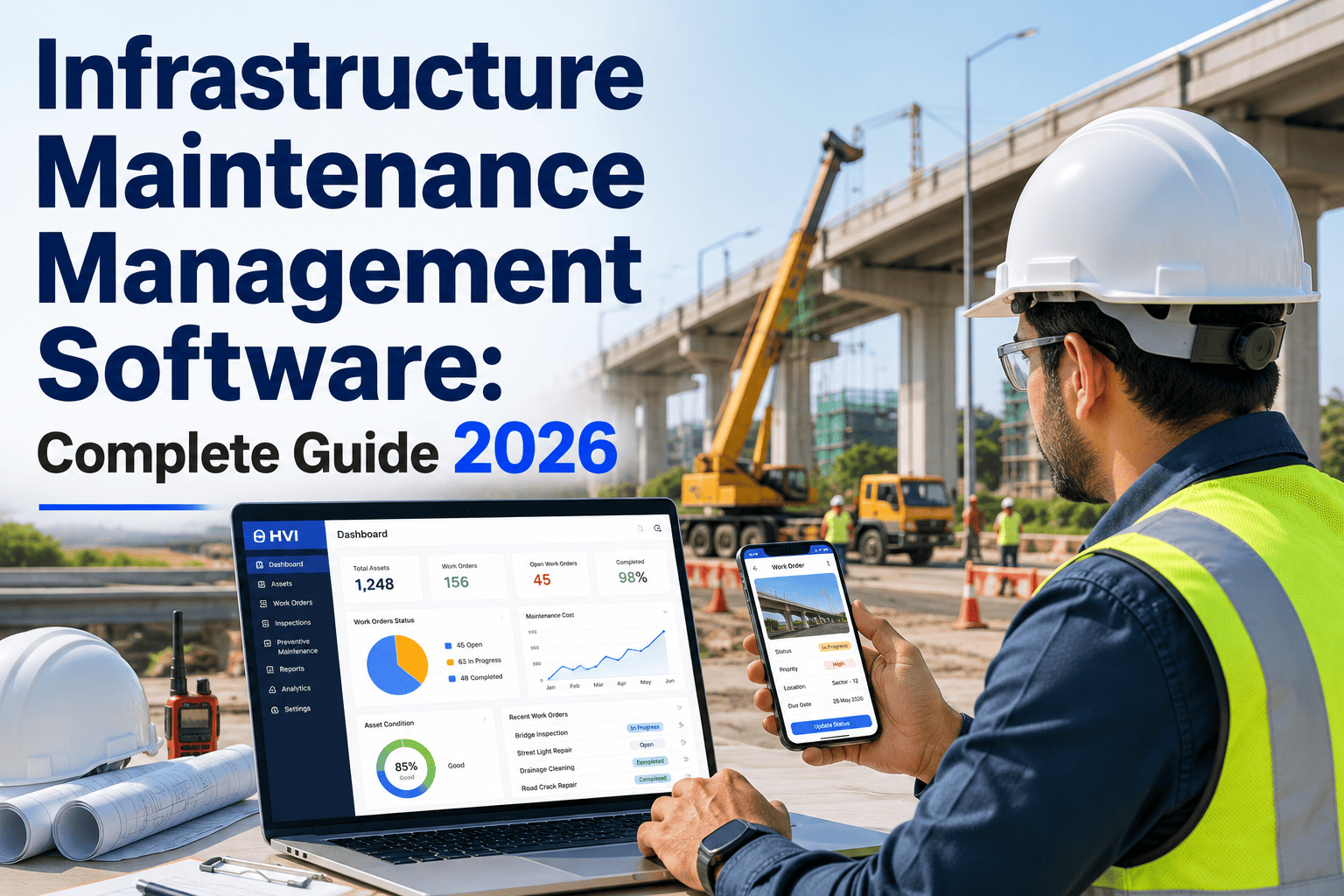
Infrastructure maintenance management software has become the operational backbone of EPC contractors, highway O&M concessionaires, and industrial plant operators across India. Where spreadsheets and paper registers once tracked work orders and equipment health, modern platforms now coordinate field teams, automate preventive maintenance schedules, and surface real-time KPIs that project owners and compliance authorities increasingly require. In 2026, the question is no longer whether to adopt maintenance management software — it is which platform fits your operation, what implementation looks like in practice, and what return you should realistically expect. This guide covers features, costs, implementation, and measurable ROI based on how leading infrastructure organisations are deploying these platforms today. Start your free HVI trial and experience purpose-built infrastructure maintenance management without any setup cost.
Infrastructure Maintenance Management Software: Complete Guide 2026
Features, implementation, pricing, and ROI — everything EPC companies, O&M concessionaires, and plant operators need to evaluate and deploy maintenance management software in 2026.
What Is Infrastructure Maintenance Management Software?
Infrastructure maintenance management software — often called a CMMS (Computerised Maintenance Management System) or asset management platform — is a purpose-built digital system for planning, executing, tracking, and reporting maintenance activity across infrastructure assets and equipment. It replaces the combination of paper registers, Excel schedules, and WhatsApp coordination that most field operations still depend on.
- Paper work order registers and maintenance logs
- Excel-based PM schedules and reminder calendars
- WhatsApp groups for breakdown coordination
- Manual data entry into SAP or ERP after the fact
- Monthly report compilation from scattered spreadsheets
- Digital work orders sent to technician phones in real time
- Automated PM scheduling with overdue alerts
- Live breakdown management with response time tracking
- Compliance records generated automatically from field data
- KPI dashboards available to managers and project owners
8 Core Features to Evaluate in 2026
Not all CMMS platforms are built for infrastructure. Many were designed for manufacturing plant rooms or facility management and lack the field conditions, compliance requirements, and asset types that EPC and O&M operations face. These eight features separate infrastructure-ready platforms from generic maintenance software:
Infrastructure sites — highway packages, remote quarries, tunnel portals — frequently have no internet connectivity. Your CMMS must allow technicians to complete work orders, inspection checklists, and defect reports entirely offline, with automatic sync the moment connectivity is restored. A platform that requires constant internet access is operationally unusable on most Indian infrastructure sites. Offline-first is not optional; it is the minimum baseline for field deployment.
A pre-shift inspection checklist for a 150-tonne dumper is categorically different from one for a road milling machine or a diesel genset. The platform must allow you to build and assign inspection templates to specific equipment types, enforce mandatory fields, and capture photo evidence against individual checklist items. Static, one-size-fits-all checklists produce incomplete records that fail DGMS or NHAI audits.
The system must schedule PMs by calendar interval, meter reading (hours, kilometres), or a combination — automatically trigger work orders when intervals are reached — and track completion rates against the plan. PM schedule adherence is one of the most scrutinised metrics in infrastructure O&M contracts, and project owners increasingly demand monthly PM adherence reports as a contract deliverable.
When equipment fails, the clock starts immediately. Your platform must capture the fault report timestamp, assign the work order to the right team, track dispatch time, and record restoration time — automatically measuring actual response against the SLA defined in your O&M contract. SLA breach visibility must be live, not reconstructed from paper records three days after the breakdown.
Every part consumed in the field should decrement inventory automatically. Reorder points should trigger restocking alerts before stockouts occur. Parts consumption linked to specific work orders gives you a true cost-per-job view that generic ERP systems — which record parts consumption at month end — cannot provide. For remote sites, accurate inventory reduces emergency procurement costs significantly.
The platform must generate compliance reports for NHAI, DGMS, ISO 55001, and contract O&M requirements directly from field execution data. Reports should be filterable by date range, equipment, operator, and site — and exportable in PDF or Excel format suitable for submission without further formatting. If generating a compliance report requires manual data assembly, the platform has not solved the compliance problem.
Large infrastructure organisations run SAP PM or other ERP systems for financial and asset management. The maintenance platform must integrate bidirectionally with SAP — pushing work order confirmations, parts consumption, and labour hours back to SAP PM and MM without manual re-entry. Organisations that run the maintenance platform as a data island create a secondary reconciliation problem that costs more than the platform saves.
EPC organisations and O&M concessionaires typically manage multiple packages, sites, or sub-contractors simultaneously. The platform must allow hierarchical visibility — site manager sees their site, regional manager sees all sites, project owner sees the contracted KPIs — without requiring separate logins or data exports for each level. Role-based access across sites is the architecture that enables multi-site operations without privacy or data security concerns.
HVI Has Every Feature on This List — Built for EPC and O&M Operations in India
Offline-first, configurable checklists, SAP integration, DGMS and NHAI compliance reporting — all in a platform your field teams will actually use from day one.
Infrastructure CMMS Pricing — What to Expect in 2026
Pricing for infrastructure maintenance management software varies widely based on deployment model, user count, and the number of assets managed. The table below summarises typical pricing structures to help you build a business case and budget evaluation.
| Pricing Model | Typical Range | Best For | Watch Out For |
|---|---|---|---|
| Per User / Month (SaaS) | ₹800 – ₹3,500 per user/month | Small to mid-size operations with defined user count; predictable monthly cost | Costs scale steeply with field technician headcount across multiple sites |
| Per Asset / Month | ₹200 – ₹900 per asset/month | Asset-intensive operations where user count is variable; mining and fleet operations | Asset counts can be disputed — ensure asset definition is clear in contract |
| Enterprise Licence (Annual) | ₹8L – ₹60L per year | Large multi-site operations needing unlimited users and assets; predictable annual budget | High upfront commitment; ensure trial and pilot period before annual commitment |
| Free Tier / Freemium | Free to start; upgrade for advanced features | Evaluation and small operations; low-risk entry for organisations new to CMMS | Free tiers typically limit assets, users, or compliance reporting — verify before depending on it |
Implementation: How to Go Live Without Disrupting Operations
Load your equipment register into the platform — equipment IDs, asset categories, site assignment, and current meter readings. For most infrastructure operations, this is the most time-consuming step and the most important: equipment records that are incomplete or duplicated in the platform produce the same gaps they produced on paper. Allocate dedicated time from your site admin or plant controller for this phase.
Build inspection checklists for each equipment type, configure PM schedules against your existing maintenance plan, and set up work order categories that match your O&M contract structure. Platforms like HVI provide template libraries for common infrastructure equipment types that you can adapt rather than building from scratch — significantly reducing configuration time.
Technicians need to learn one thing: how to use the mobile app for their daily tasks. Keep training focused on the five daily actions — receiving a work order, completing an inspection, logging a breakdown, consuming a part, and closing a job. One hour of hands-on training is typically sufficient for technicians who use smartphones regularly. Do not train field staff on the web dashboard — that is for supervisors and managers.
Run the platform live on a single site, package, or equipment category first. This limits the blast radius of any configuration errors and builds confidence in the system before full deployment. During the pilot, run paper records in parallel for two to three weeks — not because the platform needs a backup, but to verify that the platform output matches the operational reality your team is executing on the ground.
After a successful pilot, expand to remaining sites. Establish your KPI baseline in the first full month — PM completion rate, MTTR, breakdown frequency, SLA adherence — so you have a documented starting point against which to measure improvement. Share the KPI dashboard with your project owner at the one-month mark: early visibility builds client confidence and demonstrates that your operation is under data-driven management.
ROI Framework — What Infrastructure Organisations Measure
Every hour of unplanned equipment downtime on an infrastructure project has a measurable cost — in day rates, in schedule impact, and in potential LD exposure. A 20–30% reduction in unplanned breakdowns from proactive PM management is the single largest ROI driver for most deployments.
When breakdowns occur without advance warning, spare parts are sourced at emergency rates — often 25–40% above standard procurement cost. Predictive and preventive maintenance reduces the frequency of emergency procurement events directly.
NHAI performance deductions, DGMS fines, and project owner liquidated damages for maintenance non-compliance can reach multiples of the annual software cost in a single audit cycle. Documenting that compliance reporting software prevented a single major penalty typically closes the business case for any mid-size operation.
Increasingly, project owners in NHAI, NTPC, and state PWD tenders are asking for evidence of digital maintenance management systems during pre-qualification. Having a deployed and operational CMMS with documented performance data is becoming a competitive differentiator in tender submissions.
Site administrators, equipment managers, and compliance officers typically spend 8–15 hours per week on manual data compilation, report preparation, and record keeping. Digital maintenance management platforms reduce this to near zero for routine tasks, freeing capacity for higher-value operational work.
Accurate real-time inventory data eliminates the overstock that most sites carry as a buffer against stockout risk. Infrastructure operations typically find 10–20% of their spare parts inventory value is redundant or obsolete when they digitise inventory management for the first time.
We were managing forty-two pieces of heavy equipment across three highway packages with a combination of Excel, WhatsApp, and paper registers at each site. Our PM compliance rate was around 60% — we were scheduling maintenance but had no visibility into whether it was actually happening. After deploying HVI, our PM completion rate reached 91% in the second month. Our NHAI performance review for the quarter showed zero maintenance-related non-conformances for the first time in the concession history. The platform paid for itself in the first quarter purely from the LD deductions we did not receive.
Frequently Asked Questions
The Infrastructure Maintenance Platform Built for How Your Sites Actually Work
HVI combines mobile-first field execution, automated compliance reporting, and real-time KPI dashboards in a single platform designed for EPC and O&M operations in India. No generic factory CMMS adapted for infrastructure — built for it from the ground up.