Every infrastructure site in India runs some version of safety management — toolbox talks, hazard identification sheets, PPE checklists, near-miss registers. Most of it happens on paper, gets filed in a site office cabinet, and becomes invisible to anyone above site level. The result is that safety data exists in fragments across 12 sites but never becomes the fleet-wide picture that actually prevents incidents. Safety management software closes that gap by turning every field safety activity into a live, searchable, actionable record that planners, site engineers, and HSE managers all see in one place. Sign up free on HVI to see how safety and inspection workflows connect on your fleet, or book a 30-minute demo with our team.
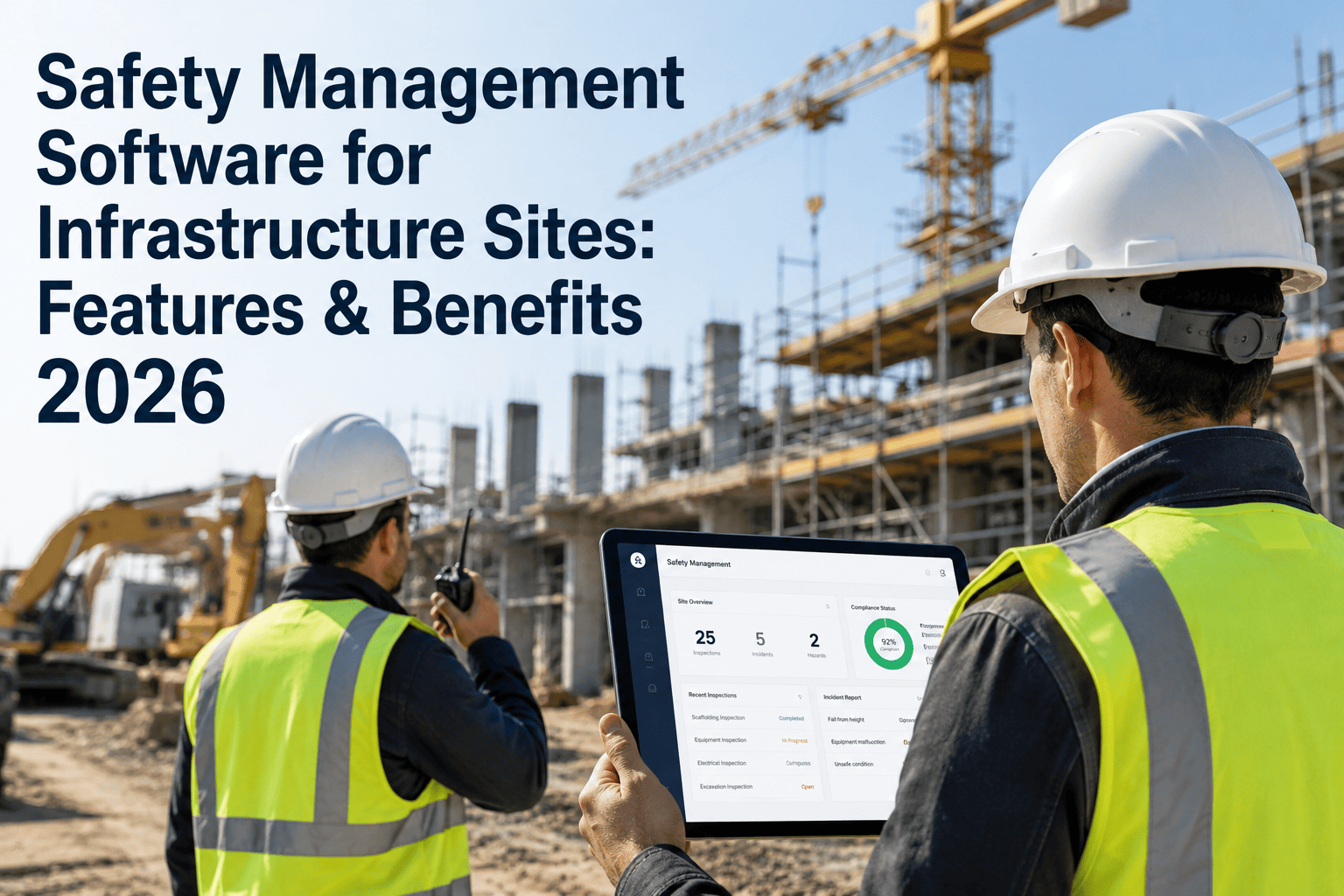
Safety Management Software for Infrastructure Sites: Features, Benefits & What to Look For in 2026
A complete guide for HSE managers, site engineers, and fleet heads at EPC, highway, mining, and metro construction companies evaluating digital safety platforms this year.
Why Paper-Based Safety Management Fails at Scale
A single project site with 30 workers and 12 machines can manage safety reasonably well on paper. An EPC company running 8 highway packages, 600 workers, and 200 pieces of equipment across 4 states cannot. The scale breaks paper systems in predictable ways — and the failures aren't random. Here is where the breakdown happens consistently.
Near-miss reports, PPE violations, unsafe act observations — all filed in a site binder. HSE managers at head office get a weekly summary email that is already 5 days old and missing 40% of incidents that weren't considered "serious enough" to report up the chain.
If the same hydraulic hose failure is causing near-misses on three different excavator models across two packages, paper-based reporting will never surface that pattern. Digital platforms with Pareto analysis flag cross-site equipment safety trends automatically.
Paper CAPA registers are opened after incidents but follow-up verification rarely happens. Digital safety platforms assign corrective actions to named individuals with deadlines, send reminders, and track closure — the unsafe condition actually gets fixed rather than just recorded.
When a NHAI safety audit or client PMC review arrives without advance notice, the preparation sprint begins. Pulling training records, PPE issue logs, inspection histories, and incident registers from paper across multiple site offices takes 2 to 3 days — for records that should be ready in seconds.
Core Features to Look For in Infrastructure Safety Management Software
Not all safety software is built for the conditions Indian infrastructure teams operate in. Here are the features that matter for highway, mining, metro, and tunnelling operations — and the questions to ask every vendor before committing.
Mobile-First, Offline-Capable Reporting
Field safety observations, near-miss reports, and toolbox talk records need to be captured where the hazard exists — not later at a desk. Offline capability is non-negotiable for remote highway stretches, tunnelling faces, and mining haul roads where 4G coverage is unreliable. Any platform that requires internet connectivity at the point of capture will see adoption collapse on your toughest sites.
Digital Inspection Checklists with Photo Capture
Safety inspections on infrastructure sites — daily equipment pre-trips, weekly site safety walks, monthly electrical and access audits — need to produce photo-tagged, GPS-stamped records that are legally defensible and instantly shareable. Checklist templates should be customizable to CMVR requirements, DGMS standards, and client-specific HSE frameworks without IT involvement.
Incident and Near-Miss Reporting with Escalation Workflows
The most valuable safety data is near-miss reports filed before an incident occurs. A platform that makes near-miss reporting fast (under 2 minutes on mobile), routes the report automatically to the right supervisor, and triggers a corrective action workflow dramatically increases reporting frequency. Indian infrastructure sites with digital near-miss reporting typically see a 3x increase in incident reports — because underreporting was the problem, not the safety culture.
Corrective Action and CAPA Tracking
Every safety observation, defect flag, or near-miss report should automatically generate a corrective action assigned to a named person with a due date. The platform should track status, send reminders, and flag overdue actions to the supervisor. Safety platforms without CAPA closure tracking create the illusion of compliance — issues are reported but unsafe conditions persist.
Cross-Site Safety Dashboard and KPI Tracking
HSE managers overseeing multiple packages need a dashboard that shows inspection compliance rates, open near-miss counts, overdue corrective actions, PPE violation trends, and safety scores by site — in one view, updated in real time. Without this, managing safety across 8 sites means 8 weekly email reports that are already days old and contain whatever the site engineer remembered to include.
Equipment Safety Integration — Defect-to-Repair Chain
Equipment defects are safety issues, not just maintenance issues. A brake fault reported on a pre-trip inspection is a safety event. The safety platform should link to the work order system so every equipment safety defect has a traceable repair chain — defect reported, work order raised, repair verified, equipment released. Without this link, equipment defects fall into a maintenance silo and disappear from the safety record entirely.
HVI Connects Equipment Safety to Maintenance in One Platform
Every defect your operator flags on a pre-trip inspection in HVI automatically raises a work order, triggers a repair workflow, and stays linked to the safety record — so your HSE manager and your maintenance planner are working from the same data. No separate systems. No data silos.
How Safety Software Reduces Incident Rates — The Mechanism
Safety management software does not reduce incidents by generating more reports. It reduces incidents by closing the loop between hazard identification and corrective action — faster and more reliably than any paper system can. Here is the mechanism in a live infrastructure site context.
Hazard Identified and Reported in the Field
An operator notices a hydraulic line showing early signs of chafing during his pre-trip check. He photographs it in HVI, marks it as a safety observation, and submits. Total time: 90 seconds. The report reaches his supervisor's dashboard immediately with GPS location and photo attached.
Corrective Action Assigned and Tracked
The platform automatically flags the observation as an equipment safety issue, raises a work order to the maintenance team, and sets a 4-hour resolution target. The supervisor receives a notification. The maintenance planner sees the job in the work order queue with the photo as context.
Repair Completed and Equipment Released
The technician replaces the hydraulic line, photographs the repaired section, and closes the work order in HVI. The equipment is marked safe-to-operate. The safety observation is closed with a repair timestamp. The full chain — hazard to repair — is documented and audit-ready.
Pattern Visible Across the Fleet
Over the following weeks, HVI's safety dashboard shows that the same hydraulic hose issue has been flagged on four excavators across two different sites. The HSE manager raises a fleet-wide inspection task for all excavators of that model. A potential incident involving multiple machines is caught from a single operator's 90-second report.
Safety Software Across Indian Infrastructure Verticals
NHAI HSE Compliance and Package-Level Safety Dashboards
Highway packages under NHAI concession agreements carry mandatory HSE reporting requirements — monthly safety statistics, incident registers, toolbox talk records, and equipment fitness documentation. Digital safety platforms generate all of these automatically from daily field activity. Site engineers stop compiling weekly reports manually and HSE managers get live package-level safety scores without waiting for site emails.
DGMS Compliance and Shift-Level Safety Records
Directorate General of Mines Safety regulations require detailed equipment inspection records, operator fitness assessments, and incident reporting in structured formats. Digital platforms aligned to DGMS requirements generate these records automatically from the shift inspection workflow — with the timestamp and photo evidence DGMS auditors now expect and paper records cannot provide.
Client HSE KPI Reporting and Subcontractor Safety Tracking
Metro and tunnelling contractors are often required to submit weekly and monthly HSE KPI reports to client project teams — incident frequency rates, near-miss counts, inspection completion percentages, open CAPA status. Digital platforms produce these reports in client-specified formats directly from field data, eliminating the compilation step that typically consumes 6 to 8 hours of an HSE manager's week.
Frequently Asked Questions
What is the difference between safety management software and a CMMS for infrastructure sites? ▼
How quickly can field operators learn to use digital safety reporting tools? ▼
Can safety management software integrate with SAP or other ERP systems used by Indian EPC companies? ▼
Does the software work on remote sites with poor or no internet connectivity? ▼
How does safety management software help during NHAI or DGMS audits? ▼
Safety That Lives in the Field — Not in a Filing Cabinet
Indian EPC, highway, mining, metro, and tunnelling teams use HVI as their daily inspection and maintenance platform. Every equipment defect, safety observation, and field inspection becomes an instant, photo-tagged, GPS-stamped digital record — visible to site engineers, HSE managers, and planners in real time, and ready for any audit in under 60 seconds.
Trusted by highway, mining, metro, tunnelling and EPC fleets across India