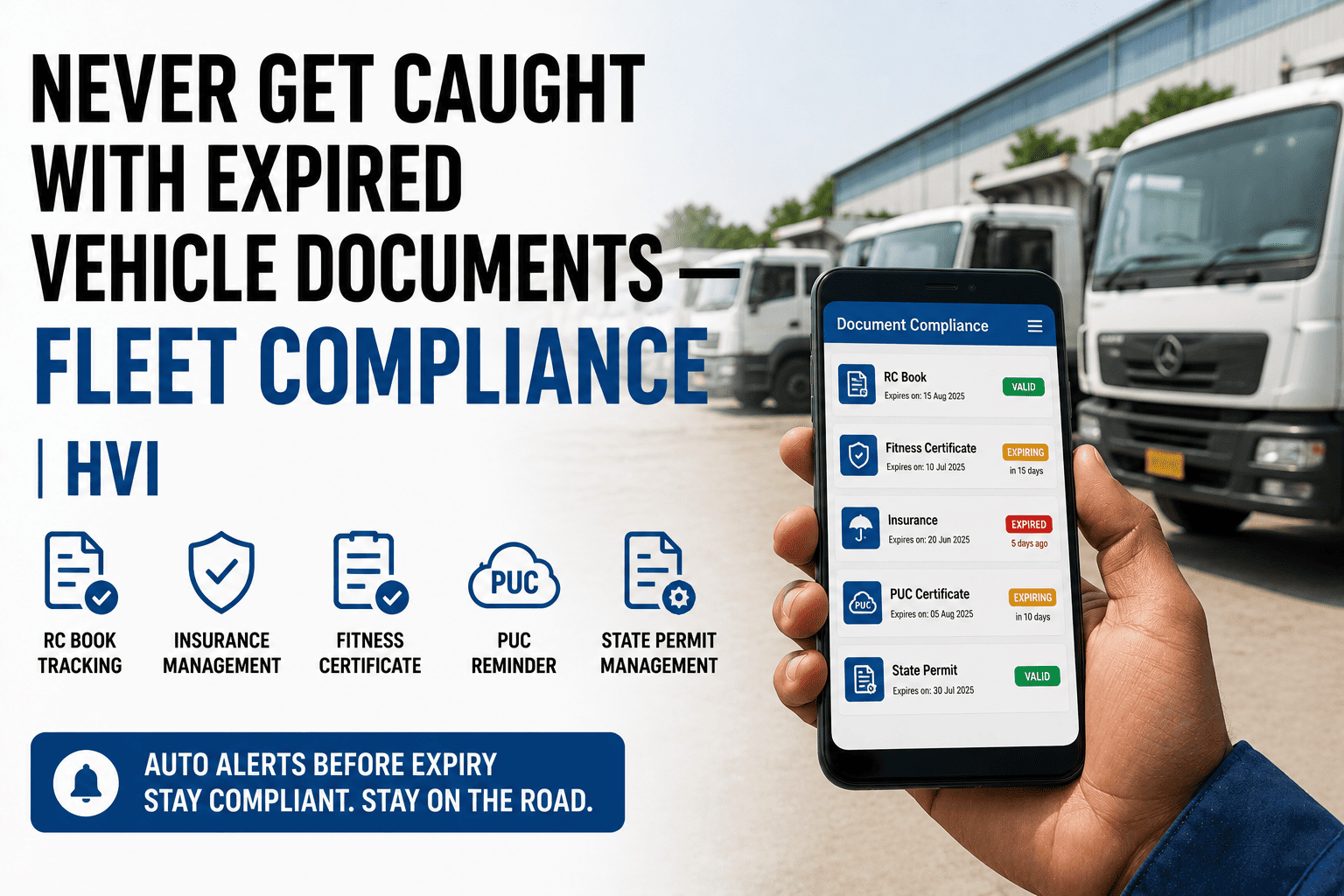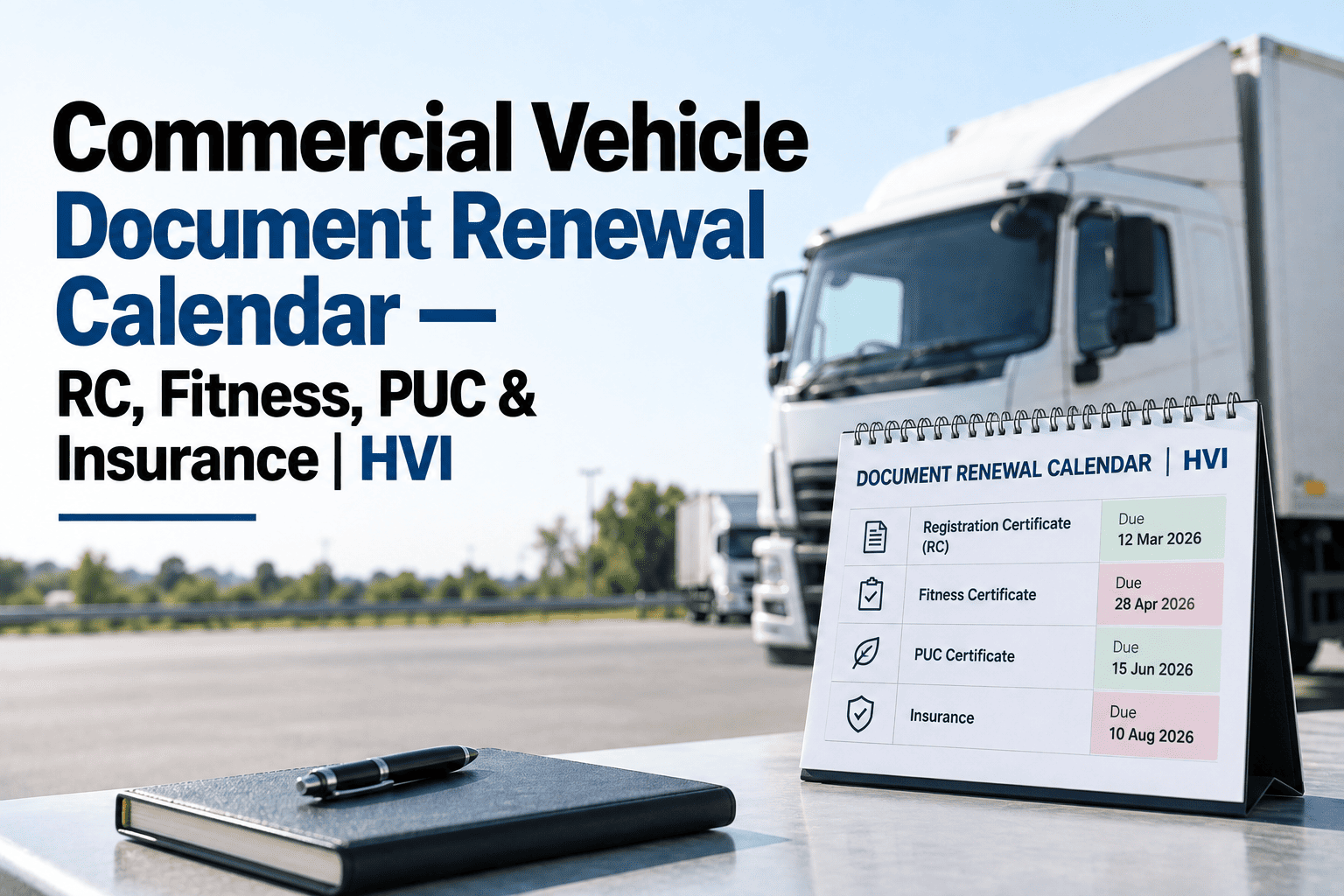
Four documents, four different renewal clocks, and not one of them runs on the same schedule as another. A fitness certificate for a commercial vehicle renews every year after its first two; PUC needs attention every six months once the first year passes; insurance runs annually; and the RC itself sits quietly for years before demanding a full renewal cycle. A fleet running fifty vehicles is effectively tracking two hundred separate expiry dates, each on its own clock, and a spreadsheet built once rarely survives the reality of staggered purchase dates and inconsistent renewal timing. This is the calendar those four clocks actually run on, and how HVI tracks every one of them automatically instead of leaving it to a spreadsheet nobody has time to maintain.
Commercial Vehicle Document Renewal Calendar
A structured annual renewal calendar for Indian commercial vehicle fleet managers — with typical validity periods, grace windows, and penalty thresholds for RC, fitness, PUC, and insurance.
The Four Clocks, Side by Side
| Document | Typical Validity | Renewal Cadence After Initial Period |
|---|---|---|
| Registration Certificate (RC) | 15 years for private vehicles from first registration | Renewable in 5-year blocks thereafter; commercial RC is effectively tied to fitness renewal |
| Fitness Certificate | 2 years for a new commercial vehicle | Annual renewal once the first 2-year period ends |
| PUC Certificate | 1 year for a new vehicle | Every 6 months once the first year passes |
| Insurance Policy | 1 year, standard commercial policy | Annual renewal, typically on the same date each year |
See every vehicle's four document clocks laid out together, instead of tracked separately across different systems.
What Happens at Each Deadline
RC Renewal
Requires Form 25, an updated fitness certificate, current insurance and PUC, and cleared road tax dues — start the process well ahead of expiry since it involves multiple linked documents.
Fitness Certificate Renewal
A physical RTO inspection covering roadworthiness — brakes, steering, lights, and general condition — with a rejection slip and grace period if the vehicle doesn't pass on the first attempt.
PUC Renewal
An emission test at an authorised centre, quick to complete but easy to let lapse given how frequently it recurs once the annual cycle shifts to six-monthly.
Insurance Renewal
A straightforward annual renewal, but the one most likely to be treated as routine — right up until a lapsed policy meets a claim.
Why a Spreadsheet Rarely Survives This
Four different cadences per vehicle
A vehicle's fitness, PUC, insurance, and RC dates rarely align, so a fleet of any size is tracking several unrelated countdown clocks per vehicle, not one.
Cadences change over a vehicle's life
PUC shifts from annual to six-monthly, and fitness shifts from a 2-year cycle to annual — a static spreadsheet built once doesn't account for these shifts as a vehicle ages.
Staggered purchase dates compound the problem
A fleet that buys vehicles throughout the year ends up with renewal dates scattered unevenly across the calendar, rather than one predictable renewal season.
Ownership of the tracking task drifts
Without a clear owner, updating the spreadsheet after each renewal becomes optional, and it quietly falls out of sync with reality within a few months.
Frequently Asked Questions
Why does PUC validity change from one year to six months?
The first PUC certificate issued with a new vehicle typically runs a full year, but every certificate after that follows a six-month cycle, which is the point where many fleets lose track since the rhythm changes partway through a vehicle's life.
Does the fitness certificate renewal cadence really change from 2 years to annual?
Yes — a new commercial vehicle's fitness certificate is valid for 2 years, but after that initial period, renewal typically becomes an annual requirement, so older vehicles in a fleet need closer tracking than newer ones.
Can RC renewal really be delayed by a lapsed fitness certificate?
Yes — RC renewal for a commercial vehicle typically requires a current fitness certificate as part of the submission, so a lapse in one document can hold up the other, which is why tracking them together rather than separately matters.
Does this integrate with our SAP, Oracle, or Tally fleet records?
Yes — document status and renewal records can sync with these systems, keeping compliance tracking connected to the same asset records your team already manages.
How would we build this calendar for our own fleet quickly?
Loading each vehicle's current document dates into a tracking system generates the full renewal calendar automatically, without needing to build and maintain it by hand; sign up free to build it for your fleet.
Four Clocks, Tracked as One
A fleet of any real size can't rely on a spreadsheet to track four separate renewal cadences that shift as each vehicle ages. Start free and see every vehicle's renewal calendar automatically, or bring your current tracking process to a 30-minute session with our India team.