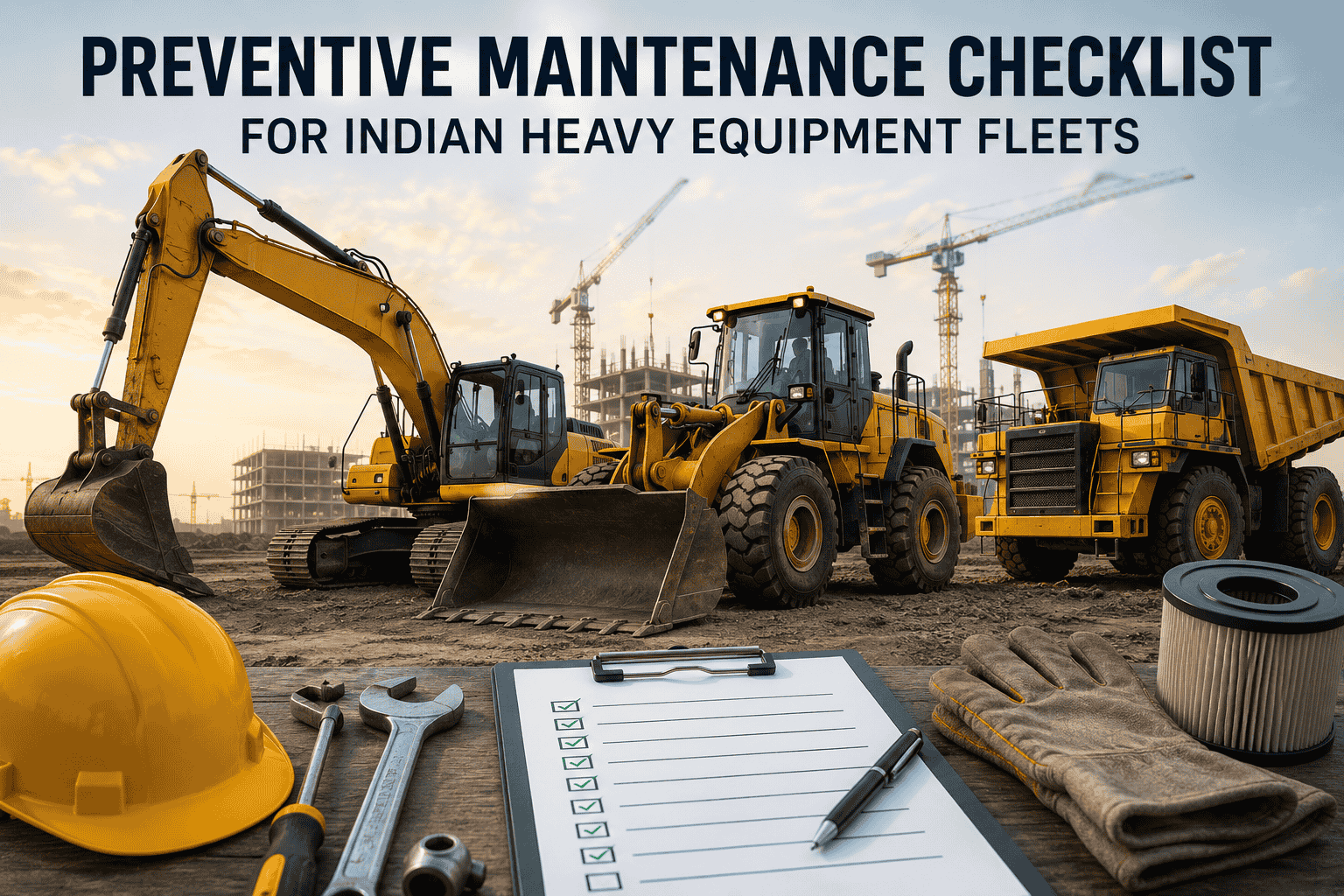
Daily Operator Checklist (POUC) for Indian Construction Machines
By Riley Quinn on June 3, 2026
Every morning on an Indian construction site — whether it's a Bharatmala highway stretch in Rajasthan, a metro rail project in Hyderabad, or a mining site in Jharkhand — hundreds of operators climb into their JCBs, Tata Hitachi excavators, tippers, and cranes without a single written check. No daily operator checklist. No POUC. Just start the engine and go. This habit costs Indian contractors ₹8–15 lakh per machine every year in avoidable breakdowns, according to industry estimates. The daily operator checklist (POUC — Pre-Operational Use Checklist) is the single most practical tool to stop that loss — and this guide shows you exactly what to check, why it matters and how Indian fleets are now doing it digitally on mobile.
Daily POUC Checklist · India · 2026
★ Check. Flag. Protect.
Daily Operator Checklist (POUC) for Indian Construction Machines
Excavators · JCB Backhoes · Tata Hitachi · Cranes · Tippers · Wheel Loaders — One checklist, every shift, every operator. Replace your paper logbook with photo-proof mobile inspections on HVI.
₹8–15L
Avg. annual loss per machine from skipped daily checks
72%
Breakdowns are preventable with daily pre-shift inspection
20 min
Time to complete a full POUC walk-around per machine
Why Indian Sites Skip the Daily Checklist — And What It Costs
The reality on most Indian construction sites is simple: operators are under pressure to start work fast. The site engineer wants production numbers. The contractor wants the machine running. So the daily operator checklist gets skipped — or filled after the fact on a paper logbook that nobody reads. Here is what that actually costs.
₹2–4 L
Hydraulic failure
A slow cylinder seal leak caught in a daily check = ₹8,000 repair. Missed for 3 weeks = ₹2–4 lakh pump rebuild.
3–7 Days
Unplanned downtime
A single unexpected breakdown on an NHAI project can hold your team for 3–7 days. Penalty clauses add up fast.
Legal risk
Safety incident
Equipment failure causing injury on NHAI or NMDC projects can result in project suspension and legal action against the contractor.
15–20%
Extra fuel burn
A clogged air filter or low tyre pressure not caught in daily checks increases fuel consumption by 15–20% — invisible but expensive.
No records
Audit failure
NHAI and government clients increasingly require daily inspection logs during safety audits. Missing paper records = non-compliance.
30–40%
Shorter machine life
Machines without daily checks lose 30–40% of their useful life due to cumulative minor neglect that compounds into major wear.
The India construction equipment market was valued at USD 162 billion in 2024 and is growing at 6.6% CAGR. With that kind of investment going into machines on site, skipping a 20-minute daily check is one of the most expensive habits in Indian infrastructure.
The Complete Daily Operator Checklist (POUC) — All Equipment Types
This is the standard daily operator checklist used across Indian construction, highway, and mining projects. It works for excavators, JCB backhoe loaders, tippers, cranes, and wheel loaders. Sign up free on HVI to run this exact checklist on mobile with photo proof for every item.
01
Engine & Fluids
5 min
Cold engine only
Engine oil level — dipstick between min and max marks
Coolant level — reservoir between min/max, colour not brown or muddy
Hydraulic oil level — sight glass check, no milky appearance
Fuel level — topped up for full shift, no water in fuel
Air filter indicator — service indicator in green zone
Battery terminals — no corrosion, connections tight
02
Walk-Around Visual
5 min
360° check
No fluid leaks — no puddles below the machine on level ground
Hydraulic hoses & cylinders — no weeping, bulges, or scoring on rods
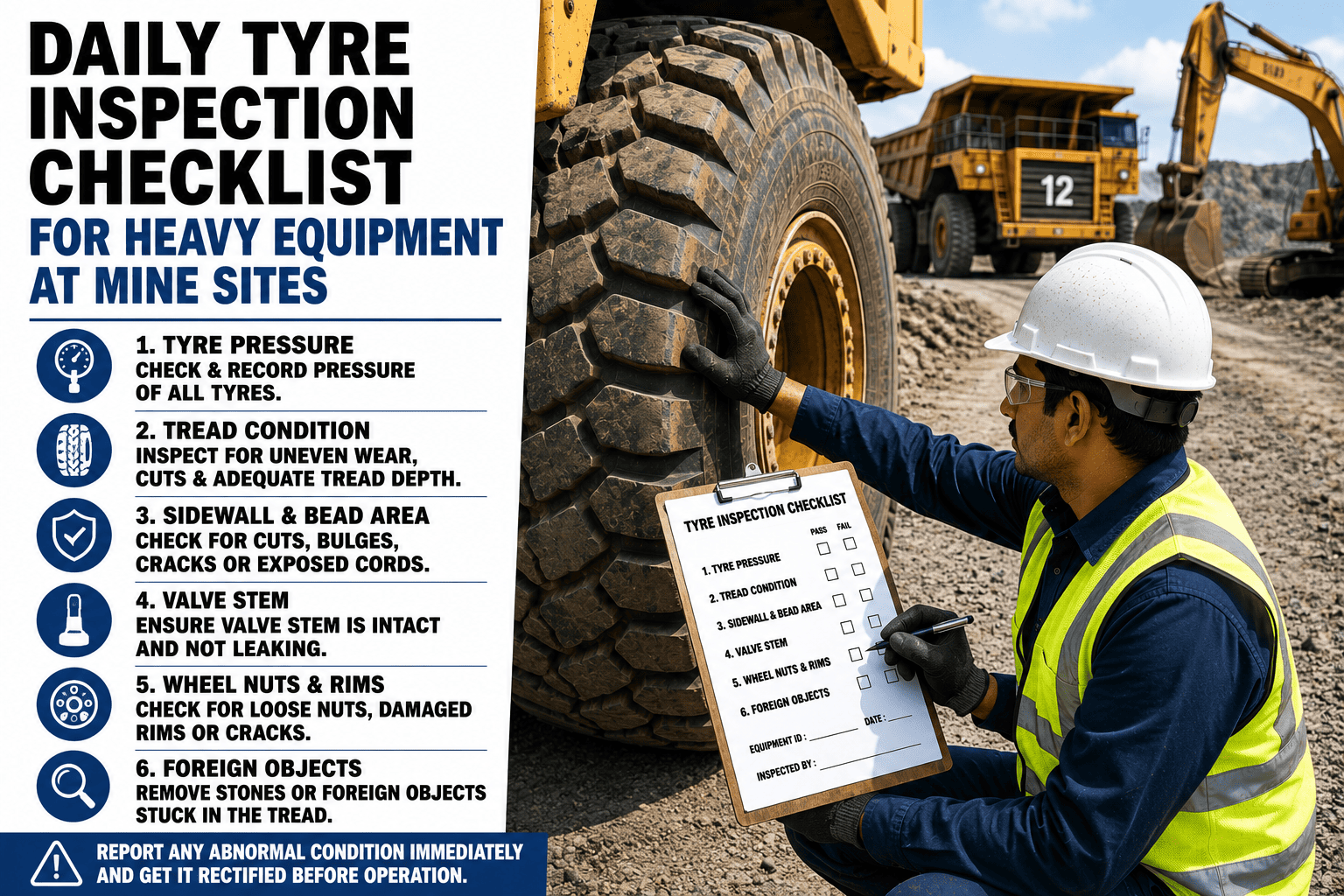
Tyres / tracks — correct pressure, no sidewall damage, even wear
Boom, stick, bucket — no cracks, no loose pins, no play at joints
Undercarriage — track tension correct, rollers intact, no debris jam
Lights, mirrors, horn — all working before machine moves
03
Cab & Controls
3 min
Inside check
Seat belt — working, not frayed
All warning lights — clear after engine start, no fault codes
Control levers — smooth, no sticking or abnormal resistance
Hour meter reading — record today's hours in the logbook
Fire extinguisher — present in cab, pin intact, not expired
Exhaust smoke colour — clear to light grey only (no blue or black smoke)
Hydraulic warm-up — cycle boom and bucket slowly for 2 minutes
Brake function — park brake holds, travel brake responds firmly
Swing / travel — no unusual grinding or pull to one side
AC / cab blower — cooling working, especially critical in Indian summers
05
Safety & Compliance
2 min
Before first movement
Work area clear — no workers, vehicles, or structures in swing radius
Ground condition — stable, no soft patches or slope risk
Overhead clearance — no power lines, scaffolding, or overhangs
Operator PPE — helmet, hi-vis vest, safety shoes all on
Daily check signed off — digital submission to supervisor before first dig
STOP RULE: If any item in zones 01–05 shows a defect — do not operate the machine. Tag the machine out, report to the site engineer, and raise a work order before that shift begins.
Paper Logbook vs Digital POUC — The Real Difference
Most Indian EPC companies — H.G. Infra, GR Infraprojects, Afcons, KEC, L&T — still manage daily equipment checks through paper logbooks maintained at the site. Here is what that actually looks like compared to a digital POUC system like HVI.
Swipe to compare
What you're comparing
Paper Logbook
HVI Digital POUC
When it's filled
After the shift or skipped
Before first movement, time-stamped
Photo proof
None
Every check point, auto-tagged
Manager visibility
Next visit to site
Live dashboard, instant alerts
Defect escalation
Depends on operator honesty
Auto-alert to engineer + work order
Audit-ready records
Paper can be lost or backdated
Tamper-proof, cloud-stored, exportable
Language for operators
English only, often not understood
Hindi + regional languages supported
NHAI audit compliance
Risk of non-compliance
Fully documented, audit-ready
Run This Checklist on Mobile — With Photo Proof — Before Every Shift
HVI replaces your paper logbook with a guided mobile POUC that operators complete in Hindi or regional language. Every defect is photo-tagged and auto-escalated to your engineer in real time.
Machine-Specific POUC — What Changes by Equipment Type
The core 20-point daily checklist stays the same for all machines. But each equipment type has 3–5 additional checks specific to how it works. Here is what to add for each machine type common on Indian sites.
Excavator
Tata Hitachi · L&T Komatsu · CAT · JCB
Track tension — sag between 20–30 mm
Swing bearing — grease nipple lubricated
Boom drift — max 5 cm in 5 minutes
Bucket teeth — not broken or missing
JCB 3DX Backhoe
Most common machine on Indian sites
Stabiliser pads — pins locked, no play
4WD engagement — switches correctly
Front loader linkage — no cracked pins
Both-end hydraulics — tested before work
Tipper Truck
Tata Signa · Ashok Leyland · BharatBenz
Tipping body — hinge pins, prop rod in place
Rear gate latches — locked before travel
Load lights — rear clearance lights working
Air pressure gauge — minimum 8 bar before move
Crane
ACE · Escorts · Liebherr · Manitowoc
Load chart — present in cab, readable
Hook block & safety latch — functioning
Wire rope — no kinks, broken strands, or rust
Outrigger pads — firm ground, fully extended
Wheel Loader
CASE · L&T · Escorts Kubota · Hyundai
Articulation joint — steering smooth, no play
Bucket cutting edge — not bent or cracked
Axle breather — not clogged
Tyre pressure — all four, including dual axle
Expert View — What a Site Manager in Bihar Says
"
We were running 14 machines on a highway widening package in Bihar — 6 excavators, 4 tippers, and 4 JCBs. Our paper logbook system meant the check was either filled by the operator after lunch or by the supervisor at the end of the day. Most of the time, nobody actually walked around the machine. When one of our Tata Hitachi excavators went down mid-shift — hydraulic pump failure — we traced it back to a slow leak that had been visible for 11 days in our own photos from the site camera. Nobody had flagged it because no one was looking. After we moved to digital POUC on HVI, every machine gets a morning check before the first bucket. My project manager in Delhi sees every flag the moment it's raised. In four months, we caught 3 issues early that would have become full breakdowns. The change is not expensive — it's just discipline made easy.
— Site ManagerHighway Widening Package, Bihar — 14-Machine Fleet
India Context — Why POUC Matters More Here
Indian construction conditions are harder on equipment than most markets. Extreme dust, heat above 45°C in summer, waterlogging in monsoon, long shifts on remote sites, and operators who have had minimal formal training — all of this means machines degrade faster here than the OEM maintenance schedule expects.
55–60%
Equipment utilisation on projects with land delays — well below the optimal 75–80%, per Mordor Intelligence 2024
815+
Large government projects facing delay as of 2024, creating pressure to skip maintenance and push machines harder
40%
Year-on-year increase in road construction equipment sales in FY 2023–24, per industry data — more machines, more risk
₹8–15L
Average annual loss per machine from undetected problems on Indian construction sites
With Bharatmala Pariyojana already completing 18,926 km of road corridors by November 2024 — and thousands of kilometres still under construction — the number of heavy machines running on Indian sites has never been higher. A daily operator checklist is no longer optional. It is the minimum standard to protect an asset worth ₹30 lakh to ₹1.3 crore. See how HVI's fleet management features support daily POUC across large multi-site operations.
Conclusion — 20 Minutes Every Morning Protects Your ₹1 Crore Machine
The daily operator checklist (POUC) is not paperwork. It is how a site that runs 10 machines and ₹50 crore of equipment budget avoids surprise breakdowns, audit failures, and safety incidents. Five zones, 20 minutes, every shift — that is the discipline that separates well-run Indian EPC fleets from those that spend on emergency repairs. Sign up free on HVI to replace your paper logbook with a guided mobile POUC checklist — with photo proof, Hindi language support, and live alerts to your fleet manager before the first shift starts. And if you want to see how HVI supports infrastructure, mining, and highway fleets across India, book a 30-minute walk-through with our team.
Mobile POUC · Photo Proof · Hindi Support · Live Dashboard
Stop the Paper Logbook. Start the Digital POUC Today.
Indian EPC, highway, mining, and infrastructure fleets use HVI to run daily operator checklists on mobile — in Hindi and regional languages — with photo proof and instant alerts to the fleet manager before every shift starts.
No credit card Hindi / Regional Photo proof Live alerts
35+ checksGuided POUC points per machine per shift
Trusted by EPC, highway, mining, pipeline & metro fleets across India
Frequently Asked Questions
01What is a POUC checklist for construction equipment in India?
POUC stands for Pre-Operational Use Checklist. It is a structured daily inspection that an equipment operator completes before starting any machine — excavator, JCB, crane, tipper, or loader — each shift. It covers engine, hydraulics, tyres, safety devices, and cab controls. In India, it replaces the old paper logbook and is now increasingly done on mobile apps like HVI.
02How long does a daily operator checklist take on a construction site?
A proper POUC walk-around for one machine takes 15 to 20 minutes. For a fleet of 5 machines, a site supervisor can complete all checks in under 90 minutes. With a digital app like HVI, operators submit photo-tagged reports that reach the fleet manager instantly, cutting reporting time by 60–70%.
03Is daily equipment inspection mandatory for NHAI and government projects in India?
Yes. NHAI, NHIDCL, and most state highway authorities require contractors to maintain equipment inspection logs as part of their site safety management plan. EPC companies working on Bharatmala Pariyojana projects are required to demonstrate daily equipment health records during safety audits. Failure to produce these records can result in project suspension or penalty deductions.
04What is the difference between a paper logbook and a digital operator checklist?
A paper logbook stays at the site and is filled manually — often after the shift or skipped entirely. A digital POUC checklist like HVI is completed on the operator's mobile phone before the shift starts, includes photo proof for each check point, time-stamps every entry, and immediately notifies the fleet manager or site engineer if any issue is flagged. Digital records also cannot be backdated or falsified.
05Which machines need a daily operator checklist in India?
All heavy and construction equipment that runs daily on site needs a POUC checklist. This includes excavators (Tata Hitachi, JCB, L&T Komatsu, CAT), backhoe loaders (JCB 3DX), tippers (Tata Signa, Ashok Leyland), motor graders, compactors, tower cranes, pick-and-carry cranes (ACE), and wheel loaders (CASE, L&T). Any machine that moves or lifts on a construction or mining site should have a daily check before operation.