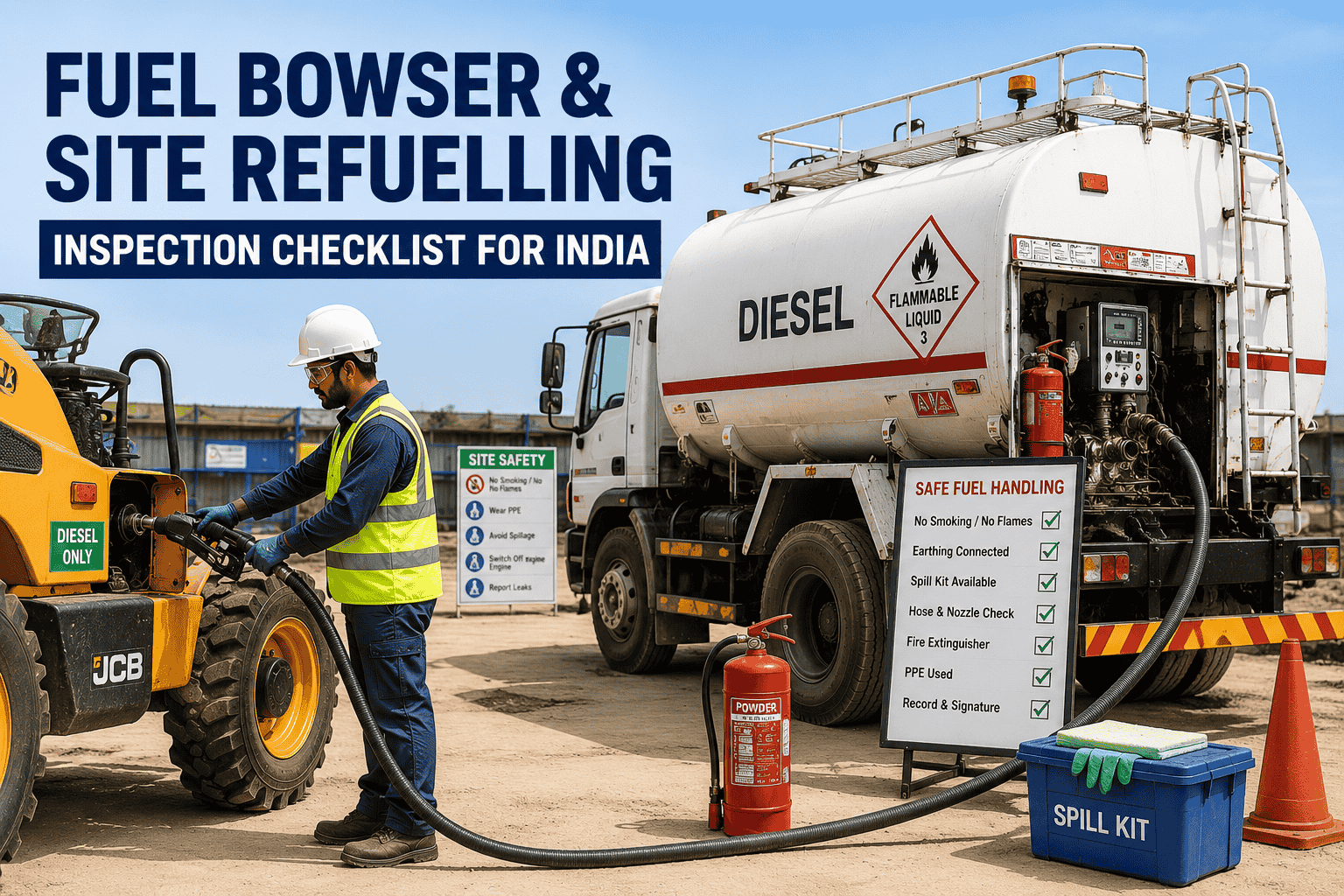
Fuel bowsers are the lifeline of every Indian construction, mining, and infrastructure project — but they are also one of the highest-risk activities on site. A single uncontrolled refuelling event can trigger a fire, a major fuel spill into soil or drains, a PESO licence violation, or a fatality. PESO (Petroleum and Explosives Safety Organisation) governs every aspect of fuel storage and transport in India under the Petroleum Rules 2002 and SMPV Rules 2016 — and inspectors are increasingly auditing construction sites for compliance. This page is your complete fuel bowser and site refuelling inspection checklist for India — built around the anatomy of the bowser itself, with tickable items across 6 anatomy zones, a PESO licence reckoner by storage capacity, and a 5-step spill response timeline you can pin to the site notice board. Sign up free to digitise this checklist on HVI and capture every refuelling event with photo proof and signatures.
Fuel Bowser & Site Refuelling Inspection Checklist for India
For Indian construction, mining, EPC, and logistics fleets. 6 anatomy zones, 35+ tickable inspection points, PESO-aligned to Petroleum Rules 2002 & SMPV Rules 2016. Use on phone during the daily bowser inspection.
Why Bowser Inspection Cannot Be Skipped
Three risks make refuelling the highest-stakes routine activity on any Indian construction site. Book a demo to see how HVI captures each risk live during the bowser walk.
Fire & Explosion
Diesel vapour ignites at 52°C. One spark from a poorly earthed bowser or a smoking worker has triggered fires that destroyed entire equipment yards.
Fuel Spill & Soil Contamination
200-litre spill contaminates 2 lakh+ litres of groundwater. CPCB and pollution board penalties run ₹50K - ₹5 lakh plus clean-up cost.
PESO Licence Violation
Expired Form XIX or Form VIII shuts down your bowser operation overnight. Pune unit was fined ₹12 lakh in 2025 for an expired PESO licence.
Bowser Anatomy — The 6 Zones You Must Inspect
The bowser itself dictates the inspection structure. Each zone of the machine has its own failure modes and its own checklist.
Six zones, each with its own failure modes. Tick the checklist below as you walk the bowser before every refuelling round.
Interactive Audit — Tick Each Zone Before Refuelling
Click each zone to expand its checklist. Tick items live as you verify them on the bowser. The full walk takes 15-20 minutes — share with the bowser driver, site engineer, and EHS officer when complete. Sign up free to capture each tick with photo proof & GPS on HVI.
01
PESO Documentation & Permits
Petroleum Rules 2002
First check of every audit — papers before petrol
PESO Documentation & Permits
Petroleum Rules 2002
02
Tank & Bunding
SMPV Rules 2016
Tank shell, bund wall, vents, dipstick — the storage core
Tank & Bunding
SMPV Rules 2016
03
Pump · Hose · Nozzle
Highest leak risk
The dispensing assembly is the most failure-prone part of any bowser
Pump · Hose · Nozzle
Highest leak risk
04
Earthing & Bonding
IS 3043 · Anti-static
Prevents static spark — the silent cause of bowser fires
Earthing & Bonding
IS 3043 · Anti-static
05
Spill Containment & Response
CPCB · Environmental
A 200-litre spill contaminates 2 lakh+ litres of groundwater
Spill Containment & Response
CPCB · Environmental
06
Fire Safety & Operator PPE
NBC 2016 · BOCW
Diesel ignites at 52°C — every spark is a potential disaster
Fire Safety & Operator PPE
NBC 2016 · BOCWAll 6 Zones Cleared? Start the Transfer — Not Before
Every red item or unticked critical check is a stop-the-job signal. The cost of a 15-minute inspection is nothing compared to one fire, one major spill, or one PESO notice. HVI captures every tick with photo & signature, links it to the receiving machine, and builds the fuel issue record from the inspection itself — no double entry.
Digitise Bowser Inspection + Fuel Issue Log in One Workflow — On HVI
Bowser walk, tick checklist, photo defects, log fuel issued to machine — all in one screen. Operator + driver + supervisor 3-way signature. Auto-generates PESO & CPCB ready report.
PESO Licence Reckoner — What You Need by Capacity
The PESO licence required depends on the diesel quantity you store and transport. These tiers reflect Petroleum Rules 2002 and the current PESO framework. Book a demo to see how HVI tracks every PESO & CMVR document with expiry alerts.
Important: Capacity tiers and form numbers reflect the current PESO framework under Petroleum Rules 2002 and SMPV (Unfired) Rules 2016. Specific licence requirements depend on diesel volume, storage type, and state-level rules — always confirm with your PESO regional office before purchase. A real 2025 case in Pune saw a manufacturing unit penalised ₹12 lakh after a missed PESO licence renewal.
Spill Response — Your First 5 Minutes
If fuel hits the ground, the first 5 minutes decide whether you have a ₹5,000 cleanup or a ₹5 lakh environmental notice. Follow this exact sequence. Pin a printed copy near your bowser parking area. Book a demo to see how HVI logs the entire spill incident with photo evidence in real time.
STOP THE FLOW
Release the deadman nozzle handle immediately. Hit bowser kill switch. Close the manual valve at pump.
ALERT & CLEAR
Shout "FUEL SPILL". Stop all hot work within 15 m. Move workers upwind. Engine off on receiving machine.
CONTAIN
Lay absorbent booms around the spill edge. Cover drains with drain mats. Stop fuel from spreading.
ABSORB
Spread absorbent granules over the spill. Allow 2-3 min to soak. Sweep into oily-waste bags. Do not wash with water.
REPORT
Photo & log incident on HVI. Notify EHS officer. If > 100 L or near drain, report to state pollution board within 24 hours.
Expert View — From a Fuel Operations Head
We run 6 fuel bowsers across our highway and quarry sites, dispensing roughly 18,000 litres of diesel per day. Until 2024, our drivers did the daily inspection on paper — half the time the form was filled in the cabin at the end of the day, not at the bowser. Two near-miss spills made us rethink. We moved to HVI — now every bowser walk is on phone, every tick is photo-tagged, every fuel transfer has driver + operator + supervisor signatures captured on the same screen. The PESO audit last month was the easiest we have ever done — we pulled up 90 days of daily inspections in 5 minutes. The inspector asked for a copy of our process. That is the kind of compliance that ends up as a competitive advantage in bids.
Conclusion — Inspect Before You Dispense
The 6-zone anatomy walk is your inspection. The PESO reckoner is your licence cover. The 5-minute spill response is your insurance. Walk every bowser before every refuelling round, tick the 35+ items, photo every defect, and turn the inspection into the fuel issue's permanent record. Sign up free to digitise this checklist on HVI and build fuel safety into every refuelling event from Day 1.
Run Bowser Inspections + Fuel Issue on Phone — One Workflow
Indian EPC, mining, infrastructure, and logistics contractors digitise daily bowser inspections, fuel issue logs, spill incident reports, and PESO compliance on HVI. One app for bowser drivers, site operators, supervisors, EHS officers, and fleet heads. Hindi UI. Offline mode. Photo & signature on every transaction. Auto-generated PESO-ready audit reports.