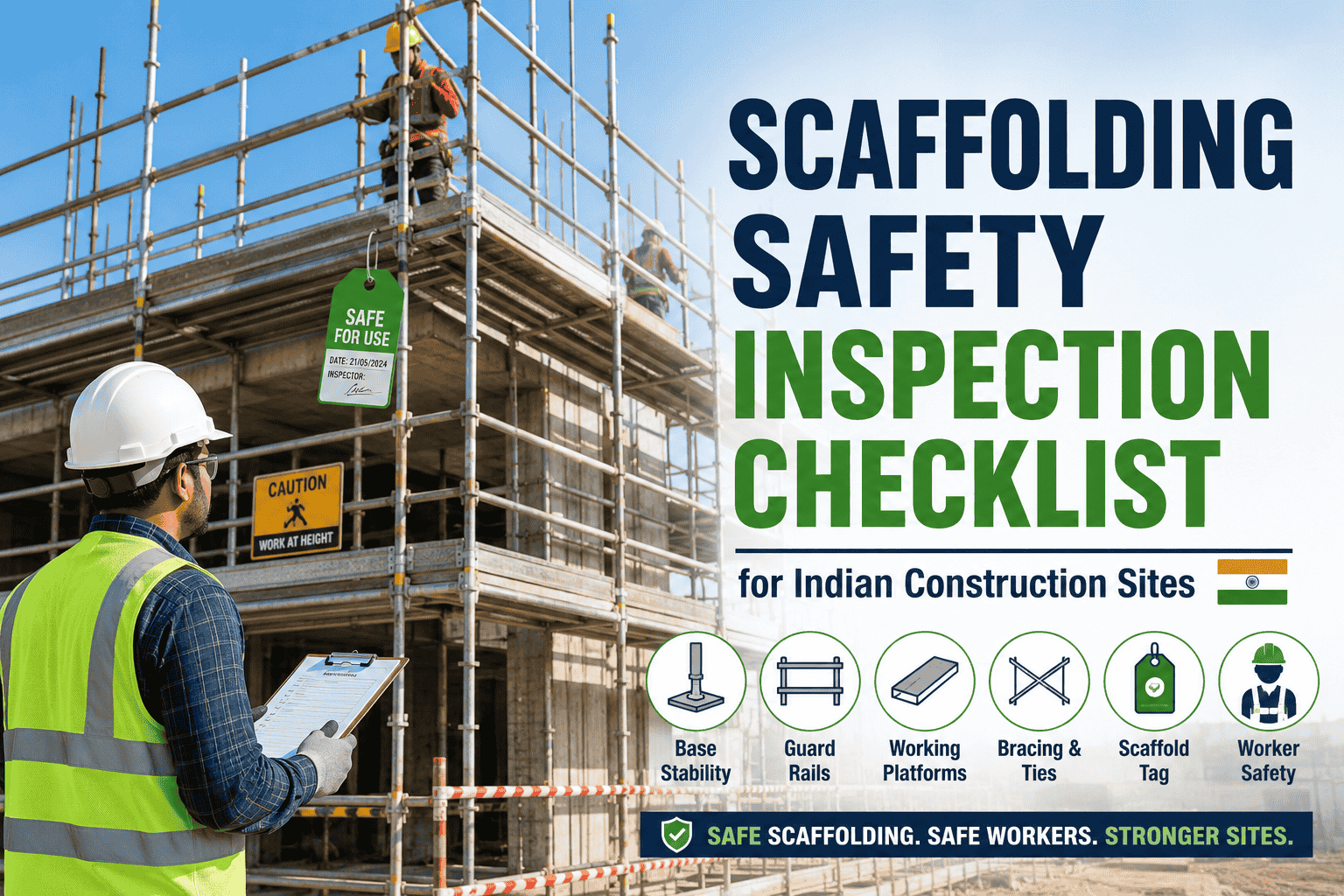
Scaffolding accounts for the largest share of fatal falls from height on Indian construction sites — across high-rise residential, commercial, metro, refinery, power, and infrastructure projects. Under the Building & Other Construction Workers (BOCW) Act 1996 + Rules 1998 (Rule 175 specifically), and the Indian Standards IS 4014 and IS 3696, every scaffold over 2 metres must be inspected by a competent person before first use, after any alteration, after rain or storm, and at minimum every 7 days. The scaffold must carry a colour-coded inspection tag (Green / Yellow / Red / Out-of-Service) signed by the inspector. Most fatal scaffold collapses on Indian sites trace back to one of three missed checks — base plate on soft soil, missing diagonal brace, or unsecured guard rail. This page is your complete scaffolding safety inspection checklist for Indian construction sites — built around the proper scaffold anatomy (8 numbered components, bottom-to-top), the 4-state scaffold tag colour system, and the full BOCW Rule 175 compliance layer. Sign up free to run this audit on phone with HVI — photo-tagged, GPS-verified, scaffold-tag-ready.
Scaffolding Safety Inspection Checklist for Indian Construction Sites
For cuplock, H-frame, modular, tube-and-clamp, and suspended scaffolds. 8-component anatomy walk-up, 4-state tag colour system, BOCW & IS-code compliance.
Scaffold Anatomy — 8 Components Inspected Bottom-to-Top
Every scaffold on an Indian site — cuplock at a power plant, H-frame on a metro project, modular at an oil refinery — shares the same 8-component anatomy. The inspector walks bottom-to-top, verifying each component as load passes through it. Book a demo to see the anatomy walk-up on phone.
The 4 Scaffold Tags — Colour Decides Who Can Climb
After inspection, the competent person fixes a colour-coded tag on the scaffold. The colour is binding — workers can only step onto a scaffold that carries a current Green tag. Yellow means restricted. Red and Out-of-Service mean do-not-use.
The 8-Component Audit — Tick Bottom-to-Top
Walk the scaffold base-up. Tick items as you verify them. Any unticked critical item downgrades the tag from Green to Yellow or Red. Sign up free to capture every tick with photo proof on HVI, or book a demo to see the workflow live.
Sole Plate
FoundationBase Plate
Load transferStandards (Vertical Poles)
Main load pathLedgers & Transoms (Horizontals)
Lift framingDiagonal Bracing
Lateral stabilityTies to Building
AnchorageWorking Platform
WorkspaceGuard Rails & Toe Boards
Fall protectionBOCW Rule 175 & IS Codes — What You're Audited On
Indian scaffold regulation comes from 3 layered frameworks. Your inspection record is the primary evidence inspectors verify during BOCW audits. Sign up free to keep your scaffold register BOCW-ready from Day 1, or book a demo to see HVI's BOCW-ready audit trail.
Mandates that every scaffold over 2 m must be erected by competent scaffolders, inspected before first use, after alteration, after rain/storm, and every 7 days. Inspection record must be kept on site.
Bureau of Indian Standards specification for material, design, erection, dismantling. Covers tube dimensions, coupler torque, brace spacing, tie patterns, load classes.
Specifies inspection frequency, scaffold class by intended use (light / medium / heavy duty), worker access, guard rail dimensions, and competent person qualifications.
Section 32 applies — safe means of access, fencing of openings. Additional requirements during shutdown / turnaround maintenance work in process plants and refineries.
We manage scaffolding across 9 active project sites — high-rise residential in Mumbai & Pune, two metro packages in Bengaluru, a refinery turnaround in Gujarat, three power plants in Madhya Pradesh and Chhattisgarh. Until early 2024, scaffold inspection was a paper Scafftag pinned at the base, often filled in casually and rarely updated after rain. Two near-miss incidents at the refinery — both traced to missing diagonal braces after a monsoon overnight — pushed us to digitise. Now every scaffold has a QR-coded tag. Scaffold inspector scans, runs the 8-component audit on phone, photos every component, signs digitally, and the tag colour updates instantly. Workers scan the same QR before climbing — Red & Yellow alerts go to the supervisor automatically. In 11 months, zero falls from scaffold, zero BOCW non-compliance notices, and our refinery client's HSE audit score went from concerning to consistently top decile.
Run the 8-Component Scaffold Audit on Phone — Across Every Site
Indian construction, infrastructure, EPC, refinery & power fleets digitise scaffold inspections on HVI. 30+ tickable checks across the full anatomy. Photo + GPS + signature on every defect. QR-coded scaffold tags. BOCW Rule 175 audit-ready from Day 1.