Port equipment has a problem that most industrial fleets do not: there is no natural pause. A cement plant has shutdowns, a construction project has phases and weather, a mine has shift patterns. A terminal has vessels arriving on schedules set elsewhere, and between them the yard is still moving boxes. The maintenance window has to be manufactured rather than found, and the cost of getting it wrong is measured against a berth window that was booked weeks ago. That constraint shapes everything else about how a terminal fleet should be maintained. You can look at how your own operation is structured in a free 30-minute session.
Maintaining Equipment That Never Gets a Quiet Week
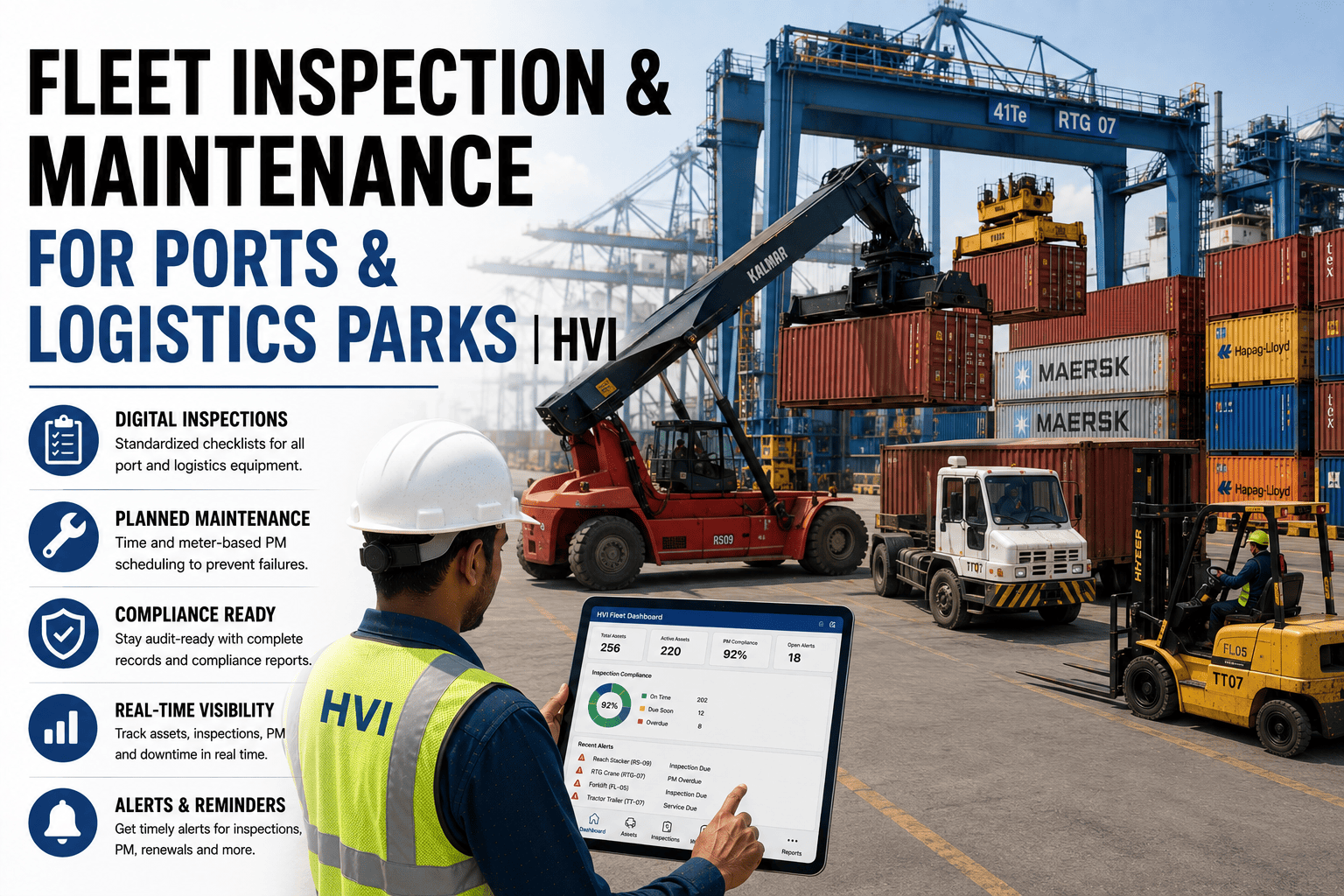
Reach stackers, forklifts, terminal tractors and trailers kept available against vessel schedules, corrosion, and continuous duty.
The Clock Belongs to the Vessel
Availability is needed in windows, not on average
Ninety percent availability spread evenly is very different from ninety percent that happens to dip during a berth window. The average tells you almost nothing about whether you met the operation.
The peak requirement is known in advance
Unlike most fleets, you know roughly when demand spikes. That is a scheduling advantage most terminals do not exploit fully.
Failure during a window costs more than failure between them
The same breakdown has two completely different costs depending on timing, which should influence when work is deferred and when it is not.
Congestion makes recovery slower
A machine failing in a working lane blocks others. Recovery time includes clearing around it, which a workshop estimate rarely accounts for.
Three Conditions That Shorten Component Life
Corrosion attacks electrical connections, chassis, and anything with exposed steel far faster than inland conditions. It also progresses while equipment is parked, so standing time is not rest.
Worth checking: connector condition, earth points, structural corrosion at stress areas, and paint or coating integrity as a leading indicator.
High cycle counts on hydraulics, masts, spreaders, and transmissions accumulate wear that hour meters understate, because a port hour contains far more operations than a construction hour.
Worth checking: whether intervals set on hours should be set on cycles for the systems that actually cycle.
Impact damage, tyre sidewall damage from kerbs and lane edges, and contact with fixed structures, none of which are mechanical failures but all of which take machines out.
Worth checking: damage reported promptly rather than at service, since delayed reporting makes cause impossible to establish.
Schedule Around the Berth Plan
Service timing aligned to known demand windows, with critical defects holding machines before a window rather than during one.
Making a Window Where None Exists
Work to the berth plan rather than a maintenance calendar, taking machines in the gaps that the schedule already creates.
Keep planned interventions short enough to fit a real gap, splitting longer jobs where the equipment allows it.
Hold a deliberate spare unit rather than running every machine, since the buffer is what makes any window possible.
Prepare parts and labour before the window opens, so the gap is used for work rather than for fetching.
Do inspection during operation and repair during gaps, keeping the two activities separate.
Track deferred work explicitly, because in a continuous operation deferral is the default and nothing surfaces it otherwise.
Frequently Asked Questions
Should intervals be based on hours or cycles?
For systems that cycle heavily — spreaders, masts, lift hydraulics — cycles usually reflect wear better than hours do. Engine-related items stay on hours. Using one basis for everything under-services the hardest-working systems. You can work through the split on a call with our team.
How do we stop deferral becoming permanent?
By recording every deferral with a date and a reason, so the backlog is visible. In continuous operations, work that is deferred informally simply disappears.
Is corrosion really worth inspecting for routinely?
In a coastal terminal, yes. It progresses continuously including while equipment stands idle, and by the time it causes a fault the remedy is considerably more expensive than prevention would have been.
How should impact damage be handled?
Reported at the time with a photo. Damage found later cannot be attributed, which means neither the cause nor the pattern can be addressed.
What gives the quickest improvement in a terminal?
Aligning planned work to the berth schedule instead of a fixed calendar. The gaps already exist; most terminals simply do not plan into them. Start with a free trial.
Plan Into the Gaps You Already Have
Work to the berth plan rather than a maintenance calendar, set intervals on cycles where systems actually cycle, inspect for corrosion as a routine item, capture impact damage at the moment it happens, and make deferred work visible so it does not quietly vanish.