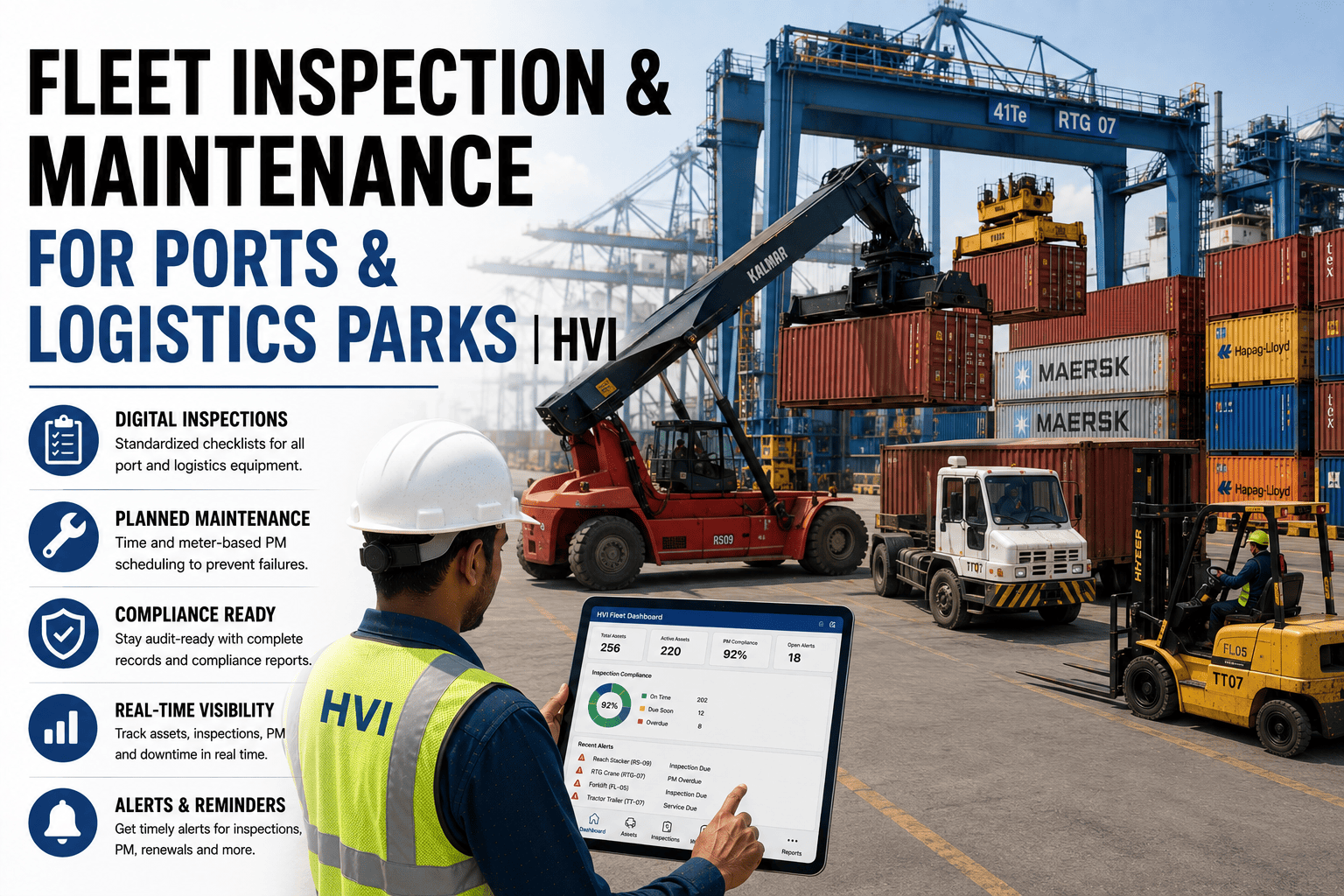
A terminal is judged in moves per hour, and moves per hour is a maintenance number: every reach stacker or ITV down during a vessel window converts straight into berth productivity lost and demurrage risk. The machines also live compressed lives — five to six thousand hours a year means the service a quarry sees quarterly arrives here every five weeks, and only meter-driven PM keeps pace. And the liability runs through the equipment itself: a worn twistlock or tired spreader is not a maintenance note, it is a dropped container, a cargo claim, and an inquiry into when it was last inspected. HVI runs the yard's fleet on hour-driven PM, shift-wise safety checks, and lifting-gear ladders — sign up free and put your yard on it this week.
Fleet Inspection & Maintenance for Ports & Logistics Parks
Reach stackers, RTGs, forklifts, terminal tractors, and trailers on one system — maintained on the hours they actually run, checked every shift, and compliant whenever the question comes.
Moves per Hour Is a Maintenance Number
Availability Gates the Rate
The vessel plan assumes a lineup of working machines — each one that fails mid-shift subtracts from moves per hour against a berth window the shipping line priced. Fleet availability is the ceiling on everything the terminal promises.
Recovery Speed Decides the Damage
A defect raised with photo and location reaches the workshop with the vessel clock in view — the hot-swap happens in minutes, the repair queues without stopping moves, and a breakdown becomes a footnote instead of a shortfall.
The Claims File Protects the Margin
A dropped or damaged container becomes a liability question about equipment condition — the daily spreader, twistlock, and fork records are the defence file, written every shift or not at all.
The Compressed Calendar Port Machines Live On
Put the Container Fleet on Hour-Driven PM This Week
Reach stackers, ITVs, and yard cranes first: meters feeding PM schedules that keep pace with 6,000-hour years, shift-wise safety checklists tuned to your models in an afternoon, and lifting certificates loaded onto ladders. Bring last month's downtime log to a 30-minute session and our India team maps the rollout against your berth schedule.
Criticality, Targets, and the Standby Plan
| Equipment | Why It's Critical | The Standby Discipline |
|---|---|---|
| Reach stackers | The vessel lineup's workhorse — and the twistlock check is the dropped-container check | Standbys named per vessel plan; a critical fail swaps before the first lift |
| RTG / yard cranes | Stack access itself — a crane down closes rows | Rope and structural cycles tracked; power packs on their own PM |
| Terminal tractors | The quay-to-yard rhythm; a coupling failure strands forty tonnes mid-haul | Fifth-wheel and kingpin on every pre-start; spare units in the rotation |
| Forklifts / ECH | Working closest to people in the busiest zones | Strictest daily list — forks, mast chains, horns, lights |
| Weighbridge & auxiliaries | Every weight on every document depends on it | Calibration records on ladders beside the machines |
The Gate Standard for Outside Equipment
Documents at the gate — transporter trailers and contractor machines show valid papers before entry; expiries flag automatically, and the yard stops inheriting the road's compliance gaps.
Condition walkaround on entry — deck twistlock pins, landing legs, tyres, brake connections checked and photographed, so pre-existing damage is on record before the first container touches the chassis.
Same rules inside — contractor-operated equipment works within your system under vendor-scoped access, because the accident, the audit, and the throughput target belong to the terminal whoever owns the machine.
Frequently Asked Questions
Can downtime be reported as moves lost, not just hours?
Yes — downtime minutes per machine during vessel operations sit beside the vessel's productivity numbers, so the post-sailing review reads the connection directly and the next lineup is built on which machines actually held.
How are spreaders and lifting tackle managed as spares?
Spreaders, hooks, and tackle are tracked items with their own test-certificate ladders and inspection cycles — a spare spreader swaps in with its papers already current, and the retired one's file travels with it to the workshop.
Port tyres take brutal point loads. Does the system help?
Tyre checks sit on the daily list and tyre changes log per position with hours — cut and wear patterns per machine surface early, and the tyre budget finally attaches to the machines and duties consuming it.
We run an ICD and two CFS yards. One system?
Yes — each yard is a scoped site with its own equipment, shifts, and registers, rolled up to one dashboard where cross-yard comparisons become possible; sign up free and bring all three under one roof.
How does 24/7 handover work?
Each shift's pre-starts, defects, and open jobs are on the dashboard when the next shift logs in — a machine flagged at 11 PM is still flagged at 6 AM with photos attached, and nothing travels by word of mouth. See a full cycle in a 30-minute demo with our India team.
The Berth Window Doesn't Stretch. Make the Fleet Fit It.
Every move the terminal promises rides on machines maintained at the pace they're consumed — and every preventable mid-vessel breakdown is a maintenance plan that ran on the wrong clock. Put the yard on one system: hour-driven PM in the vessel gaps, twistlock and coupling checks every shift, certificates and calibrations on ladders, and outside equipment held to the gate standard. The berth stops losing moves to surprises and the claims file answers itself. Start free and put the container fleet on the system this week, or bring your yard's equipment list to a 30-minute session and leave with the rollout mapped.