Every Indian enterprise fleet with SAP eventually has this argument: the CoE says "we already paid for SAP PM — use it," the site says "nobody can run a pit inspection in a GUI transaction," and both are right. SAP PM is a world-class asset management backbone — equipment masters, maintenance plans, cost settlement, and financial integration that no dedicated app should pretend to replace. But it was designed for planners at desks, not operators in cabs; and the gap between the two is where Indian HEMM fleets quietly fall back to paper, WhatsApp, and Excel while SAP fills with late, retyped data. This guide gives you the honest version of the comparison: where SAP PM alone genuinely is enough, where a dedicated field layer earns its keep, a dimension-by-dimension table that credits each side's real strengths, and the integration pattern most large fleets land on — SAP as the system of record, a mobile-first inspection layer at the machines, standard interfaces between them. Read it, run the six-question self-assessment, and decide with evidence — then sign up free and test the field layer against your hardest site this week.
SAP PM vs Dedicated Fleet Inspection Software — Which Is Right?
When SAP PM alone is enough, when a dedicated inspection app adds value at Indian mine and project sites, and how large fleets integrate both — compared dimension by dimension, without the vendor spin.
Two Tools, Built for Two Different Jobs
SAP PM: The Enterprise Asset Backbone
Built to be the single financial and technical truth about assets across an enterprise — equipment masters and functional locations, maintenance plans and task lists, order costing and settlement, budgets, and seamless flow into MM, FI/CO, and procurement. Its strengths are governance, integration, and auditability at scale, and in those it has no equal.
Dedicated Inspection Software: The Field Execution Layer
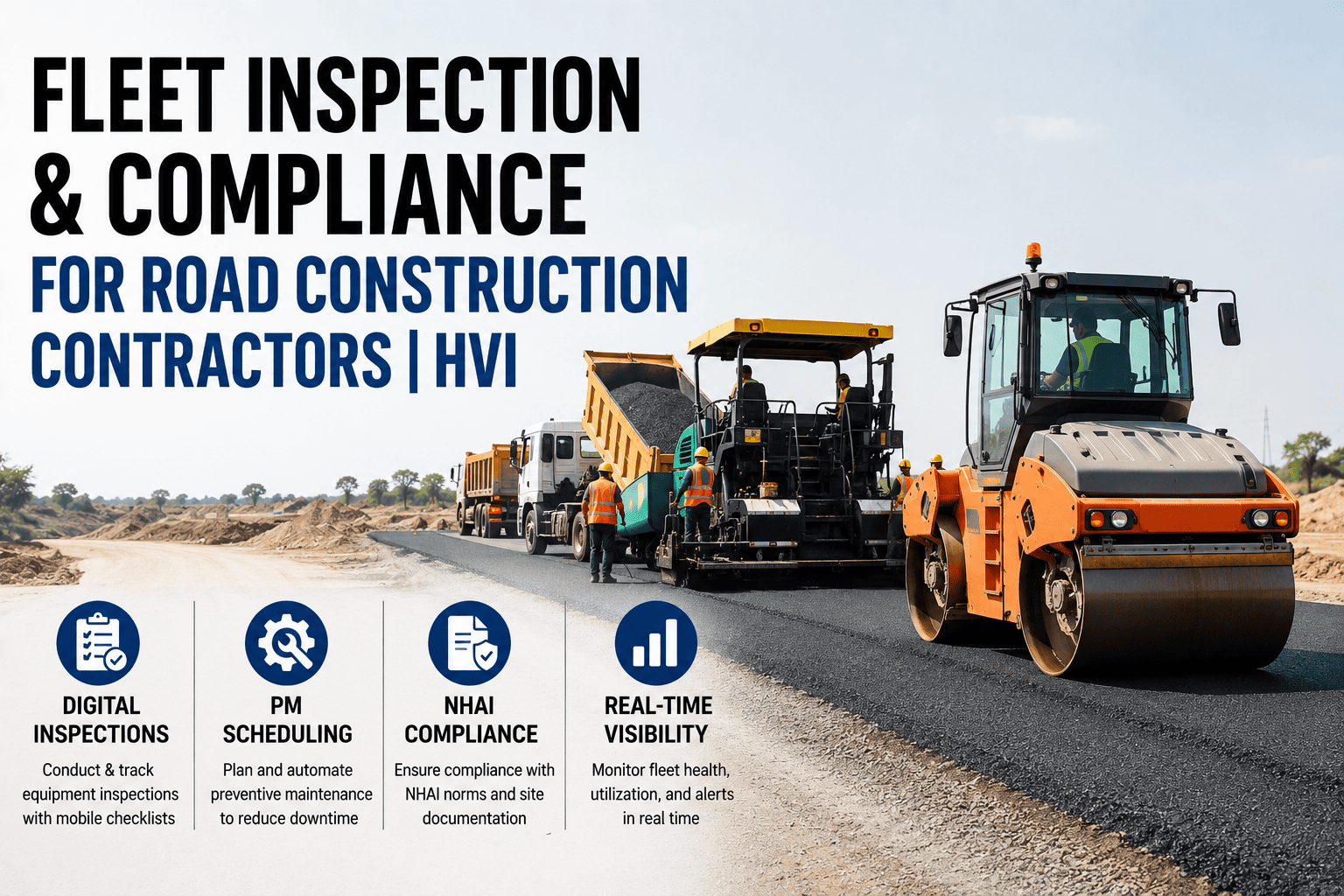
Built for the person standing at the machine — mobile-first checklists with photos, fully offline at pit bottoms and tunnel faces, defect-to-work-order automation, DGMS and Factories Act formats out of the box, and configuration in hours by a site engineer rather than a change request to a CoE. Its strengths are adoption, speed, and field reality.
The Honest Verdicts
SAP PM alone is genuinely enough when…
A dedicated field layer earns its keep when…
Most large HEMM fleets end up with both because…
Head to Head, Dimension by Dimension
| Dimension | SAP PM | Dedicated (HVI) |
|---|---|---|
| Field usability at the machine | GUI/Fiori built for planners; heavy at a pit bottom | Mobile-first, gloved-finger UI, photo-first — built for operators |
| Offline at remote sites | Limited; assumes connectivity or thin offline scenarios | Fully offline for weeks, capture-time stamps, auto-sync |
| Daily inspections & checklists | Possible via rounds/custom development | Core function — no-code checklists, escalations, photo evidence |
| Configuration speed | CoE change control — weeks to months | Site-level changes in hours |
| Operator & fitter adoption | Historically the struggle point | Designed for it — minutes to learn, one screen per role |
| DGMS / Factories Act formats | Custom reports to build and maintain | Statutory-style registers out of the box |
| Order costing & settlement | Unmatched — native FI/CO integration | Feeds SAP; does not replace enterprise costing |
| Master data governance | The gold standard — MDM, authorisations, audit | Consumes SAP masters; never creates its own |
| Procurement & enterprise finance | Native MM/FI flow — clearly SAP's ground | Posts consumption and costs into that flow |
| Time to first value | Quarters, with implementation partners | Days — first site live within a week |
Read the table honestly and the pattern is clear: SAP PM wins everything enterprise, the dedicated layer wins everything field — which is why "versus" is usually the wrong frame, and "together, through standard interfaces" is the answer most large fleets converge on.
Run This Comparison Against Your Own Sites — Live
Bring your SAP landscape and your worst-connectivity site's scenario to a 30-minute session: our India team shows the field layer running a full inspection offline on a phone, then walks exactly how it posts into your PM and MM — masters down, transactions up, SAP untouched as the record. If SAP alone genuinely fits your operation, we will tell you that too.
If You Run Both: The Division of Labour
SAP Does
Equipment and material masters, maintenance plans and budgets, order costing and settlement, procurement, and the financial close — everything your auditors and CFO already trust it for.
HVI Does
Daily inspections with photos, defect-to-work-order automation, technician assignment, parts issues at site stores, meter capture, and statutory registers — on mobile, offline, at the machine.
The Interface Does
Masters flow down so the field works on SAP's IDs; notifications, confirmations, goods issues, and measurement documents flow up through OData, BAPI/IDoc, or governed batch — validated by SAP's own rules, reconciled daily.
The Six-Question Self-Assessment
Frequently Asked Questions
Does a dedicated app replace SAP PM?
In an enterprise that runs SAP costing and procurement — no, and be wary of any vendor who says otherwise; it complements PM as the field capture layer while SAP remains the system of record. For fleets without SAP, HVI runs standalone as the full maintenance system, which is exactly how most mid-size Indian contractors use it.
Aren't Fiori and SAP's mobile apps enough for the field?
They are a real improvement over GUI for connected, SAP-literate users — honest credit where due. But for daily operator walkarounds at zero-signal HEMM sites, with photos, Hindi flows, weeks-offline capacity, and hour-level checklist changes, they still carry enterprise assumptions the pit does not meet; run both on the same phone at your worst site and let the crews vote.
How should we compare costs fairly?
Count the full stack on each side: SAP-only means licences plus the custom development, clerk hours, posting lag, and adoption workarounds; the combined stack means the field layer's subscription plus a standard integration. Most fleets find the clerk-and-lag line alone outweighs the field layer's cost — put your own numbers into that frame before deciding.
We are mid-migration to S/4HANA. Wait or move now?
Move now — the field layer works against ECC today and S/4 tomorrow with the same object mapping, so field discipline and clean data build while the migration runs, and cutover does not disturb the sites at all. Arriving in S/4 with a year of verified field history is a better start than arriving with paper; sign up free and start on your current landscape.
We are a growing fleet with no SAP. Should we implement SAP PM first?
Usually not for maintenance alone — start with the dedicated system, get inspections, work orders, parts, and costs disciplined in weeks, and let your ERP decision follow your finance needs on its own timeline. If SAP arrives later, the field layer connects to it rather than being replaced; walk both paths in a 30-minute demo with our India team.
Stop Arguing SAP vs the Field. Give Each the Job It Was Built For.
SAP should remain the enterprise system of record, while field teams need a simpler mobile solution. Let SAP handle masters, costing, and reporting while a mobile-first layer captures inspections and work at the machine—even offline—and syncs through standard interfaces. Test it at your worst-connected site, measure the cost of manual entry, and see the difference. Start free or book a 30-minute live demo.