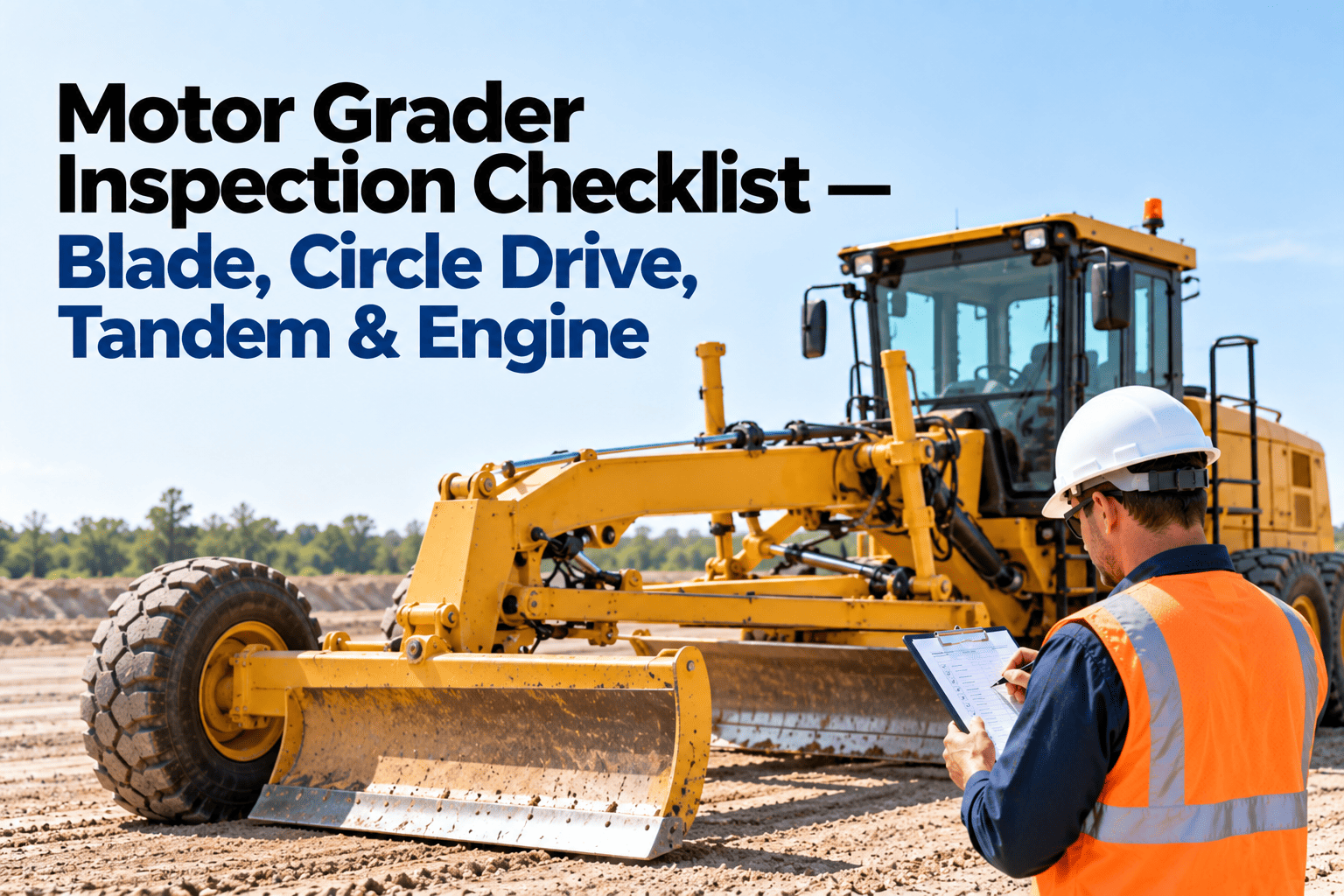
A motor grader can fail in two completely different ways and only one of them is obvious. The first is the familiar kind — something breaks, the machine stops, everyone knows. The second is that the machine keeps working perfectly while producing a surface that is out of tolerance, and nobody finds out until survey or until the layer above it goes down. Most grader checklists treat every item the same way, which means the accuracy items sit buried among the safety ones and get the same cursory tick. Separating them makes both more likely to be done properly. You can adapt this to your own machines in a free 30-minute session.
Two Kinds of Grader Failure, Two Sets of Checks
One set keeps the machine safe to operate. The other keeps the surface within tolerance — and a grader can pass the first while failing the second all shift.
Checks That Keep It Safe
Checks That Keep It Accurate
These rarely stop a machine. They determine whether the work it produces has to be done again.
Circle drive wear and backlash
Play in the circle lets the blade wander under load, which shows up as an uneven surface rather than as a fault.
Circle and drawbar wear strips and shims
Worn or badly adjusted wear surfaces are the most common cause of blade movement that operators compensate for without reporting.
Blade and cutting edge condition
A worn or unevenly worn edge cannot produce a flat surface regardless of operator skill.
Moldboard slide rails and blade side-shift
Play here appears as inconsistency between passes that is very difficult to diagnose from the finished surface alone.
Lift cylinder drift, measured rather than judged
Slow settling during a pass produces a gradual deviation the operator corrects instinctively and never mentions.
Blade control and machine control system status
Where fitted, calibration and sensor condition determine everything downstream. A system reporting confidently from bad calibration is worse than none.
Tyre pressure equality across positions
Uneven pressures change machine attitude, which changes blade position. This is an accuracy item as much as a tyre item.
Separate the Two Sets in the Form Itself
Safety items holding the machine, accuracy items routed to whoever owns quality, both captured in one check.
Why Accuracy Failures Cost More Than They Appear To
An out-of-tolerance surface is rarely fixed by regrading alone. Material has already been placed, compaction has been done, and the correction usually means additional material, another pass, and a delay to whatever was following behind.
The cost also lands somewhere other than maintenance. It appears as material overrun and rework in the project's numbers, which means the maintenance report shows a machine performing acceptably while the project shows a problem nobody has connected back to circle drive wear.
And it compounds quietly. An operator who has adapted to a wandering blade produces acceptable work and reports nothing, so the wear continues until it becomes bad enough to notice — by which point several layers have been placed on a surface that was never quite right.
Frequently Asked Questions
Should accuracy items stop the machine?
Usually not, but they should route somewhere rather than sitting as a note. Sending them to whoever owns surface quality means they get acted on without taking a machine off work unnecessarily. You can set up that routing on a call with our team.
Why does circle drive wear go unreported so often?
Because it degrades gradually and skilled operators compensate without consciously noticing. Nothing feels broken, so nothing gets reported.
How should blade control calibration be handled?
Follow the system manufacturer's procedure and record when it was last done. A machine control system giving confident readings from stale calibration produces worse outcomes than working without one.
Can a daily check really cover accuracy items?
Visual and functional aspects yes; measured wear checks belong on a longer cycle. Splitting them by frequency keeps the daily check short.
Who should see accuracy findings?
Both maintenance and the site or quality team, because the consequence lands on the project rather than on the workshop. Start with a free trial.
Check for Both Kinds of Failure
Keep the safety items holding the machine, give circle drive, wear strips, blade condition and control calibration their own section, and route accuracy findings to whoever carries the cost of rework.