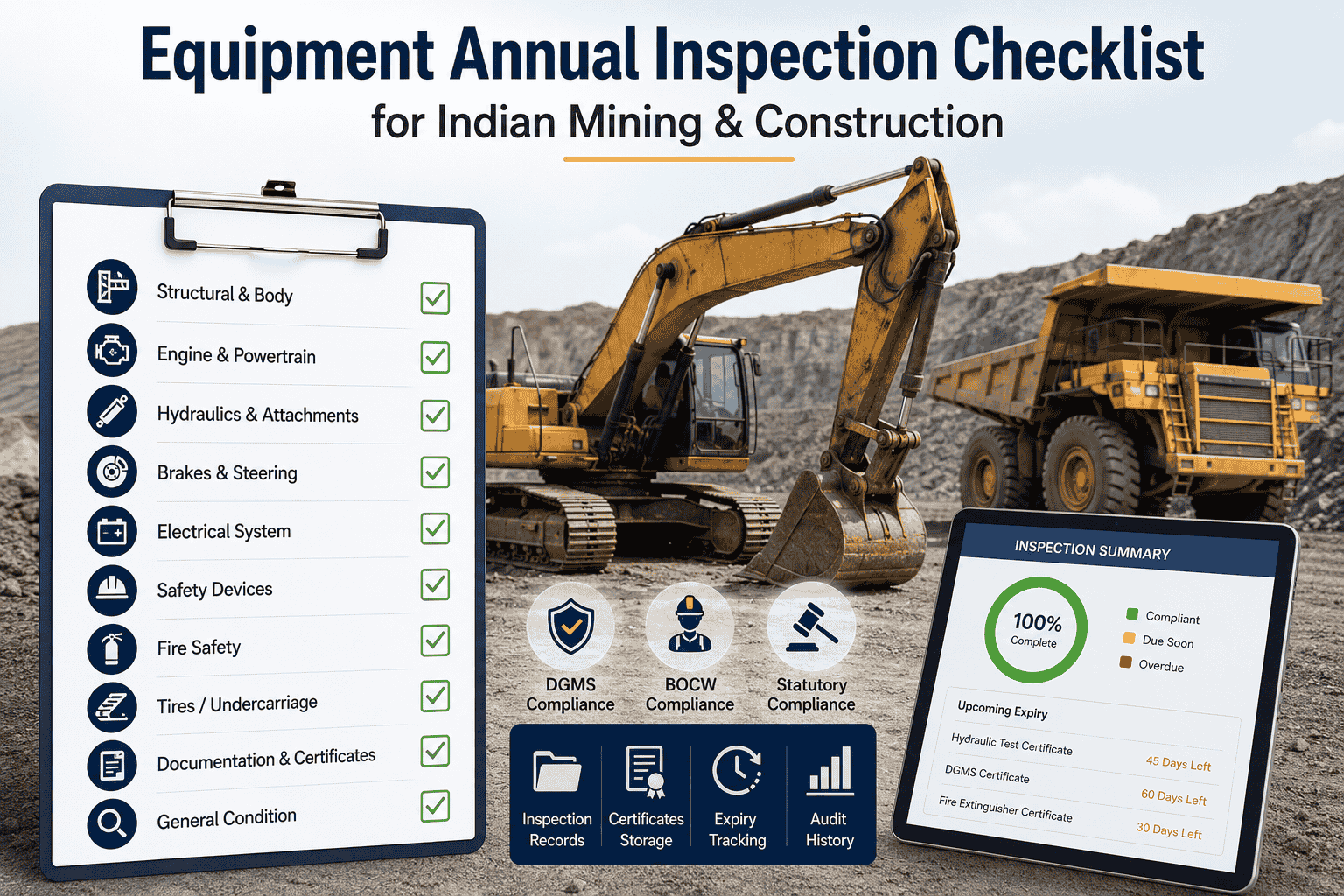
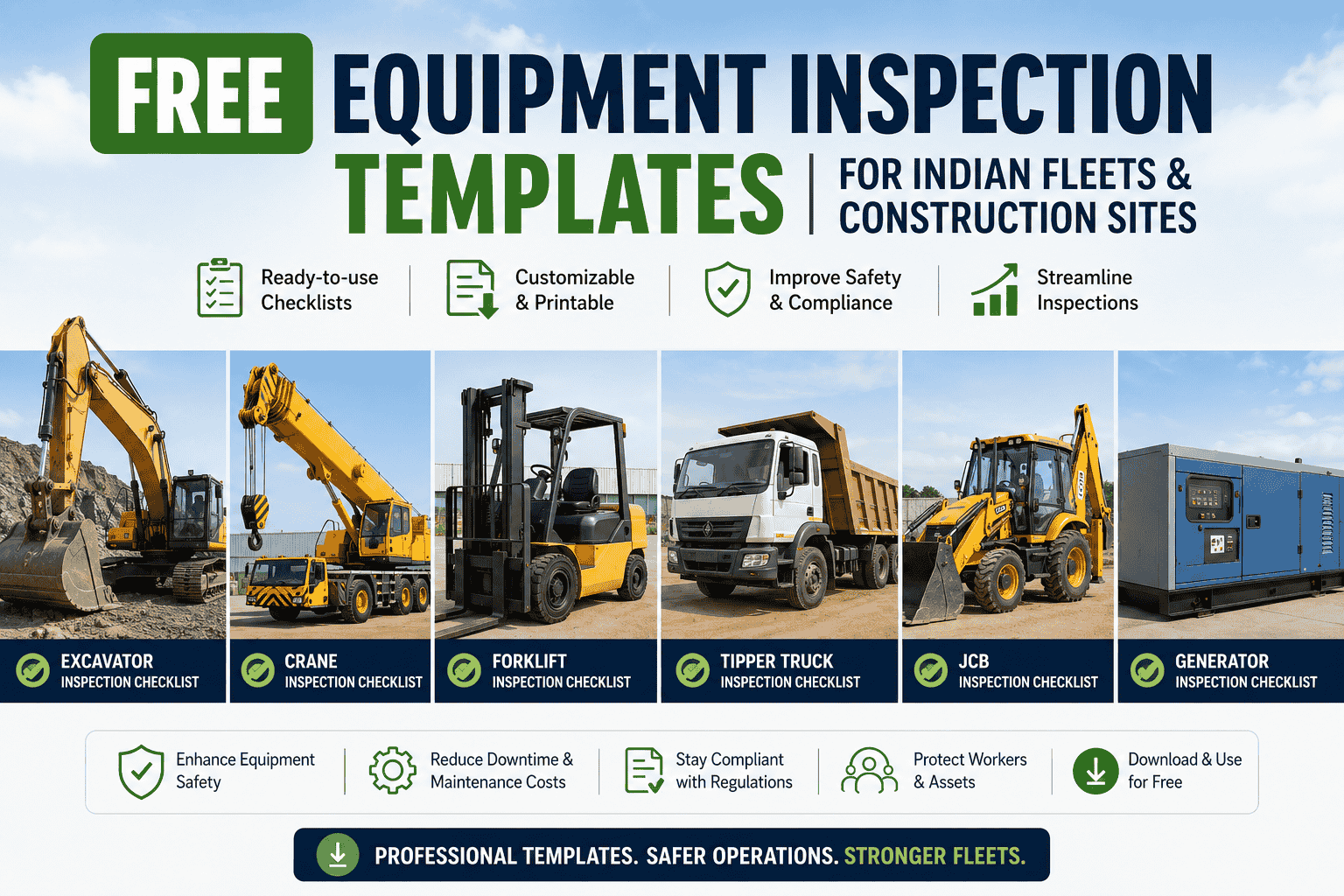
Indian mining and infrastructure companies lose crores annually due to equipment failures that a simple, well-structured inspection could have prevented. The problem is not a lack of safety awareness — it is that off-the-shelf checklist tools built for American or European fleets cannot capture the realities of a Jharkhand open-cast coal mine, a Gujarat limestone quarry, or a Delhi metro tunneling project. HVI's no-code inspection checklist builder was designed specifically for Indian operations, letting you create DGMS-aligned, AIS-140-ready, and site-specific forms in minutes without writing a single line of code. Start building your first custom checklist free.
The Only Inspection Checklist Builder Built for Indian Mining and Infrastructure Operations
Create unlimited DGMS-compliant, AIS-140-ready, and site-specific inspection forms using a visual drag-and-drop builder. No coding, no IT tickets, no weeks of waiting.
Why Your Current Inspection System Is Costing You More Than You Think
Paper Checklists Destroyed Within Days at Mine Sites
Monsoon rain in Odisha iron ore mines, red dust in Karnataka steel plants, and sub-zero fog in Jharkhand coal belts make paper forms unreadable within a single shift. When an auditor from DGMS or the Directorate of Mines asks for the last three months of pre-shift inspection data for a BEML dump truck, your team cannot produce it. This single gap has resulted in stop-work orders across multiple Indian mining companies in 2023-24, costing 8 to 12 crore per day in lost production.
Excel Templates Cannot Handle Conditional Inspections
A Tata Hitachi ZX870 excavator working in an overburden removal zone requires different inspection parameters than the same machine doing selective mining near a highwall. Excel checklists force your inspectors to answer irrelevant questions or skip critical ones. There is no way to show a hydraulic boom crack inspection section only when the operator reports abnormal vibration — but a conditional logic builder can.
Foreign SaaS Tools Miss Indian Regulatory Requirements
Tools like iAuditor or GoCanvas were built for OSHA and Australian WHS standards. They do not have fields for DGMS Regulation 93 (examination of machinery before use), Regulation 106 (testing of brakes and steering), or AIS-140 speed governor and emergency button verification. Your safety officers end up maintaining parallel paper registers for compliance, defeating the purpose of digitisation.
Every New Form Requires an IT Ticket and Weeks of Waiting
When an OCP-2 mine in Singrauli needs a new checklist for a recently procured L&T Komatsu PZ220 pipelayer, the operations team raises a request with the IT department. The IT team consults the vendor, the vendor gives a timeline, and by the time the form is ready, the machine has been operating for three weeks without a proper inspection protocol. This is a compliance violation that DGMS inspectors catch immediately.
What Indian Operators Actually Need in a Checklist Builder
Based on conversations with 120 plus safety managers across Coal India subsidiaries, NMDC, Vedanta, JSW Steel, and L&T Construction, these are the non-negotiable capabilities a checklist builder must have for Indian deployments.
DGMS Regulation Mapping
Every checklist should allow tagging fields to specific DGMS regulations — Regulation 93 for pre-use examination, Regulation 106 for brake and steering tests, Regulation 132 for electrical installations in mines, and Regulation 154 for haul road inspections. When an auditor asks for proof of compliance, the system should generate a regulation-wise compliance report in one click, not require manual cross-referencing.
OEM-Specific Parameter Fields
An Excavator PC200-8 from Komatsu has different hydraulic pressure specifications than a Tata Hitachi ZX200. A checklist builder must allow setting equipment-specific acceptable ranges — not just pass/fail checkboxes. If the swing bearing torque on a specific crane model should be between 45 and 55 Nm, the form should flag values outside this range as amber or red automatically.
Mine-Site Environmental Context
Checklists for the same equipment type should be configurable based on the operating zone. A dumper working in an OB removal zone needs different attention points than one doing coal haulage — specifically around fire risk, spontaneous combustion proximity, and blast zone clearance. The builder must support site-level template variations without creating entirely separate form libraries.
Multi-Shift Handover Integration
Indian mines typically run three shifts. A pre-shift checklist filled by the night shift operator must be visible to the morning shift maintenance team before they take over. The builder needs to support shift-tagged submissions with automatic handover flagging — if the night shift reported a hydraulic leak, the morning shift form should automatically surface that pending item for verification.
Regional Language Support for Field Workers
Over 40 percent of heavy equipment operators in Indian mines are contract workers from states like Jharkhand, Chhattisgarh, Odisha, and Bihar. Their comfort with written English is limited. A checklist builder that only produces English forms will get inaccurate responses — workers will tick "OK" on items they do not fully understand. Hindi, Odia, and Chhattisgarhi form support directly impacts data quality.
Offline-First Architecture for Remote Mines
Mining leases in Bastar (Chhattisgarh), Keonjhar (Odisha), and Dhanbad (Jharkhand) have areas with zero mobile connectivity. If a checklist app requires internet to load the form, inspectors simply skip the inspection or fill it from memory after returning to the office — making the entire exercise meaningless. The builder must produce forms that download completely to the device and sync when connectivity returns.
Ready-to-Customise Templates for Equipment Used Across Indian Sites
Every template below is pre-loaded with Indian-relevant fields and fully editable. Add, remove, or reconfigure any element in minutes.
Excavator Inspection (10T to 120T)
Covers hydraulic system pressure checks, boom and stick cylinder leak detection, track tension measurement, swing bearing play assessment, and cabin safety equipment verification. Pre-configured for Komatsu PC200, Tata Hitachi ZX series, and L&T Komatsu models common in Indian OCM operations.
Dumper and Tipper Audit (35T to 240T)
Includes brake system testing per DGMS Regulation 106, tyre condition and pressure logging, payload monitoring system check, rear dump body crack inspection, and fire suppression system verification. Aligned with BEML 100T and 190T dumper specifications used at Coal India and NMDC.
Crane and Hoist Safety Check
Wire rope diameter measurement against discard criteria, sheave alignment check, load moment indicator calibration verification, anti-two block device testing, and outrigger pad condition assessment. Covers tower cranes at metro construction sites and mobile cranes at steel plant maintenance yards.
Conveyor System Inspection
Belt condition and splice integrity check, idler roller rotation verification, skirt board gap measurement, pull cord and emergency stop testing, and dust suppression system check. Designed for the long overland conveyors used at NMDC Bailadila and Coal India SECL washeries.
AIS-140 Vehicle Compliance Form
Vehicle tracking unit installation verification, emergency response button functionality test, speed governor calibration against CMVR limits, and immobiliser system check. Required for all new commercial vehicles registered after January 2019 under AIS-140 mandate.
Crushing and Screening Plant Audit
Feeder grate condition check, jaw crusher liner wear measurement, cone crusher setting verification, vibrating screen deck inspection, and dust extraction system performance. Built for the aggregate plants feeding NHAI highway projects and railway ballast supply chains.
Drill Rig Safety Inspection
Drill steel and bit condition check, dust collector efficiency, compressor pressure verification, mast alignment assessment, and noise level monitoring. Covers surface drill rigs like Sandvik DD422i used in iron ore and limestone mines across India.
PPE and Operator Readiness Check
Helmet condition and ISI mark verification, reflective jacket adequacy, safety boot sole integrity, earplug availability for noise zones above 85 dB, and operator fitness declaration. Aligned with DGMS guidelines on personal protective equipment at mining operations.
Build a DGMS-Ready Inspection Form in Under 10 Minutes
Select Base Template
Choose from 50 plus Indian industry templates or start blank. Each template comes pre-loaded with relevant regulatory tags and OEM parameters.
Customise Fields
Drag text inputs, numeric ranges, dropdowns, photo capture, signatures, barcode scans, and date-time stamps into your form sections.
Configure Logic
Set conditional branching — if brake test result is below threshold, auto-trigger a detailed brake component inspection sub-form.
Deploy and Track
Push to specific teams, set submission schedules, define escalation rules, and monitor completion rates from a single dashboard.
Builder Capabilities That Go Beyond Simple Form Creation
15 Plus Field Types Including Annotated Photos
Go beyond text and checkboxes. Capture numeric readings with min-max validation, single and multi-select dropdowns, date-time stamps, GPS location capture, barcode and QR code scanning, photo annotations with drawing tools, and digital signatures with timestamp — all within a single form.
Multi-Level Conditional Logic Engine
Build decision trees within your forms. If an operator selects "Abnormal Vibration" in the general check, the form can branch into a hydraulic pump inspection, a swing bearing assessment, or an undercarriage check based on where the vibration is reported. This eliminates irrelevant questions and reduces inspection time by 30 to 40 percent.
Auto-Scoring with Weighted Criticality
Assign criticality weights to each field. A failed brake test scores 100 points and triggers an immediate vehicle hold, while a missing mirror scores 5 points and allows operation with a minor defect flag. The overall equipment health score is calculated automatically and trended over time.
Regulation Tagging and Audit Trail
Tag every inspection field to a specific DGMS regulation, AIS-140 clause, or internal SOP reference. When an external auditor requests compliance evidence, generate a regulation-wise report showing every inspection submission that covered that requirement — with timestamps, inspector names, photos, and signatures.
Template Versioning and Change Control
When a regulation changes or you add new equipment, create a new version of the template without losing historical data. Old submissions remain linked to the version that was active at the time of inspection, maintaining a clean audit trail that survives regulatory scrutiny.
Assignment Rules and Escalation Workflows
Set rules for who fills which form, when, and what happens if they don't. If a pre-shift dumper check is not submitted by 6:00 AM, automatically notify the shift supervisor. If a critical failure is reported, trigger a maintenance work order and prevent the equipment from being assigned to the next shift.
Honest Comparison: How Different Approaches Perform for Indian Operations
| Capability | Paper Registers | Excel Checklists | Foreign SaaS Tools | HVI Builder |
|---|---|---|---|---|
| DGMS Regulation Tagging | Manual reference | Separate tracking | Not available | Built-in tagging |
| AIS-140 Compliance Fields | Not possible | Manual entry | No India standards | Pre-configured |
| Conditional Logic | Not possible | Not possible | Basic branching | Multi-level logic |
| Offline Form Submission | Works offline | Desktop only | Rarely supported | Fully offline |
| Photo Evidence with Annotation | Separate process | Not possible | Basic photos | Annotated capture |
| Regional Language Forms | Handwritten | Limited | Rarely | 10 plus languages |
| OEM-Specific Parameter Ranges | Manual lookup | Manual entry | Generic values | Configurable ranges |
| Auto-Scoring and Health Trends | Not possible | Manual charts | Basic scoring | Weighted trending |
| Shift Handover Integration | Verbal only | Shared file | Limited | Auto handover flags |
| Audit-Ready Report Generation | Weeks of compilation | Hours of formatting | Generic reports | One-click regulation reports |
| New Form Deployment Time | Days (printing) | Hours (editing) | Days (vendor) | Minutes |
Indian Regulatory Frameworks Pre-Loaded in the Builder
Examination of Machinery Before Use
Pre-use inspection templates that cover every component a DGMS inspector expects to see verified before a HEMM machine enters an active mining zone. Includes fields for operator licence verification, safety equipment check, and structural integrity assessment of booms, sticks, and buckets.
Testing of Brakes, Steering, and Safety Devices
Detailed brake testing forms with specific stopping distance parameters for different equipment classes, steering response verification, and safety device functionality checks including reverse alarm, fire suppression trigger, and emergency stop systems.
Electrical Installation and Equipment in Mines
Inspection checklists for electrical panels, cable routing, earth fault protection, and flameproof equipment verification in underground and surface mines with electrical installations. Includes insulation resistance test fields with acceptable range validation.
Automotive Industry Standard for Vehicle Tracking
Compliance verification forms for AIS-140 mandated components including vehicle tracking unit installation, panic button functionality, speed governor calibration against prescribed CMVR limits, and immobiliser system operation — required for all commercial vehicles registered after January 2019.
Frequently Asked Questions
Can I build checklists for equipment not listed in your template library?
Yes, every template is a starting point, not a limitation. You can build a completely custom checklist from scratch using the drag-and-drop editor for any equipment type — whether it is a specialised tunnelling machine for a metro project, a cold milling machine for highway resurfacing, or a unique material handler at a port terminal. Create a custom form now.
How does the conditional logic actually work in practice?
Conditional logic lets you create rules like: if the operator selects "Hydraulic Leak Detected" in the visual inspection section, the form automatically reveals a detailed sub-form asking for leak location, severity level, and photo evidence. If they select "No Issues Found," that sub-form stays hidden. This keeps forms short for normal conditions but thorough when problems are detected.
Can I set different pass-fail criteria for different equipment models?
Absolutely. Each checklist can store model-specific thresholds. A brake stopping distance test might have a 12-metre limit for a 35-tonne tipper but an 18-metre limit for a 190-tonne dumper. The builder lets you define these ranges at the template level, so inspectors see the correct benchmark for the specific machine they are inspecting. See this in action during a demo.
What happens to old inspection data when I update a template?
Template updates create a new version without modifying or deleting historical data. Every past inspection submission remains linked to the exact template version that was active when it was filled. This version control is critical for DGMS audits where regulators may ask what the inspection criteria were on a specific date months ago.
Can my contract workers use the forms in their own language?
Yes, the builder supports forms in Hindi, Odia, Chhattisgarhi, Tamil, Telugu, Bengali, Marathi, and other regional languages. You build the form once in English and the field labels and instructions can be configured in the preferred language for each user group, significantly improving response accuracy from field workers. Try building a multilingual form.
Build Inspection Forms That Actually Fit Your Operations
Stop forcing your teams into generic templates. Create DGMS-aligned, AIS-140-ready, and equipment-specific checklists in minutes — no coding, no IT dependency, no compromise.