Any site engineer who has been through an NHAI quality audit will tell you the same thing: the violations that cost contractors money are rarely technical failures — they are documentation failures. The equipment worked fine. The inspection happened. But the record does not exist, the format is wrong, or the data cannot be found in time. India's national highway programme is currently executing over 12,000 km of active construction under NHAI and MoRTH oversight, and compliance enforcement has tightened significantly since 2024. This guide breaks down the five compliance challenges Indian EPC contractors face most frequently on highway packages, why each one occurs, and the exact digital solutions that eliminate them. If your team is preparing for an NHAI audit or building a compliance system that holds up under scrutiny, start a free HVI trial to have GPS-tagged, timestamped inspection records available from day one.
Field Guide for EPC Teams — NHAI Compliance 2026
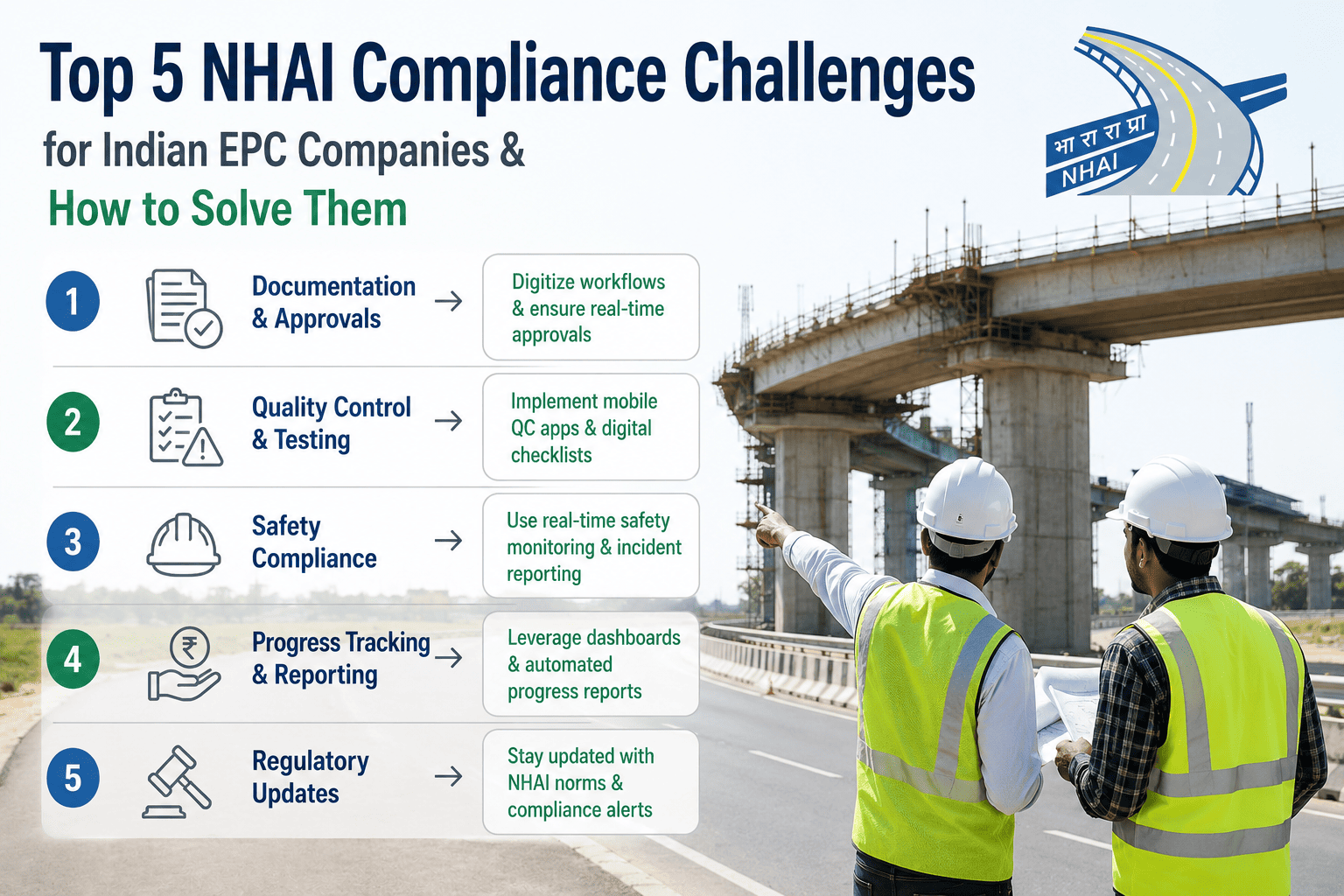
Top 5 NHAI Compliance Challenges for Indian EPC Companies — and How to Solve Them
The documentation gaps, inspection process failures, and record-keeping weaknesses that cause EPC contractors to fail NHAI audits — and the digital tools that fix each one before the next site visit.
The NHAI Compliance Environment — What Changed After 2024
NHAI EPC contracts have always required equipment inspection records, safety documentation, and PM maintenance logs. What changed from 2024 onward is the enforcement intensity. NHAI quality engineers and Independent Engineers appointed under EPC and HAM contracts are conducting more frequent unannounced site inspections, and they are specifically asking for digital records — not paper registers. Multiple contractors have faced work suspension orders and contract penalty triggers because their inspection records were either incomplete, clearly back-filled, or in a format that could not be verified.
The Building and Other Construction Workers (BOCW) Act requirements for machinery safety records run parallel to NHAI contractual obligations. A contractor who fails both simultaneously — which is common because the same paper inspection system fails both — faces compounding penalties from two regulatory directions at once.
The 5 Compliance Challenges — One by One
Challenge One
No Verifiable Pre-Shift Inspection Record for Deployed EquipmentThe Problem
NHAI and BOCW both require that machinery is inspected before deployment on each shift. In practice, most EPC sites use a paper register at the yard gate — filled in by the operator or gate attendant, often retrospectively. When an NHAI IE asks to see inspection records for a specific machine on a specific date, the register is found, but the entries are in the same handwriting, the timestamps are identical across 20 machines, and there is no location data proving the inspector was at the machine.
This is not a compliance record. It is a document that creates liability, not removes it. NHAI engineers have become familiar with back-filled paper registers, and producing one during an audit now raises questions rather than answering them.
The Digital Solution
Mobile pre-shift inspection completed by the operator at the machine generates a record with three verification layers that paper cannot replicate: GPS coordinates proving the operator was at the machine's location, a timestamp embedded at submission that cannot be retrospectively altered, and photo evidence of the machine's actual condition at the time of inspection.
When an NHAI IE asks for inspection records for Dumper MH-32 on March 14th, the site manager exports a PDF in under 60 seconds showing the operator's name, their GPS location matching the machine's deployed position, the inspection timestamp, checklist results, and any defect photographs. That is a compliance record.
Challenge Two
Defect-to-Repair Loop Has No Audit TrailThe Problem
NHAI contract clauses on equipment safety require that defects identified during inspection are remediated before the machine is redeployed on safety-critical work. With paper systems, even when a defect is noted, the trail from defect identification to work order to repair completion to machine clearance has no verifiable continuity. The inspection register says "hydraulic hose — needs attention." There is no corresponding repair record, no technician name, no parts issued, no machine reinstatement sign-off.
During an audit, this gap is often more damaging than a missed inspection. It suggests that defects are being noted for appearance rather than for remediation — a pattern that creates serious safety liability for the contractor and the project director.
The Digital Solution
Digital inspection platforms close the defect loop automatically. When the operator marks a checklist item as Fail, a work order is created in the maintenance module instantly — without manual entry. The work order is linked to the specific inspection record, the specific machine, and the specific defect photo. The workshop supervisor receives a notification, acknowledges the work order, assigns it to a technician, and records the repair completion with parts used and hourmeter at repair.
The audit trail is: inspection timestamp → defect record with photo → auto-generated work order → technician assignment → repair completion log → machine clearance for redeployment. Every step is timestamped and linked. NHAI IEs can follow this trail for any machine, any defect, any date — in under two minutes.
Challenge Three
PM Records Are Incomplete or Cannot Be Produced for Specific MachinesThe Problem
NHAI project agreements and BOCW regulations require maintenance records for machinery used on construction sites. For large EPC fleets — 30, 50, 80 machines across two or three sites — the paper-based PM register is almost always incomplete by the time it needs to be produced. Machines move between sites. Service was done but not recorded. The register for a machine that arrived from another project three months ago covers only the last two months on this site.
When an NHAI project director asks for the PM history of a specific excavator involved in a near-miss or breakdown event, an incomplete or missing PM record exposes the contractor to contractual penalty clauses around equipment maintenance obligations and safety management.
The Digital Solution
A machine-linked digital PM record follows the machine, not the site. When a Tata Hitachi EX200 moves from a Gujarat site to a Madhya Pradesh site, its complete PM history — every inspection, every service event, every defect and repair — moves with it in the platform. The new site's plant engineer can see the machine's full history from the day it was registered. There are no gaps, no missing registers, no site-transfer documentation failures.
PM records accessible from the cloud dashboard can be filtered by machine, date range, service type, and technician. A compliance export for any machine for any period generates in under 60 seconds — the format that NHAI IEs and BOCW inspectors expect to see.
Challenge Four
Inspection Compliance Rate Cannot Be Demonstrated Across a FleetThe Problem
A sophisticated NHAI quality audit does not just ask for a single machine's records — it asks for the inspection compliance rate across the fleet. What percentage of machines deployed on shift completed a pre-shift inspection in the last 30 days? Which operators have a consistent record of completing inspections and which do not? For a contractor managing 45 machines across two packages, answering this question from paper registers requires days of manual counting — by which time the audit team has formed an opinion based on the inability to answer the question in real time.
This is increasingly a benchmark question for NHAI quality engineers evaluating contractor safety management systems. Inability to demonstrate compliance rates signals a systemic gap, not just a record-keeping inconvenience.
The Digital Solution
The HVI manager dashboard shows fleet inspection compliance as a live metric — inspections completed vs. machines deployed, by shift, by site, by date range, and by operator. When an NHAI quality engineer asks for the last 30-day inspection compliance rate, the site manager opens the dashboard and shows it live in under 30 seconds. The answer is 94%, or 87%, with the breakdown by machine and the list of any missed inspections.
That level of real-time compliance visibility is itself a demonstration of a functioning safety management system — which is exactly what NHAI EPC contract quality clauses require contractors to maintain and demonstrate. Book a demo to see the compliance dashboard live.
Challenge Five
Multi-Site Compliance Cannot Be Consolidated for a Single Audit ReviewThe Problem
Large EPC contractors managing three or four active highway packages simultaneously face a consolidation problem: each site has its own register system, its own compliance officer, and its own format. When a project director at head office needs to review equipment compliance across all active sites — for an NHAI regional audit, an internal safety review, or an insurance claim — pulling records from four sites takes days and produces data in four different formats that cannot be meaningfully compared.
This problem compounds when a safety incident on one site triggers a corporate-level review of all sites. The inability to produce a consolidated, cross-site compliance picture quickly signals to NHAI that equipment safety management is site-dependent rather than systemic — which is the finding that leads to contract-level remediation requirements.
The Digital Solution
A cloud-based inspection platform with multi-site architecture shows all sites, all machines, and all inspection records in a single dashboard accessible from head office. The project director in Chennai can see compliance data from Rajasthan, Gujarat, and Maharashtra sites in the same view. Any site's data can be exported to PDF at any time. Cross-site compliance comparison is a standard dashboard view.
For NHAI regional audits that request multi-site documentation packages, the compliance report for all active sites can be compiled and exported in under 20 minutes — compared to two to three days of gathering paper records from individual sites. That difference in response time is itself a compliance signal: it demonstrates a functional, scalable safety management system rather than a site-by-site patchwork.
Build Your NHAI Compliance System in One Day
HVI gives EPC teams GPS-tagged inspection records, automatic defect-to-work-order trails, and fleet-wide compliance dashboards — everything NHAI IEs ask for, available in under 60 seconds per report.
NHAI vs BOCW Compliance Requirements — Where They Overlap
Indian EPC contractors on highway projects face dual regulatory exposure: NHAI contractual requirements from the project agreement and statutory obligations under the Building and Other Construction Workers Act. The good news is that digital inspection records satisfy both simultaneously, because both require the same core documentation. The table below maps the overlap.
| Compliance Requirement | NHAI EPC Contract | BOCW Act | How HVI Satisfies It |
|---|---|---|---|
| Pre-shift equipment inspection | Required — equipment safety management plan | Required — Section 38, building worker safety | GPS + timestamped mobile inspection per machine per shift |
| Defect identification and remediation record | Required — equipment safety and maintenance logs | Required — machinery defect register under BOCW Rules | Auto work order from every defect, repair completion log |
| Preventive maintenance schedule and records | Required — contractor to maintain PM programme | Required — periodic safety check of machinery | Hourmeter-triggered PM alerts, service event log per machine |
| On-demand record production for inspector | Required — NHAI IE can request records at any time | Required — BOCW inspector can inspect records on site visit | PDF compliance export for any machine, any date, under 60 sec |
| Operator-identified inspection records | Required — inspection responsibility per operator | Required — records identify the responsible worker | Every inspection digitally signed with operator ID and PIN |
What an NHAI Audit Visit Actually Looks Like — and How to Be Ready
NHAI audit visits to active EPC sites range from scheduled quality audits by the Independent Engineer to unannounced safety inspections by the NHAI project director or regional office. The equipment compliance checks that most frequently result in contractor non-conformance notices fall into three categories: missing or unverifiable inspection records, machines deployed without current PM clearance, and inability to demonstrate how defects are tracked from identification to closure.
Before the Visit
Run a fleet compliance audit yourselfPull the last 30-day inspection completion rate from your dashboard. Identify any machines with gaps. Check that PM service records for all machines are current and linked to hourmeter readings. Confirm that all open defects from the last week have corresponding work orders with status updates. If you cannot answer these questions in 10 minutes with digital tools, an NHAI IE cannot either — and that is a finding.
During the Visit
Open the live dashboard — do not look for paperWhen the NHAI IE or BOCW inspector arrives, open the fleet dashboard on a tablet or laptop. Show the live inspection compliance view. Pull the PDF report for any machine they name in under 60 seconds. Walk them through the defect-to-work-order trail for the last notable defect on any machine they select. Demonstrating this capability in real time communicates that your safety management system is functional and systematic, not performative.
After the Visit
Use findings to close gaps before the follow-upIf the audit identifies any gaps — an operator with a poor inspection completion rate, a machine with a PM overdue notice — the digital system makes remediation faster. Reassign the machine to a different operator, schedule the PM service, and document both actions in the platform. When the follow-up inspection happens, the records demonstrate the remediation. That is the response pattern NHAI expects from a contractor running a compliant safety management system.
Real Scenario: How a 47-Machine EPC Fleet Passed an Unannounced NHAI Audit
A highway EPC contractor running a 47-machine fleet across two NH packages received an unannounced quality audit visit from the NHAI project director's office at 8:15 AM on a working day. The site engineer received a 20-minute warning phone call. Under the previous paper register system, this call would have triggered a scramble to locate registers from three yard locations, reconcile back-entries, and hope nothing was visibly inconsistent. Under the digital inspection system deployed six months earlier, the site engineer opened the HVI dashboard on his phone before the audit team arrived. By 8:35 AM, he had printed three compliance summary reports — one for each equipment category — and had the defect-to-work-order trail open on a tablet for any machine the team wanted to review. The audit team requested records for 11 specific machines across different inspection dates. All 11 PDF reports were produced within four minutes total. The defect trail for a motor grader hydraulic issue from three weeks prior was demonstrated in full — inspection record, auto work order, technician repair log, and machine clearance. The audit closed with zero non-conformance notices related to equipment inspection. The site engineer's comment afterwards was that the audit itself was less stressful than preparing for it had been under the old paper system.
Frequently Asked Questions
What specific equipment records does NHAI require EPC contractors to maintain?
Under standard NHAI EPC contract conditions, contractors are required to maintain equipment inspection records for all machinery deployed on the project, a preventive maintenance schedule and service log for each machine, records of any defects identified and how they were rectified, and operator qualification records for machine operators. The contract also requires that these records are available to the Independent Engineer or NHAI project director on demand — which in practice means within the duration of a site visit. Paper registers rarely satisfy this on-demand requirement reliably, particularly for machines that have moved between sites or for projects that have been active for more than six months. Digital inspection platforms generate PDF compliance reports for any machine and any date range in under 60 seconds. Start an HVI trial to see the report format that satisfies NHAI record requirements.
Does the BOCW Act apply to NHAI highway construction projects and what are the equipment-related requirements?
Yes, the Building and Other Construction Workers Act 1996 applies to any construction project employing 10 or more building workers, which covers virtually all NHAI EPC projects. The BOCW Act requires employers to maintain safe working conditions for workers operating machinery, to carry out periodic safety checks on machinery and maintain records of those checks, and to identify and remediate defects in machinery before it is used. These requirements run in parallel with NHAI contractual obligations on equipment safety. A contractor who fails a BOCW machinery safety inspection while simultaneously being subject to an NHAI quality audit faces penalty exposure from two directions at once. Digital inspection records — GPS-tagged, timestamped, signed by the operator, linked to defect work orders — satisfy the evidence standard for both the NHAI IE and the BOCW inspector.
How quickly can HVI generate a compliance report for an NHAI audit request?
A PDF compliance report for any individual machine — covering any date range you specify — generates in under 60 seconds from the HVI web dashboard. The report includes the operator name and employee ID for each inspection, GPS coordinates at submission time, inspection timestamp, checklist results by zone (engine, hydraulics, tyres, cab, lights), any defect items with photo evidence, and the linked work order reference if a defect was flagged. For a fleet-level compliance summary — showing inspection completion rates across all machines for a 30-day period — the dashboard view is live and immediate, and the export takes under two minutes. For auditors conducting extended reviews, inspection data can be exported to Excel for further analysis. Book a demo to see the exact report format used for NHAI site audits.
What happens if an operator submits a false pre-shift inspection — ticking everything pass without actually checking?
Digital inspection systems reduce false submission in two ways. First, GPS coordinates embedded at submission show whether the operator was physically at the machine's location when the inspection was submitted — operators standing at the gate cannot produce the machine's GPS coordinates. Second, the structured checklist format — with sequential items that cannot be skipped — adds time pressure: an operator who actually reads and ticks 25 items correctly takes three to four minutes minimum, and the submission timestamp compared to the machine's startup log will flag any inspection submitted in under two minutes. Third, when defects are consistently never flagged by a specific operator but are found during PM services or by other operators, the inspection completion history creates a pattern that supervisors can act on. No system eliminates bad-faith submissions entirely, but digital inspection with GPS verification reduces them substantially compared to paper registers where the gate attendant often fills in the entire register for all machines simultaneously.
Can we use HVI on sites with poor mobile connectivity — remote highway or mining locations?
Yes. HVI is specifically built for Indian infrastructure site conditions, which include remote highway corridors, mining locations in Jharkhand, Odisha, and Chhattisgarh, and metro construction sites in areas with temporary network disruption. The mobile app operates in full offline mode — the operator completes their pre-shift inspection, photographs defects, and submits their signed inspection record entirely without network connectivity. All data is stored in the device's encrypted local database. When the device next connects to any network — at the end of shift, on the drive back to camp, or when the operator reaches a network coverage area — all queued inspections sync automatically to the platform. The GPS coordinates embedded at submission are the coordinates where the inspection was completed, not where it synced. NHAI compliance records are therefore geographically accurate regardless of connectivity conditions at the inspection site.
Pass Your Next NHAI Audit Without Scrambling for Records
HVI gives EPC contractors GPS-tagged inspection records, automatic defect trails, and fleet compliance dashboards that satisfy NHAI and BOCW requirements — available on demand, in under 60 seconds per report.
No credit card required. NHAI-compliant records from day one of deployment.