The toolbox talk is the cheapest safety instrument a site owns — ten minutes, no equipment, and it reaches every worker before the day's first risk does. Yet most Indian sites extract almost none of its value: the talk is given, a sheet is signed, and nothing that was said, asked, or raised survives the week. The waste compounds quietly — hazards workers mention at 7:15 die unrecorded, the same weak topics get repeated to the same blank faces, and when a Mines Act or Factories Act investigation asks whether the injured worker was ever briefed on that hazard, the site holds a bundle of signatures that prove presence and nothing else. The difference between a ritual and a system is not effort; it is documentation that compounds: scheduled topics tied to real risks, roster-verified attendance with signatures and GPS, two-question quizzes that separate "was present" from "got the message," and every raised hazard converted to an owned, dated action — building each worker's safety file shift by shift, offline at the remotest site. HVI turns the same ten minutes into all of it — sign up free and upgrade tomorrow's talk.
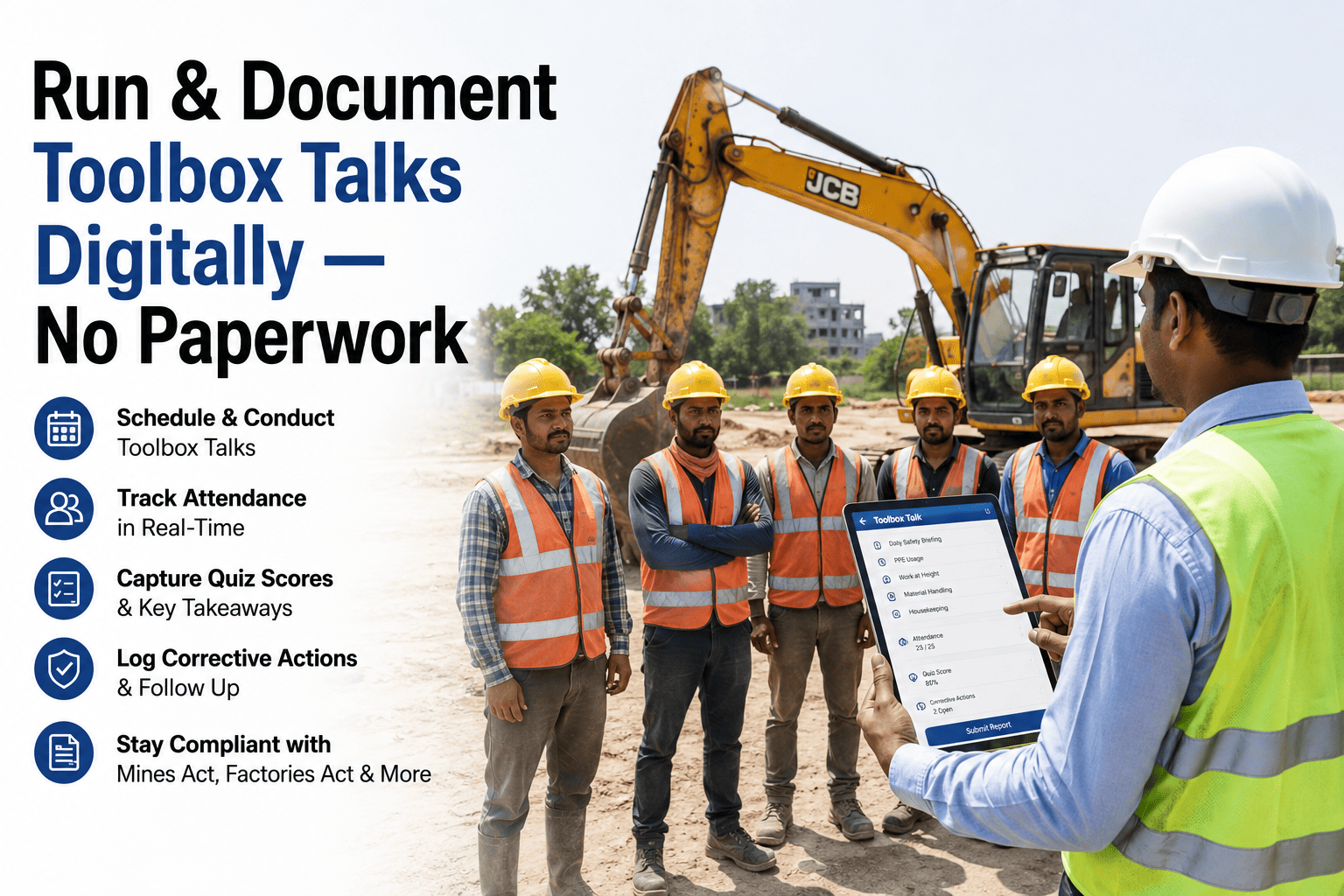
Run & Document Toolbox Talks Digitally — No Paperwork
From signed sheets nobody can find to a closed-loop safety system: scheduled topics, verified attendance, tested understanding, and actions tracked to closure — with Mines Act and Factories Act evidence built in.
Where Does Your Site Stand? The Four Levels
Every operation sits somewhere on this ladder. Each level up costs little — and pays in incidents that never happen and audits that never scramble.
No Structured Talks
Briefings happen only after something goes wrong. Hazard knowledge lives in a few heads and leaves with them.
Paper Ritual
Daily talks with sign sheets — presence recorded, understanding unknown, actions unowned, records irretrievable within weeks.
Digital Record
Talks scheduled and conducted on mobile — attendance signed and timestamped, worker-wise history searchable forever.
Closed-Loop System
Quizzes verify understanding, hazards raised become tracked actions, scores steer topic re-runs — the talk teaches the site back.
HVI takes a site from Level 1 to Level 3 in about a week — same supervisors, same ten minutes, no new hardware beyond the phones already on site.
Anatomy of a Talk That Actually Protects You
Level 3 by Next Week — Configured With Our India Team
Bring your current topic list and crew rosters to a 30-minute session; we set up your schedule, quizzes, and action routing live, and your supervisors run the first digital talk the next morning. Or start free right now and configure it yourself in an evening.
After an Incident, These Questions Come. Compare the Answers.
| The Question | Paper Answer | HVI Answer |
|---|---|---|
| Was the injured worker briefed on this hazard? | "Talks are conducted regularly" — no worker-wise proof | Topic-wise attendance: session date, signature, and quiz score for that worker |
| Did they understand the briefing? | A signature that proves presence at best | Recorded comprehension score, with any low-score repeat session logged |
| Was this hazard ever raised before? | Nobody can say — raised points were never written | Full history of the hazard across talks, with the action trail it generated |
| What did the site do about it? | Verbal assurances and meeting minutes | Corrective action with owner, due date, escalations, and closure photo |
| Show the last six months of briefings for this crew | A hunt through files, gaps explained away | Complete crew record exported in one tap, statutory-review ready |
The Four Numbers on the Safety Head's Dashboard
Percentage of rostered workers briefed today, by site and crew — with repeat absentees named, not averaged away.
Quiz scores revealing which messages land and which topics need rewriting or re-running.
Hazards raised in talks still awaiting closure, sorted by age and owner — the list reviewed in every safety meeting.
Coverage across the topic calendar, proving mandated subjects — fire, HEMM, monsoon — actually reached every crew.
Frequently Asked Questions
How should we choose weekly topics?
Blend three sources: a fixed calendar of mandated subjects, seasonal risks like monsoon operations, and last week's incidents and near-misses from your own site — the most powerful talks are about hazards crews recognise. HVI's library covers the first two; your incident data feeds the third automatically.
What about night shifts and multiple crews?
Every shift gets its own scheduled talk with its own attendance — the same topic runs across all shifts of the day, and coverage reports show each crew separately. No shift disappears from the record because its talk happened at 2 AM.
Our workers have mixed literacy. Do quizzes still work?
Yes — questions are tap-answer with simple wording in Hindi or English, and supervisors can read them aloud with workers tapping their choice. The goal is confirming the key message landed, and two spoken questions do that regardless of reading level.
Do Mines Act or Factories Act reviews actually ask for talk records?
Training and briefing evidence features in inspections and, decisively, in post-incident investigations — where worker-wise proof of briefing and understanding shapes findings on management systems. That is the record sign sheets cannot reconstruct and this system never loses; sign up free and start building it.
Can toolbox talks link with inductions and other safety records?
Yes — talks, inductions, incident reports, and equipment inspections share one system, so a worker's file shows briefings beside induction validity, and hazards raised in talks join the same action tracker as incident findings. See the whole loop in a 30-minute demo with our India team.
Ten Minutes a Day Is Already Being Spent. Start Collecting the Return.
Your site will run roughly 300 toolbox talks this year — on paper, they evaporate; on HVI, they compound into coverage you can prove, understanding you can measure, hazards closed before they become incidents, and a statutory-ready archive that builds itself. Climb from sign sheets to a closed-loop system in a week, with the same supervisors and the same ten minutes. Start free and run tomorrow's talk digitally, or bring your topic list to a 30-minute session and leave with the system configured.