An excavator that stops for want of a filter or a bucket tooth costs far more in lost hours than the part itself. Yet many Indian fleets still decide what to stock by memory, or by what the last breakdown needed. Much excavator downtime comes back to a familiar set of service parts and wear parts, and knowing which ones to keep on the shelf, and how many, is one of the simplest ways to protect uptime. This guide lists 20 spares commonly kept for excavators and explains how to track them, with tips on how fleets link parts use to each machine in HVI.
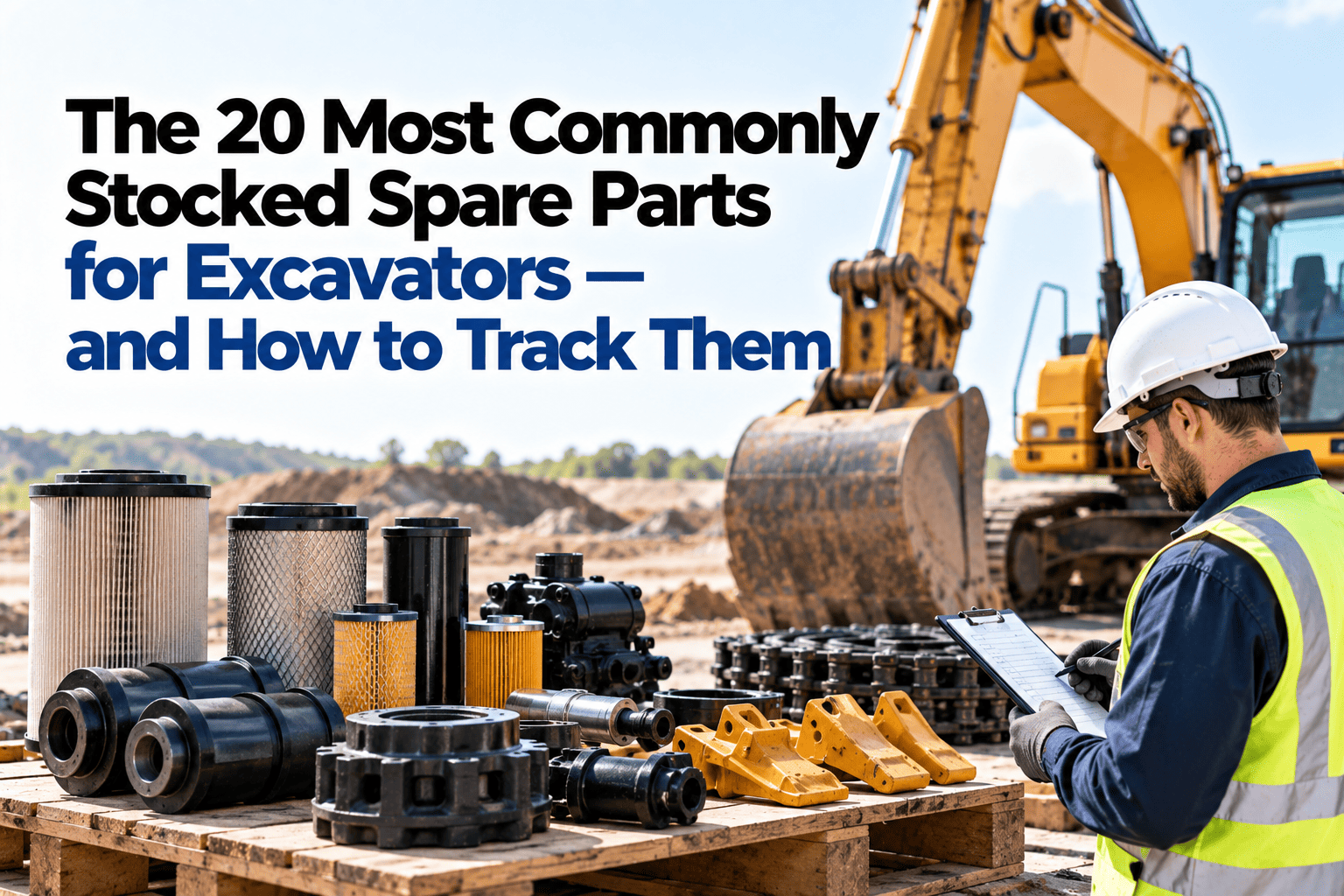
The 20 Most Commonly Stocked Spare Parts for Excavators and How to Track Them
Filters, ground engaging tools, undercarriage parts, hydraulic hoses and seals, belts and electrical spares, with practical stocking and tracking tips.
The 20 Spares to Keep on Hand
Exact part numbers depend on the make, model and serial number, so build your list from the maker's parts book for each machine.
| # | Part | Group | Usually replaced | Stock tip |
|---|---|---|---|---|
| 1 | Engine oil filter | Filters | Every engine oil service | One per machine per service |
| 2 | Primary fuel filter or water separator | Filters | At service, or sooner with poor fuel | Keep extra where fuel quality varies |
| 3 | Secondary fuel filter | Filters | At fuel system service | One per machine per service |
| 4 | Outer air filter | Filters | When the indicator shows restriction | Stock more on dusty sites |
| 5 | Inner safety air filter | Filters | With every few outer changes | Small buffer |
| 6 | Hydraulic return filter | Filters | At hydraulic service | Match to service plan |
| 7 | Pilot line filter | Filters | At hydraulic service | Match to service plan |
| 8 | Hydraulic tank breather | Filters | At hydraulic service | Small buffer |
| 9 | Bucket teeth | Ground engaging | When worn to the limit | Full sets for every bucket type |
| 10 | Tooth pins and retainers | Ground engaging | With every tooth change | Always more pins than teeth |
| 11 | Side cutters | Ground engaging | When worn | One set per bucket |
| 12 | Bucket pins and bushes | Ground engaging | When play develops | One set for key machines |
| 13 | Track shoe bolts and nuts | Undercarriage | When loose or damaged | Box of common size |
| 14 | Track rollers | Undercarriage | When worn or leaking | A few for the main model |
| 15 | Carrier rollers | Undercarriage | When worn or seized | One or two for the main model |
| 16 | Sprocket segments | Undercarriage | When teeth are hooked | Order ahead of planned work |
| 17 | Hydraulic hoses, common sizes | Hydraulic | When damaged or leaking | Most-failed hoses ready-made |
| 18 | Cylinder seal kits | Hydraulic | When a cylinder leaks or drifts | Boom and bucket kits for key machines |
| 19 | Fan and alternator belts | Belts and electrical | When cracked or glazed | One set per model |
| 20 | Fuses, relays and bulbs | Belts and electrical | When they fail | Small kit in every service van |
How Much of Each Part to Stock
Not every part needs the same rule. Sort your list into three tiers.
Filters, teeth, pins, common hoses, belts and fuses. Cheap, used often and they stop the machine if missing.
Rollers, seal kits and bucket pins. Hold a small quantity and reorder as soon as stock falls to the set level.
Sprockets and larger undercarriage parts. Order before planned undercarriage work, using wear readings.
Know Which Parts Each Excavator Really Uses
HVI records the parts used on every job against the machine and its hours, so you can see which spares each excavator consumes and plan stock from real usage.
How to Track These Parts
A simple routine turns a parts shelf into reliable data about each machine.
List by model
Record part numbers for each model in the fleet.
Issue to machines
Log every part issued against a machine and job.
Review usage
Check monthly which parts each machine uses.
Count and adjust
Count stock and update reorder levels.
Mixed Fleets and Genuine Versus Other Parts
Many fleets run excavators from several makers and buy parts from more than one source.
- Keep a separate parts list for each model
- Note which parts are shared across models
- Label shelves by model and part number
- Check serial number ranges before ordering
- Check warranty terms before using non-genuine parts
- Record the brand of every part fitted
- Compare life, not just price
- Stay with proven suppliers for critical parts
What to Test Before Choosing Software
If you are evaluating a system to track parts, try these with your own data during the trial.
Parts per machine
Can you see every part a machine has used?
Hours link
Are parts tied to machine hours, not just dates?
Site view
Can you see stock and usage across sites?
Ease on site
Can mechanics record parts quickly on a phone?
Excavator Parts Use in HVI
A sample monthly view of parts used by three excavators.
| Machine | Hours this month | Main parts used | Pattern | Status |
|---|---|---|---|---|
| EX-03 | 410 h | Filters at service | As expected | Normal |
| EX-06 | 395 h | Two air filters, one outer early | Dusty site | Raise air filter stock |
| EX-09 | 380 h | Three hoses on the boom | Repeat failure | Investigate routing |
Excavator Spare Parts FAQs
Which excavator spare parts should always be in stock?
Service filters, bucket teeth with pins and retainers, common hydraulic hoses, drive belts and a small electrical kit, because they are used often and a missing one stops the machine.
How many bucket teeth should I keep?
At least one full set for each bucket type in the fleet, plus spare pins and retainers. Increase the stock on abrasive or rocky sites where teeth wear faster.
How do I get the right part numbers?
Use the maker's parts book for each model and check the serial number range, because parts can change between production runs of the same model.
Why track parts against each machine?
It shows which machines use parts faster than expected and reveals repeat failures. Teams that record parts use in HVI can plan stock from real usage.
Can HVI help with excavator parts tracking?
HVI records parts used on each job against the machine and its hours, alongside inspections and services. Book a demo to see how it fits your parts process.
The Right Parts, on the Right Shelf
Keep the spares your excavators really need, set sensible stock levels and track every part against each machine in HVI. Less waiting for parts and more hours in the bucket.