
A highway project in Rajasthan, a coal mine in Dhanbad, a metro package in Mumbai — and no one in head office can say how many JCB filter kits exist across the three. Each site keeps its own register, so one store runs out while another sits on a year of dead stock, and purchase ends up buying at panic rates for a part already lying idle 250 km away. Month-end stock valuation never matches accounts, and auditors ask for issue records nobody can produce. HVI gives infrastructure fleets one live dashboard for every store on every site — site-wise stock, inter-site transfers, low-stock alerts, vendor reorders, and a clean audit trail, all working offline at remote locations — sign up free and connect your first two sites today.
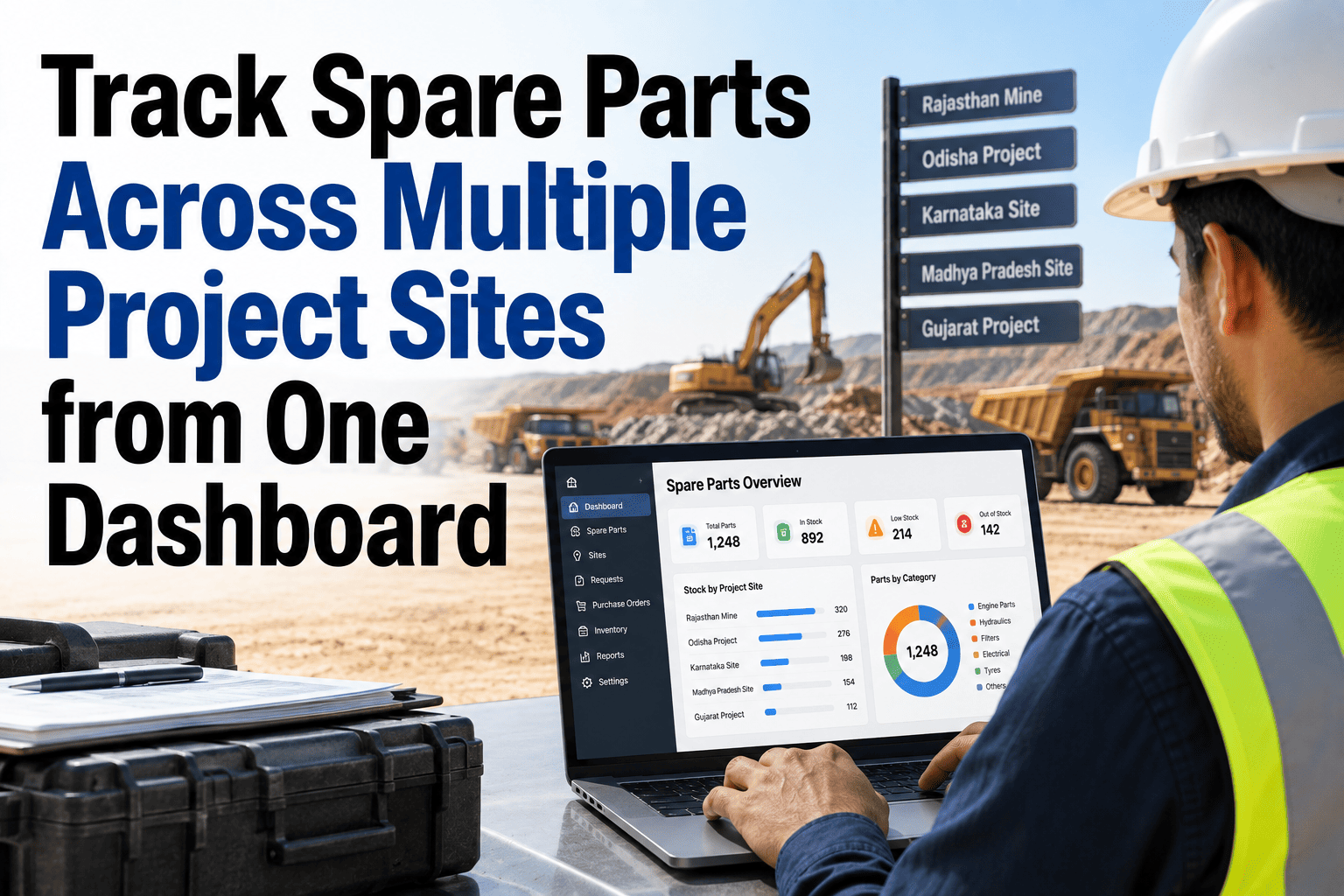
Track Spare Parts Across Every Project Site from One Dashboard
Site-wise stock, consumption trends, low-stock alerts, and vendor reorders for JCB, Tata Hitachi, BEML, Volvo, and SANY fleets — from mines to highways to metro packages, all in one screen.
What Head Office Sees: Every Site, One Screen
Instead of calling five storekeepers for numbers that were true yesterday, your dashboard shows live stock health across the project map — and drills down to any store, bin, or part number in two taps.
BEML cutting edges below minimum. Air filter kits at reorder point. PO suggested to approved vendor.
All fast movers above minimum. Volvo hydraulic hoses received against PO yesterday, stock updated automatically.
14 months of Tata Hitachi pilot filters on shelf. Transfer suggestion raised to cover Dhanbad's shortfall.
Regional buffer stock in range. Consumption trend steady across last three months, next review scheduled.
Anatomy of a Stockout — and Where HVI Breaks the Chain
A Volvo EC210 goes down on the highway package. The fitter needs a hydraulic return filter — the site store shows empty, though the register said three were left.
With HVI: stock is live, so the shortage was flagged two weeks ago when the last-but-one filter was issued against a work order.
Calls go out to other sites. Nobody is sure of their stock either. Purchase starts hunting local vendors, who quote 35% above contract rates for urgent supply.
With HVI: one search shows six filters sitting at the metro depot 250 km away — a transfer order moves one the same day.
The part finally arrives. The excavator has been idle three days — roughly ₹60,000–₹75,000 in lost production for a ₹4,200 filter.
With HVI: the machine would have been back the same evening, and the reorder PO raised automatically at contract rates.
See Your Sites on One Dashboard — In a 30-Minute Demo
Our India team sets up two of your real sites with sample stock, then shows live transfers, low-stock alerts, and consumption trends on screen. Bring your storekeeper on the call — if they can use WhatsApp, they can use HVI.
Alerts That Reach the Right Person Before the Shelf Goes Empty
HVI watches every store's consumption and fires role-based alerts — storekeepers see counts, purchase sees POs, and project heads see only what threatens uptime.
Air filter kit JCB 3DX at 2 units against minimum 6. Average consumption 5/month. Suggested PO: 8 units to approved vendor at contract rate.
Volvo hydraulic return filter: 0 at NH-48, 6 at Metro Depot with 14 months of cover. One-click transfer order with transporter note attached.
Bucket teeth consumption up 60% over 3-month average. Possible hard-strata patch or operator issue — flagged to maintenance head for review.
Built for Every Kind of Site Your Projects Run
| Site Type | Parts Challenge on the Ground | How HVI Handles It |
|---|---|---|
| Mining (DGMS regulated) | Remote location, weak network, strict audit trail for HEMM spares and brake components | Offline-first mobile store, timestamped issue records, exportable DGMS-ready audit trail |
| Highway / EPC packages | Stores spread over 60–100 km stretches, machines shifted between packages mid-project | Multiple stores per site, machine transfers carry history, stock follows the fleet |
| Metro / urban projects | Night shifts, tight laydown space, no room for excess inventory | Min-max tuned to lean stock with fast vendor reorder integration and transfer-first logic |
| Plant & crusher yards | High-value slow movers, month-end valuation mismatch with accounts | Live stock value by store, cycle count support, SAP, Oracle, and Tally sync |
Everything the Multi-Site Module Covers
Beyond alerts and transfers, HVI runs the full parts operation across your project map — each capability working per site, and rolling up to head office in real time.
Site-Wise Stock Ledger
Every receipt, issue, return, and adjustment recorded per store and bin, with running balances and the user who made each entry — a live ledger that replaces the register.
Inter-Site Transfers
Move parts between sites with in-transit tracking, transporter references, and receiving confirmation — idle stock at one project covers shortages at another.
Vendor & PO Management
Approved vendors with contract rates per part, purchase requests raised straight from low-stock alerts, and receipts booked against POs so nothing enters stock unaccounted.
Consumption Analytics
Part-wise and machine-wise consumption trends across sites — spot the excavator eating hoses, the site burning bucket teeth, and the seasonal spikes worth pre-stocking for.
Stock Valuation & Cycle Counts
Live stock value by store for month-end books, with cycle count support and variance reports — so physical, system, and accounts finally agree.
Role-Based Access
Storekeepers see their store, site heads see their site, purchase sees POs, and head office sees everything — every action permission-controlled and logged.
Frequently Asked Questions
How many sites and stores can we manage on one HVI account?
There is no practical limit — fleets run anywhere from two sites to dozens, each with multiple stores and bins under one account. Head office sees the consolidated picture while each site works only with its own stock, and permissions control who can view, issue, or approve at every level.
Can parts be transferred between project sites in the system?
Yes. When one site is short, HVI shows which other stores hold the part and raises a transfer order in one click — stock deducts from the sender and arrives as in-transit until the receiving storekeeper confirms it. Transfers are usually the single biggest saving, because idle stock replaces fresh purchases.
How do low-stock alerts and vendor reorders work together?
Each part carries a minimum and reorder quantity per store. When stock touches the minimum, the alert includes average consumption and the approved vendor with contract rate, so purchase converts it to a PO in seconds. You can watch the full alert-to-PO flow live if you book a 30-minute demo.
Does it work at remote sites with poor connectivity?
Yes — the mobile app is offline-first. Storekeepers receive, issue, and count stock without any network, and transactions sync automatically when signal returns. A mine store in Jharkhand and a city depot behave exactly the same in the dashboard once synced.
How long does it take to bring all our sites onto HVI?
Most fleets start with one or two sites in the first week — parts masters import from Excel and opening stock is captured in days. Remaining sites follow site by site without disrupting operations. You can begin today at no cost: create your account and add your first site's store this week.
One Dashboard. Every Site. No More Blind Spots.
Stop running multi-crore projects on site-wise registers and WhatsApp stock checks. Bring every store into one live system with alerts, transfers, and vendor reorders — free to start, and set up site by site at your pace.

.png)