India's highway and infrastructure projects run on heavy equipment — and heavy equipment runs on maintenance. When a Komatsu PC210 excavator on a Bharatmala package goes silent at 7 AM, the entire crew stops, penalty clauses start ticking, and your project manager starts making calls that could have been avoided. After analysing breakdown patterns across Indian EPC, highway, mining, and metro sites, eight causes account for over 80% of all unplanned equipment downtime. This page breaks each one down — what triggers it, how much it costs, and exactly what Indian project teams do to stop it from happening again. To see how HVI's inspection platform prevents these breakdowns automatically, start your free account or book a 30-minute site demo.
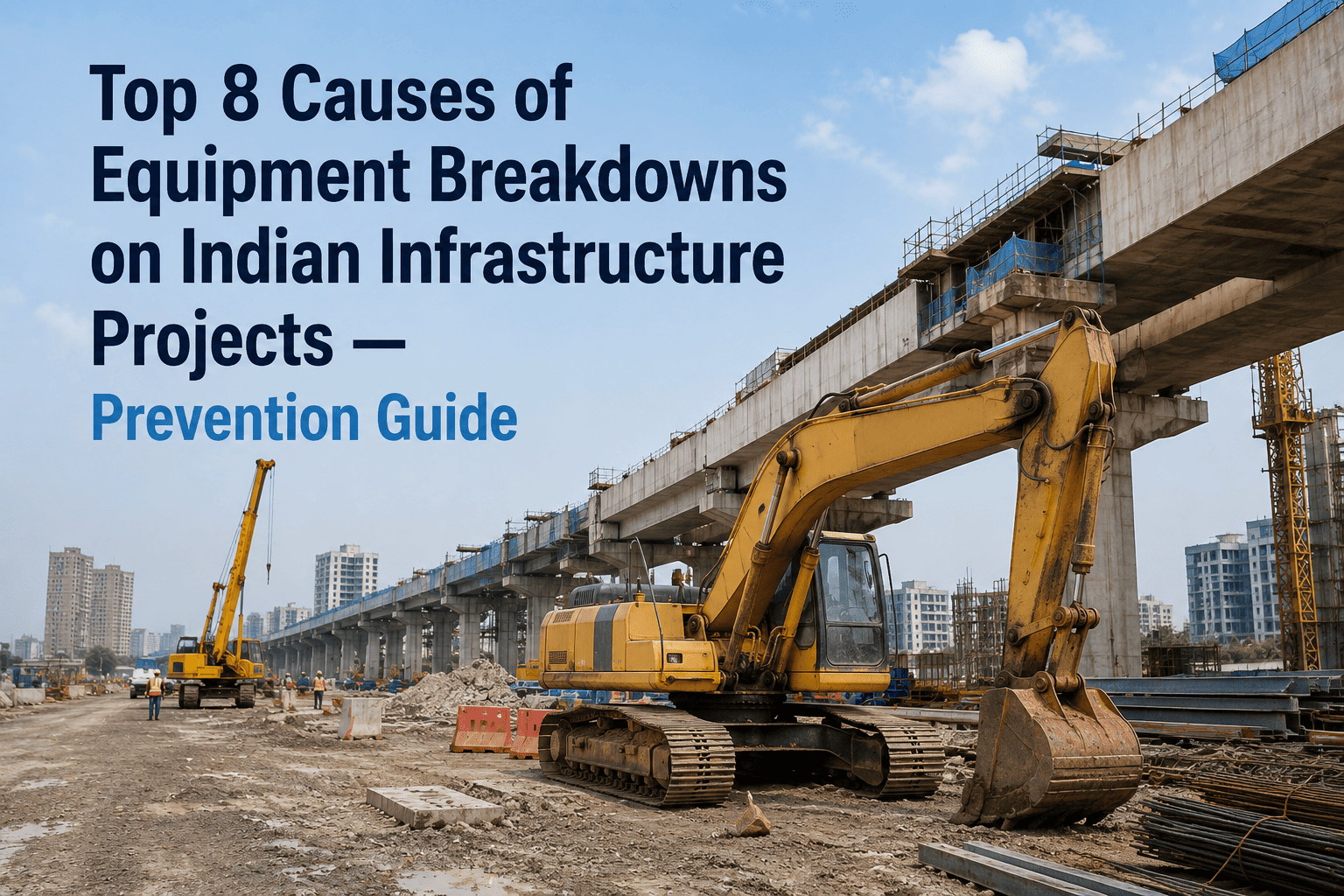
Top 8 Causes of Equipment Breakdowns on Indian Infrastructure Projects
From Bharatmala highway packages to metro tunnels and open-cast mines — these are the real failure modes costing Indian EPC contractors crores in preventable downtime every year.
Each cause below includes the warning signs your operator will notice first, why it gets missed on Indian project sites, and the exact prevention steps that stop it. The fix column shows what a digital maintenance system catches automatically — versus what falls through the cracks on paper-based sites.
Hydraulic failures are the single leading cause of excavator and dozer breakdowns across Indian construction sites. Dust-laden environments accelerate seal wear; contaminated hydraulic fluid destroys pump internals; and hose fatigue from constant flexing in rocky terrain causes sudden blow-outs. On Indian sites, the problem is compounded because hydraulic oil changes are often delayed well beyond 1,000-hour intervals due to procurement delays.
On highway packages covering 100+ km with equipment scattered across packages, PM schedules tracked in Excel or paper logs get missed — not because no one cares, but because no one has real-time visibility. A motor grader due for a 250-hour engine oil service keeps running at 290 hours because the site engineer is managing three other issues. That 40-hour overrun costs ₹3–5 lakh in accelerated engine wear over 12 months.
Indian highway, quarrying, and mining sites generate extreme dust loads — far beyond what equipment manufacturers design for in standard environments. Air filters clog in 60–80 hours instead of the rated 250 hours. Fuel tanks breathe in airborne silica. Hydraulic reservoirs get contaminated during open-air oil top-ups. The result is accelerated wear across every major system simultaneously — engine, hydraulic, final drives. Sites near soil stabilisation or crusher operations are especially vulnerable.
Indian EPC sites commonly use operators from diverse backgrounds — many skilled but trained informally, without formal machine-specific certification. Overloading a dumper beyond its rated capacity, using an excavator as a crane to lift concrete elements, aggressive throttle use on cold engines, and failure to complete warm-up cycles all cause premature wear that compounds over months before a catastrophic failure occurs. Without a pre-shift inspection record, there is no evidence trail when a gearbox or final drive fails after 2,000 hours instead of 8,000 hours.
Adulterated diesel is a documented problem on remote Indian project sites where fuel is sourced from local dealers with inconsistent quality control. Water contamination from poor storage practices — open drums, uncovered tanks — reaches injection pumps and common rail fuel systems. A single tankful of contaminated fuel can destroy a high-pressure injection pump worth ₹2–4 lakh on modern CEV-IV compliant engines. Remote highway and mining packages in Rajasthan, MP, and Chhattisgarh are especially exposed to fuel quality issues.
Excavator undercarriage — tracks, rollers, sprockets, and idlers — wears three to four times faster on rocky or abrasive terrain than on soil. On Indian quarrying and hill road projects, track tension is rarely checked daily, leading to derailments and roller failures that halt production for 6–16 hours. Similarly, OTR tyres on motor graders and dumpers on highway packages develop cuts and sidewall damage that go undetected until a tyre blows out under load. Undercarriage and tyre costs can represent 20–30% of total maintenance spend on excavators over a project lifecycle.
Modern CEV-IV construction equipment is significantly more electronics-dependent than earlier generations. ECU faults, sensor failures, and alternator issues now account for a growing share of non-starts and mid-shift shutdowns on Indian sites. Vibration in rocky terrain loosens connections; monsoon moisture causes short circuits; and battery failure in remote areas means waiting hours for a replacement. Sites that do not include electrical system checks in their daily inspection routines miss early warnings like warning lights, unusual sensor readings, and parasitic drain symptoms.
This is not a mechanical failure — it is a management failure that enables every other cause on this list. When inspections happen on paper, via WhatsApp photos, or not at all, there is no accountability, no audit trail, and no early warning system. A hydraulic leak that should have been flagged at 7 AM becomes a ₹4 lakh pump replacement at 3 PM. The single highest-ROI action any Indian EPC company can take is deploying a digital, photo-verified inspection system that makes pre-shift checks mandatory, automatic, and traceable across the entire fleet.
Every Cause Above Has a Digital Fix. HVI Implements All of Them.
Photo-verified inspections, automated PM scheduling, instant work orders, and audit-ready reports — deployed on your site in under 10 minutes, no hardware required.
Preventing equipment breakdowns on Indian EPC sites is not about buying newer machines — it is about building three systematic layers of protection that work together, every shift, across every asset.
Every operator inspects their machine before starting work — hydraulics, tyres, undercarriage, engine oil, fuel, battery, and warning lights. Photo evidence goes into the system with GPS tag and timestamp. This single habit catches 60% of imminent failures before the machine even moves. Paper-based sites skip this; digital sites make it impossible to skip.
Preventive maintenance triggered by engine hours, kilometres, or calendar — not by someone remembering. Services are planned 7–10 days in advance so spares arrive before the due date. No emergency procurement, no 2x dealer pricing, no machine sitting idle waiting for an oil filter that could have been ordered last week. This layer eliminates cause #2 and dramatically reduces causes #1, #3, and #6.
When an operator flags a defect in the inspection, a work order is automatically created for the site mechanic — with the photo, the machine ID, and the priority level. No phone calls, no WhatsApp forwarding, no information lost in shift handovers. The mechanic sees it, acts on it, and closes it with a repair record. Site manager sees the resolution timeline. Project owner sees the audit trail. All three causes of management failure are eliminated at once.
Register Your Fleet — Under 10 Minutes
Add your assets to HVI by machine type, make, model, and current hour-meter or odometer reading. No IT team, no hardware, no on-premise server. Works from a laptop or mobile phone at the project office.
Configure Site-Specific Inspection Checklists
Set up inspection templates matched to your asset types — excavator pre-shift, dumper daily, batching plant weekly. Add extra checks for high-dust environments, monsoon conditions, or rocky terrain. Templates are available in Hindi for operator use.
Set PM Schedules for Every Asset
Configure preventive maintenance intervals — excavator hydraulic oil at 1,000 hours, grader engine oil at 250 hours, transit mixer drum at 500 cycles. HVI sends alerts 7–10 days before due dates and auto-creates work orders when service is overdue.
Operators Start Daily Inspections — Defects Go Straight to Mechanic
Operators open HVI on their phone, complete the inspection with photos, and submit. Any defect flagged automatically creates a prioritised work order for the site mechanic — no phone call, no WhatsApp, no information gap between shifts.
Project Manager Gets Live Fleet Dashboard & Audit Reports
Real-time visibility of every asset's status, breakdown frequency, maintenance cost, and PM compliance across all project packages. One click generates an audit-ready inspection report for your owner's engineer or NHAI compliance requirement — no paper hunting, no Excel compilation.
01 How much downtime can we realistically expect to reduce in the first 3 months? ⌄
02 Our operators have limited digital experience. Will they actually use a mobile inspection app? ⌄
03 We work on remote sites where 4G is unreliable. Does the system work without network? ⌄
04 Which equipment types and brands does HVI support for Indian EPC fleets? ⌄
05 Can we use HVI to generate compliance reports for NHAI or our owner's engineer? ⌄
8 Causes. One Platform That Addresses All of Them.
Indian EPC contractors on Bharatmala, metro, and mining projects are deploying HVI to turn all 8 breakdown causes above into checklist items — caught before shift start, fixed before they become failures.