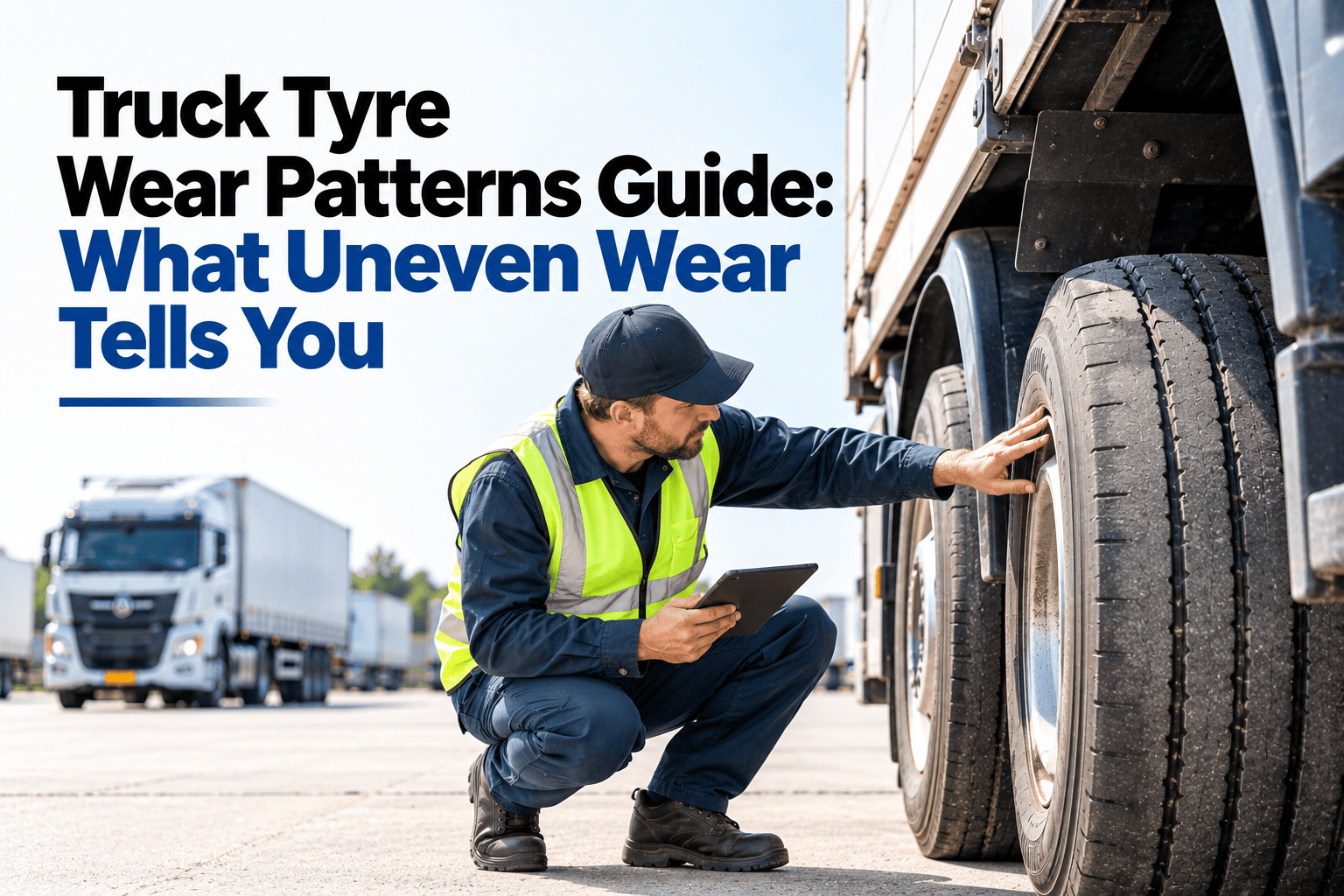
Tyres are often the second biggest running cost of a truck after fuel, and most of them are thrown away early for reasons nobody spotted. The clues are written on the tread. A worn shoulder, a bald centre, scalloped dips or sharp feathered edges each point to a specific problem with pressure, alignment, suspension or loading. Read them early and you fix a cheap cause instead of buying a new tyre. This guide explains the common wear patterns on Indian trucks and buses, and how fleets track tyre wear with photo inspections in HVI.
Truck Tyre Wear Patterns Guide: What Uneven Wear Tells You
Learn to read shoulder wear, centre wear, cupping, feathering and more, find the real cause behind each one and get more kilometres from every tyre.
Eight Wear Patterns and What Each One Means
Each graphic shows remaining tread depth. Taller bars mean more rubber left. Across the tread means shoulder to shoulder, and around the tyre means along its circumference.
Both shoulders worn
Cause: Under-inflation or overloading
Fix: Set correct cold pressure for the load and stop overloading
Centre worn
Cause: Over-inflation for the load carried
Fix: Reduce to the recommended pressure for that load
One shoulder worn
Cause: Camber or toe misalignment, or bent axle parts
Fix: Full wheel alignment and check for worn kingpins
Feathering
Cause: Toe-in or toe-out out of adjustment
Fix: Reset toe. Rib edges feel sharp one way, smooth the other
Cupping or scalloping
Cause: Worn shock absorbers, imbalance or loose wheel bearings
Fix: Check suspension and bearings, then balance the wheel
Heel and toe wear
Cause: Driving and braking torque on lug-type drive tyres
Fix: Rotate drive tyres on schedule and avoid harsh braking
Diagonal or flat spots
Cause: Axle not parallel, locked brakes or skidding
Fix: Check axle alignment and brake balance
One dual wears faster
Cause: Different pressures or mismatched tyre sizes
Fix: Match duals by size and tread, and equalise pressure
Where on the Vehicle Each Pattern Shows Up
Wheel position narrows down the cause quickly. These are the patterns workshops see most often on Indian trucks and buses.
| Position | Most common pattern | Usual cause | First check |
|---|---|---|---|
| Steer axle | One shoulder worn, feathering | Toe or camber out, worn steering parts | Alignment and steering linkage |
| Drive axle | Heel and toe, both shoulders | Torque, under-inflation, overloading | Pressure and rotation schedule |
| Trailer axle | Diagonal wear, flat spots | Axle misalignment, brake lock-ups | Axle tracking and brakes |
| Dual wheels | One tyre of the pair worn faster | Pressure or diameter mismatch | Pressure of both and tread match |
| City bus front | Outer shoulder worn | Tight turns and kerb contact | Rotation and driver turning habits |
Catch Uneven Wear While It Is Still Cheap to Fix
HVI lets inspectors photograph each tyre, record tread depth and pressure, and send alignment or suspension jobs straight to the workshop.
Fix the Cause, Not Just the Tyre
Replacing a badly worn tyre without fixing the cause means the new tyre wears the same way. Five root causes explain almost every pattern above.
Pressure
Check cold pressure weekly with a calibrated gauge, not by kicking the tyre.
Alignment
Align after any steering repair, kerb strike or new uneven wear.
Suspension
Replace worn shock absorbers, bushes and springs before they cup new tyres.
Loading
Overloading and uneven loads overheat and crush shoulders.
Driving
Harsh braking, fast cornering and kerb contact all leave marks.
A Tyre Inspection Routine That Fits Any Fleet
Spread these checks across the people who already touch the vehicle, so tyre care does not depend on one busy tyre man.
Driver walk-around
Look for cuts, bulges, low tyres and stones between duals.
Pressure and tread
Check cold pressure and tread depth, and photograph any uneven wear.
Pattern review
Compare photos over time and book alignment or suspension work where wear is growing.
Record and retread
Note the wear pattern and send good casings for retreading before tread runs too low.
How HVI Tracks Tyre Wear Over Time
A sample record for one steer tyre. Monthly photo inspections show the outer shoulder wearing faster than the rest of the tread.
What HVI did
Truck Tyre Wear FAQs
What causes uneven tyre wear on trucks?
The main causes are wrong inflation pressure, wheel misalignment, worn suspension parts, overloading and harsh driving. Each cause leaves its own pattern, such as shoulder wear for under-inflation or feathering for toe problems. Reading the pattern tells you which one to fix first.
How do I tell feathering from cupping?
Feathering runs across the tread: the edges of each rib feel sharp when you slide your hand one way and smooth the other way. Cupping runs around the tyre as a series of dips and high spots you can see and feel along the circumference. Feathering usually means toe misalignment, while cupping points to suspension or balance problems.
How often should truck tyre pressure be checked?
At least once a week, and always when the tyres are cold, using a calibrated gauge. Long-haul trucks and heavily loaded tippers benefit from checks before every long trip. Teams that record pressures in HVI can see which vehicles keep losing air.
Can a tyre with uneven wear be retreaded?
Often yes, as long as the casing is sound and the tyre is removed before the tread wears too low. Badly worn shoulders or exposed belts can make the casing unfit for retreading. That is why catching uneven wear early protects the casing as well as the tread.
How can a fleet track tyre wear across many vehicles?
Record tread depth, pressure and a photo for each tyre position at regular inspections. Comparing records over time shows which tyres are wearing unevenly and which vehicles need alignment or suspension work. Book a demo to see tyre wear tracking in HVI.
Get More Kilometres From Every Tyre
Photograph and measure every tyre, spot uneven wear as it starts and send the real cause to the workshop. Longer tyre life, more retreadable casings and fewer roadside tyre failures.