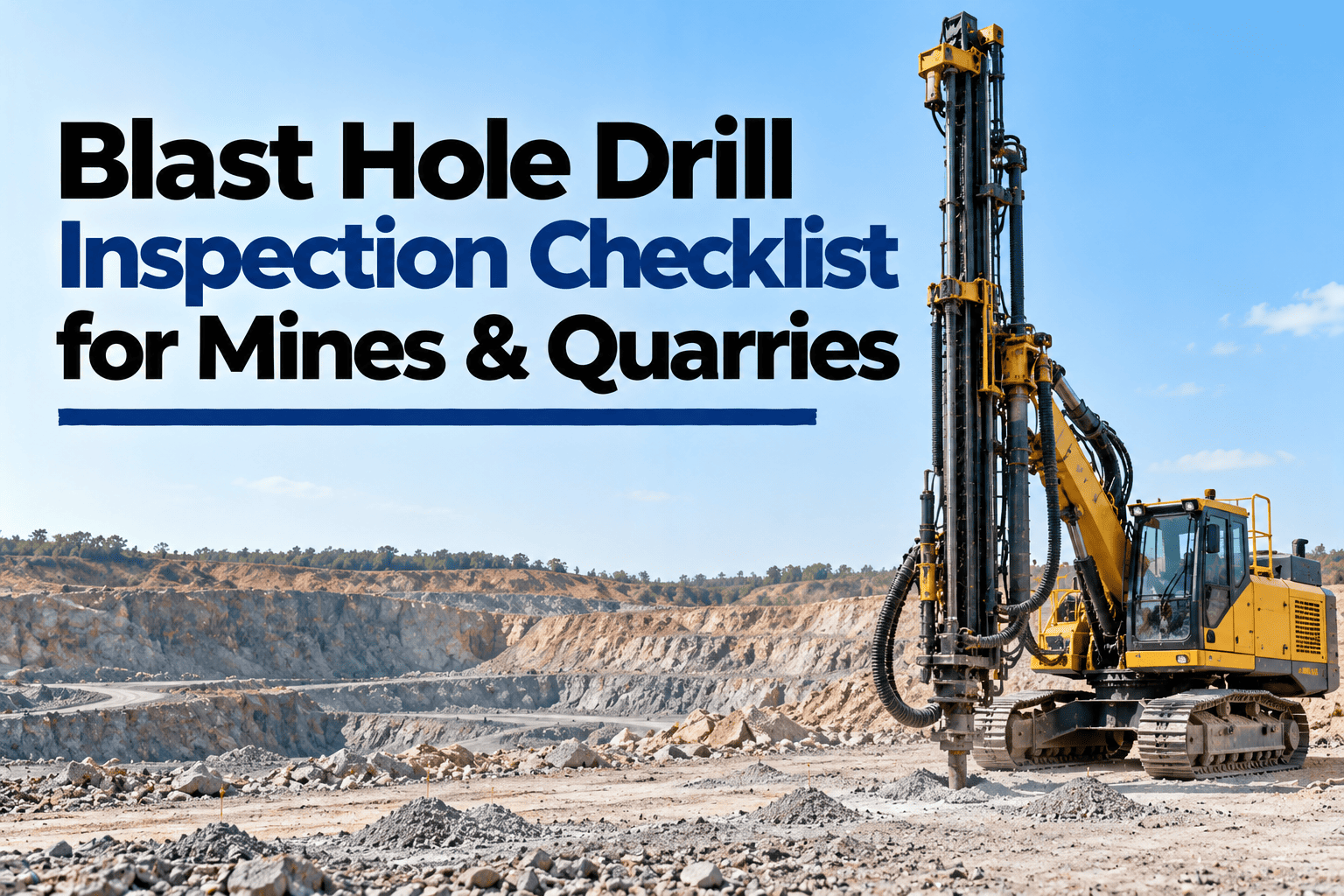
In an open-cast mine or quarry, every tonne starts with a drilled hole. If the blast hole drill stops, blasting stops, and shovels and dumpers soon run out of work. Drills also work near bench edges, handle heavy rods and raise dust, so faults quickly become safety problems. Poor holes often trace back to a worn bit, a bent rod or a weak compressor. This guide gives a daily checklist, and shows how mines record drill checks with photos in HVI.
Blast Hole Drill Inspection Checklist for Mines and Quarries
Mast and feed system, drill rods, bits and DTH hammer, compressor, dust collector, hydraulics, tracks and cab safety devices.
Pre-Start Checklist
The operator should complete these before tramming or drilling each shift. Do not drill if any safety item fails.
Component Inspection Guide
Inspect these regularly alongside the daily check. Follow the drill maker's manual for limits and service intervals.
| Component | What to inspect | Warning signs |
|---|---|---|
| Mast and feed | Welds, pins, feed chain or cylinder, guides | Cracks, worn guides, slack feed |
| Rotation head | Gearbox, seals and mounting | Oil leaks, noise, loose bolts |
| Drill rods | Straightness, threads and wear | Bent rods, damaged or worn threads |
| Bits and DTH hammer | Buttons, gauge and hammer performance | Flat or broken buttons, loss of gauge |
| Compressor | Oil, filters, separator and pressure | Low pressure, overheating, oil carry-over |
| Dust collector | Filters, fan, hoses and skirt | Dust at the collar, high filter pressure |
| Tracks and frame | Pads, rollers, tension and frame welds | Loose pads, worn rollers, cracks |
Looking After Bits and Rods
Consumables are a major running cost. Good habits stretch their life and keep holes straight.
Inspect bits
Check buttons and gauge after every few holes.
Regrind on time
Regrind worn buttons before they break.
Rotate rods
Share wear evenly across the rod set.
Protect threads
Clean and grease threads at each change.
Every Drill Checked Before Every Shift
HVI gives drill operators this checklist on their phone, records photos of defects and tracks bits, rods and services for each drill, so problems are fixed before they stop blasting.
Compressed Air and Dust Control
Air drives the hammer and clears the hole. Dust control protects the operator and meets site conditions.
- Check oil level and air filter every shift
- Drain water from the receiver as instructed
- Watch working pressure and temperature
- Service the separator and filters on time
- Keep the skirt sealed to the ground at the collar
- Clean or replace blocked filters
- Check the fan and hoses for damage
- Use water injection where fitted and allowed
Working Safely on the Bench
Drills work close to bench edges and handle heavy steel, so site rules must be followed every time.
Keep the drill a safe distance from the bench crest as set by your mine's rules, and tram with the mast lowered where the maker requires it. Never stand near rotating rods or under a raised mast, and use the rod handling system rather than lifting rods by hand.
Drill Status in HVI
A sample view across a mine, showing each drill's daily check, metres drilled and open defects.
| Drill | Bench | Daily check | Metres this week | Status |
|---|---|---|---|---|
| DR-01 | Bench 3 north | Passed | 1,240 m | Drilling |
| DR-02 | Bench 5 east | Passed, filters dirty | 980 m | Clean dust filters |
| DR-04 | Bench 2 south | Failed, mast pin clip missing | 1,060 m | Do not drill |
Blast Hole Drill Inspection FAQs
What should be checked on a blast hole drill every shift?
Engine, hydraulic and compressor oil, the mast and feed system, drill rods, bits, the dust collector, tracks, emergency stops, horn and the cab fire extinguisher, all before tramming or drilling.
Why is my drill penetrating slowly?
Common causes are worn or flat bit buttons, low air pressure from the compressor, a worn DTH hammer or too little feed force. Check the bit first, then air pressure and the hammer.
When should drill bits be reground?
Regrind buttons when they show flat wear, before they crack or break. Regular regrinding keeps penetration high and extends bit life. Follow the bit maker's guidance on intervals.
How do I reduce dust from a blast hole drill?
Keep the dust collector filters clean, make sure the skirt seals at the collar and use water injection where allowed. Teams that log filter checks in HVI keep dust control on track.
Can drill inspections be recorded digitally?
Yes. Operators complete daily checks with photos, and bits, rods and services are tracked per drill. Book a demo to see blast hole drill checklists in HVI.
Keep the Drills Turning and the Blasts on Schedule
Run daily drill checks, look after bits and rods, keep dust under control and track every defect in HVI. Better hole quality, fewer breakdowns and steady production.