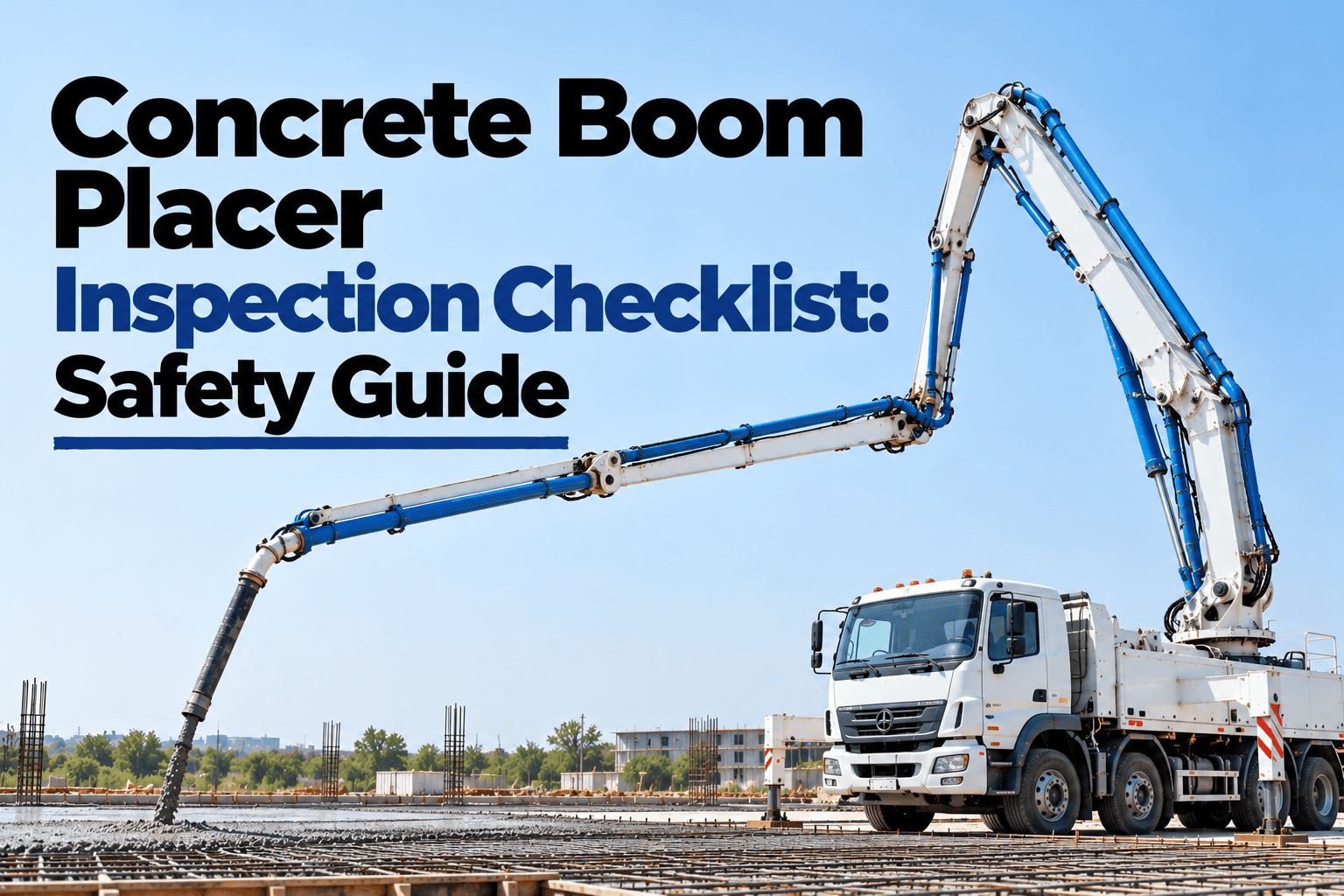
On a high-rise site, the boom placer swings a heavy, pressurised pipeline over the people placing concrete. A worn pipe can burst, a loose clamp can let go and an anchoring fault can bring the boom down. As the building rises, the boom climbs and its anchoring changes, so each move needs checking. An inspection before every pour, with pipeline thickness tracked over time, keeps these risks under control. This checklist covers it, and shows how sites record boom checks and readings in HVI.
Concrete Boom Placer Inspection Checklist: Safety Guide
Boom sections and pins, pipeline and clamp wear, slewing ring, hydraulics, mast anchoring, counterweight and remote controls, checked before every pour.
Pre-Pour Checklist
The operator should complete these before every pour. Do not pump if any safety item fails.
Structure and Mounting Checks
Check these at every climb or relocation and at regular intervals between. Follow the manufacturer's manual for limits and torque values.
| Component | What to check | Stop work if |
|---|---|---|
| Mast and anchoring | Floor frames, wedges, tie-ins and verticality | Loose wedges, cracked frames or mast out of plumb |
| Slewing ring | Bolts, play and lubrication | Missing or loose bolts, excessive play |
| Boom sections | Welds, plates and pin bores | Cracks, bends or worn pin bores |
| Boom cylinders | Seals, rods and holding valves | Boom drifts down or leaks heavily |
| Counterweight | Mounting and security | Loose, incomplete or wrongly fitted |
Managing Pipeline Wear
Abrasive concrete thins the pipeline from inside, out of sight. Measuring wall thickness is the most reliable way to know when it is unsafe.
Measure
Use an ultrasonic thickness gauge at set points.
Record
Log each reading against the pipe's position.
Rotate
Turn straight pipes to spread the wear.
Replace
Change any pipe below the maker's minimum.
Safety During Pumping
Many boom placer injuries happen during pumping or while clearing blockages.
Never stand under the boom or within reach of the end hose while pumping. Never open a clamp or clear a blockage while the line is under pressure. Stop work when wind exceeds the maker's limit, and keep the boom clear of overhead power lines.
Every Pour Checked, Every Reading Stored
HVI records pre-pour checks, photos and pipeline thickness readings for each boom placer, so worn pipes and mounting faults are flagged before they become accidents.
Remote Control and Operation
The remote control puts the boom in the operator's hands. Keep it reliable and use it with care.
- Battery charged and spare available
- Emergency stop cuts all movement
- Joysticks return to neutral
- Casing and strap undamaged
- Keep the boom in clear view at all times
- Move slowly near structures and people
- Use a signaller when sight is blocked
- Fold and secure the boom after work
After the Pour
Good clean-up protects the pipeline and makes the next pour faster and safer.
Wash out the line
Clear all concrete before it sets.
Clean clamps
Remove concrete from clamps and couplings.
Grease points
Lubricate pins and slewing ring as specified.
Report defects
Record anything found during the pour.
Boom Placer Status in HVI
A sample view across towers, combining pre-pour checks with the lowest pipeline reading on each boom.
| Boom placer | Tower and floor | Pre-pour check | Lowest pipe reading | Status |
|---|---|---|---|---|
| BP-01 | Tower A, level 22 | Passed | 74% left | Ready to pour |
| BP-02 | Tower B, level 18 | Passed | 56% left on a bend | Order spare bend |
| BP-03 | Tower C, level 9 | Failed, loose wedge | 69% left | Do not pump |
Boom Placer Inspection FAQs
What should be checked on a boom placer before each pour?
Mast anchoring and wedges, counterweight, boom pins and clips, pipeline clamps, hydraulic leaks, the end hose and safety rope, the remote control and emergency stop, and wind speed.
How do I know when a concrete pipe needs replacing?
Measure wall thickness with an ultrasonic gauge and compare it with the maker's minimum. Bends usually wear fastest, so check them more often and replace any pipe below the limit.
Why is mast anchoring so important?
The anchoring carries the boom's weight and moving loads into the structure. Loose wedges or cracked frames can let the mast move or tip, so check them after every climb and before each pour.
Can a boom placer be used in high wind?
Only within the wind limit set by the manufacturer. Above it, stop pumping and secure the boom. Teams that record checks in HVI can log wind readings with each pour.
Can pipeline thickness readings be tracked digitally?
Yes. Each reading can be recorded against the pipe's position, so wear trends show which pipes need replacing next. Book a demo to see boom placer records in HVI.
Safer Pours on Every Floor
Check boom placers before every pour, track pipeline wear and record anchoring at every climb in HVI. Fewer pipe bursts, safer crews and confident high-rise concreting.