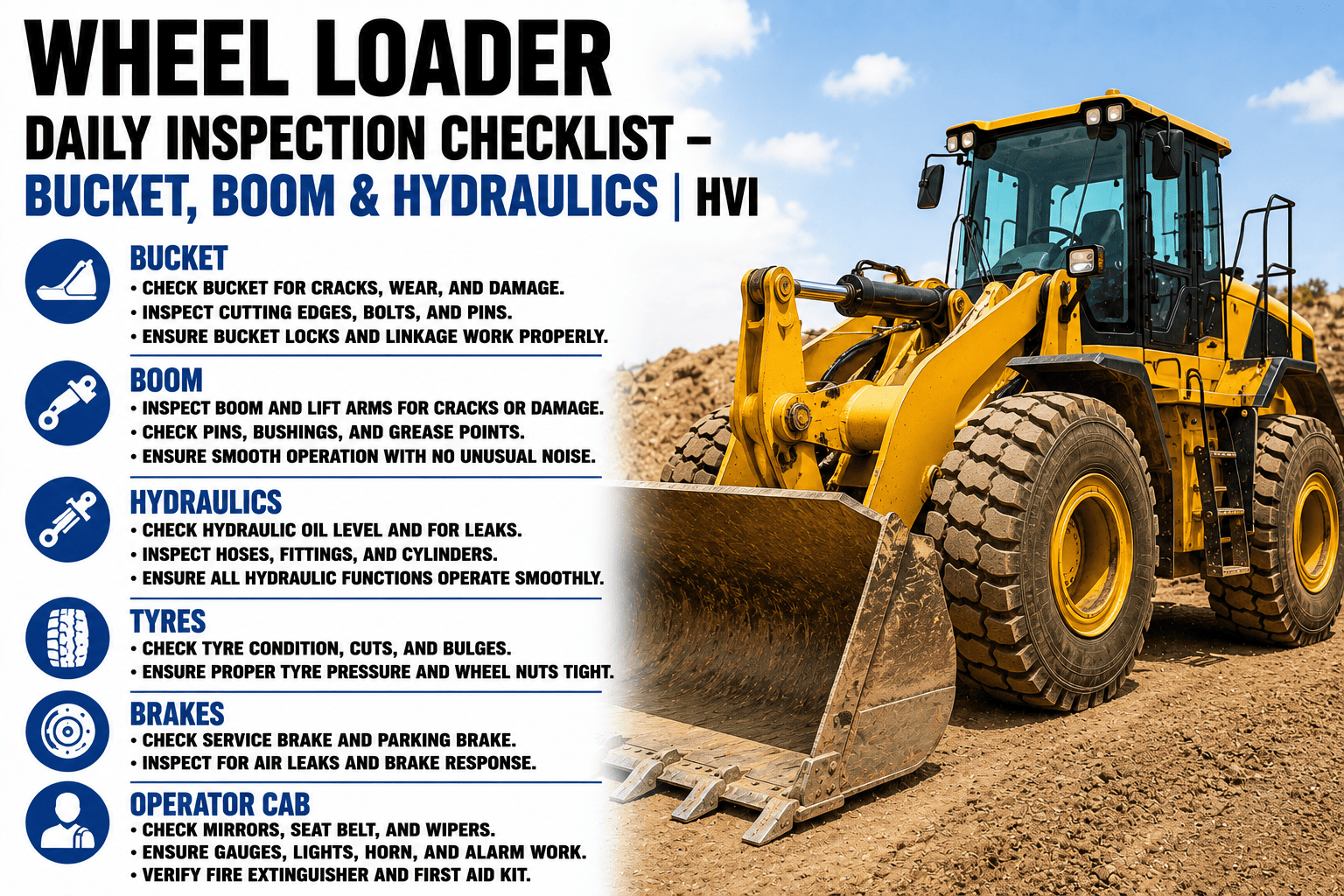
A wheel loader runs several hundred load-travel-dump cycles a shift — flexing the articulation joint, punching the pile, loading tyres against rock, and betting on brakes in reverse with people behind. Two of those zones carry most of the money: tyres that can cost more than an engine over a life, and a centre joint that is pins and bushes when caught early but a frame-line rebuild when caught late. This checklist targets exactly what that cycle punishes, in ten minutes of plain-language checks with critical items marked. Run it on paper, or in HVI where fails carry photos and hold the machine — sign up free and put it on your operators' phones this week.
Wheel Loader Daily Inspection Checklist — Bucket, Boom & Hydraulics
Ten minutes of checks aimed at what the loading cycle actually punishes — front linkage, articulation, tyres, brakes, hydraulics, and the cab that keeps everyone behind the machine alive.
What the Cycle Punishes
The bucket punches the pile and the Z-bar linkage takes the shock — cutting edges, teeth, pins, and boom welds wear and crack here first.
Loaded runs over rock load the tyres, driveline, and articulation joint on every turn — the most expensive consumables and the one irreplaceable joint.
Full height on the boom, then reverse with people invisible behind — hydraulics decide the first half; brakes, alarms, and camera decide the second.
Zone 1 — Bucket, Boom & Linkage
Zone 2 — Articulation, Driveline & Frame
The Joint the Machine Pivots On
The centre hinge takes every turn under every load — pivot pins checked for grease and play, steering cylinders for leaks, and clunks listened for on lock-to-lock steering at idle.
Underneath, in One Pass
Axle and differential cases for oil traces, propshaft guards secure, transmission leaks at the belly plate, and fresh spots on the parking ground read before anything is disturbed.
Zone 3 — Tyres & Brakes: The Money and the Safety
| Check | What You're Looking For | Why It Pays |
|---|---|---|
| Pressures (all four) | Against spec for the duty, checked cold | Underinflation is the quiet killer of loader tyres — heat builds until the casing gives |
| Cuts, chunking & sidewalls | Rock cuts reaching cords, chunked lugs, sidewall bulges | A ₹3–6 lakh tyre saved by a floor-cleanup call is the day's best economics |
| Beads, rims & nuts | Seating, rim damage, missing or loose wheel nuts | Rim failures under pressure injure; loose nuts finish rims |
| Service & parking brake | Proven at first slow travel, both directions | A loader with brake doubt does not work — reverse is where loaders hurt people |
| Uneven wear patterns | Fronts vs rears, left vs right, noted over days | Wear patterns reveal alignment, pressure habits, and operator technique — free diagnostics |
Put the Whole List on Your Operators' Phones
This checklist loads from HVI's template library and tunes to your BEML, Komatsu, or CAT models in minutes — your pressures, your duty's items, Hindi or English, photos mandatory where you want proof. Critical fails hold the machine and alert the workshop before the first bucket. Bring your current form to a 30-minute session and our India team rebuilds it live.
Zone 4 — Engine, Hydraulics & Cooling
Zone 5 — Cab, Visibility & the People Behind You
Machine-holding fails on a loader: brake or steering doubt, articulation play beyond normal, any hydraulic leak reaching ground, a failed reverse alarm or camera on a peopled site, and structural cracks at boom or frame. In HVI these carry critical severity by default — the fail photographs, holds the machine's status, and alerts the workshop and supervisor instantly, with escalation rules editable to your site.
Frequently Asked Questions
Does this fit BEML, Komatsu WA, and CAT 966 machines alike?
Yes — the zones are universal; only the numbers change: tyre pressures, sight-glass positions, and greasing points come from your OEM manual, and per-model checklists in HVI carry each machine's own values so operators never see generic figures.
How long should the daily check take?
Ten to twelve minutes once the route is habit — the articulation and tyre checks that feel extra are exactly the ones that pay, since those two zones carry most of a loader's repair bill and downtime.
Stockpile duty vs quarry face — same list?
Same zones, shifted emphasis — quarry duty weights tyres, cutting edge, and structure harder; stockpile and rehandling duty weights cooling cores and visibility. In HVI, duty-specific items toggle per site without rebuilding the form.
What belongs on weekly checks instead?
Batteries, axle and transmission oil levels, detailed greasing rounds, wheel-nut torque, and brake measurements — keeping them off the daily list keeps the daily list alive, and HVI schedules them separately by calendar and hours; sign up free and load both layers together.
Is the rest of the fleet covered in the library?
Yes — excavators, dump trucks, cranes, tippers, DG sets, and plant machinery in the same plain-language, critical-items-marked format, each editable per site and model. See the full library in a 30-minute demo with our India team.
Several Hundred Cycles a Shift. One Ten-Minute Answer.
Everything the day will throw at the loader — the pile, the rock floor, the reverse with people behind — gets its answer in the morning's ten minutes, or it gets answered mid-shift at breakdown prices. Run this checklist daily and the machine's warnings get heard; run it in HVI and they get photographed, escalated, and fixed while the fix is small. Start free and load it onto your operators' phones this week, or bring your current form to a 30-minute session and leave with it rebuilt.