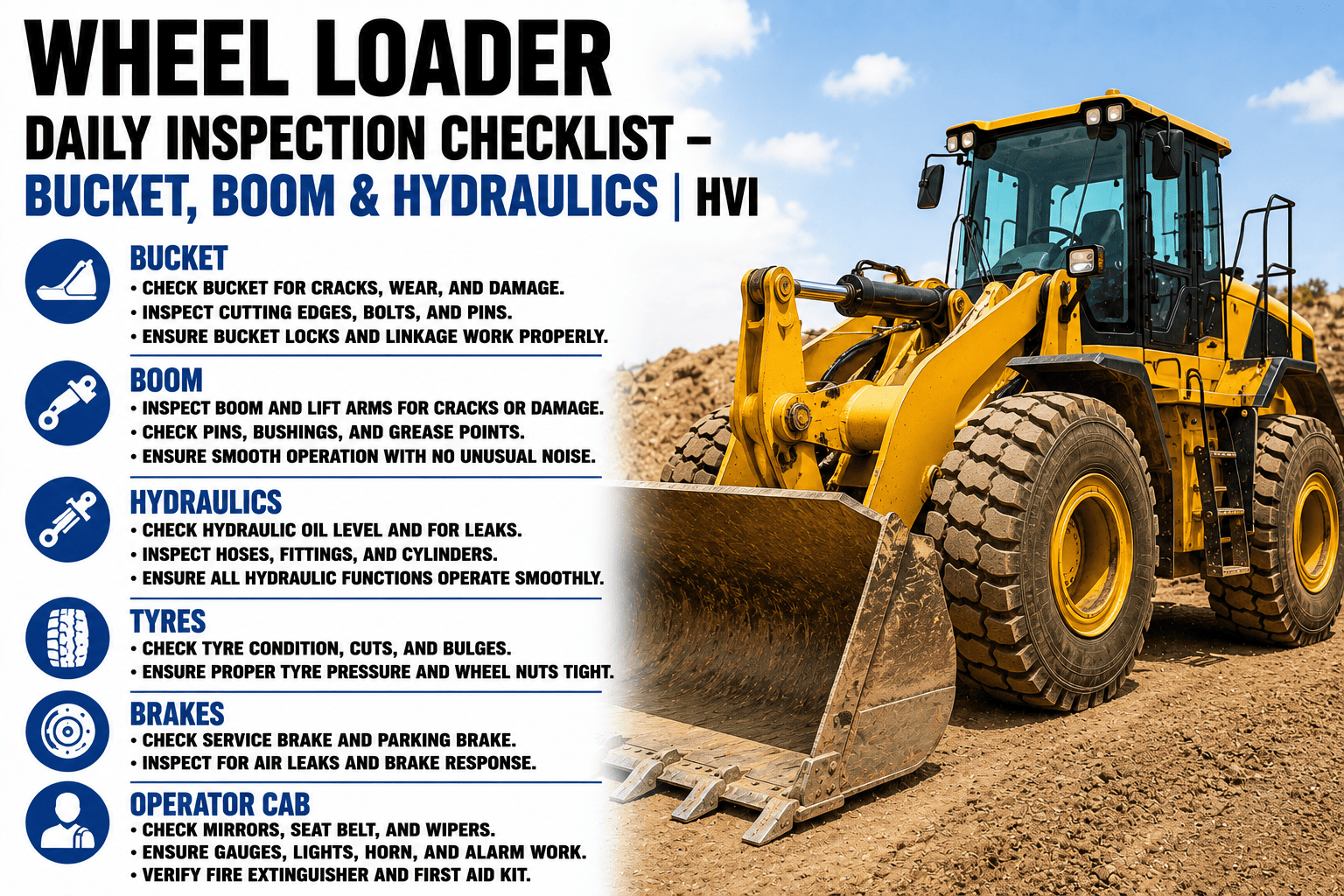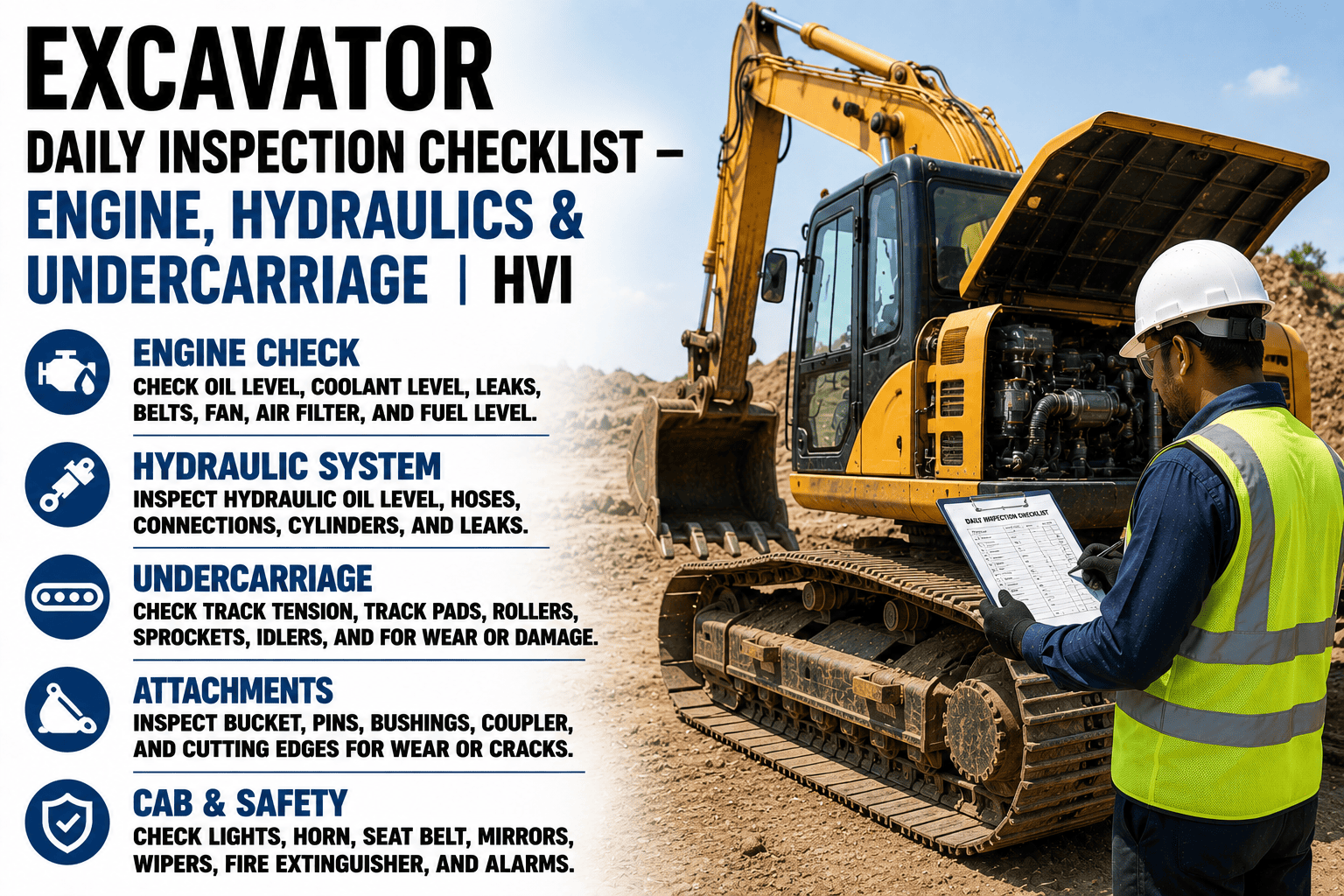
Every excavator inspection guide lists the same fifty items; what separates fleets is whether the operator has a route that makes those items automatic. This version of the checklist is built as a walk — four stations around and up the machine, each with its own questions, taking ten to twelve minutes from parking spot to first bucket. Walked the same way daily, it does something no list on a clipboard does: it teaches the operator the machine's normal, so the creeping coolant level, the newly wet cylinder rod, and the track link running hot stand out the morning they appear instead of the night they fail. Run it on paper if that is your starting point; run it in HVI and every station's checks carry photos and timestamps, critical fails hold the machine and alert the workshop instantly, and each morning builds the asset's history — sign up free and put the walk on your operators' phones this week.
Excavator Daily Inspection Checklist — Engine, Hydraulics & Undercarriage
A four-station route around crawler and wheeled excavators — ground, upper structure, cab, and function checks — that turns fifty items into one ten-minute habit.
The Four Stations
Ground Level — The Circle
Fresh spots under the parked position, track tension and links, roller and final-drive weep, bucket teeth and pins, boom welds for cracks — tyres, pressures, and axle lock on wheeled machines.
Upper Structure — Fluids & Lines
Engine cold: oil, coolant, and hydraulic levels noted against yesterday's; filter indicator and radiator cores for dust; belts, hoses, and every hydraulic run for sweating and rub — anything wet photographed before it's wiped.
Cab — Controls & Safety
Belt, mirrors, glass, extinguisher, lockout tested, control pattern confirmed after any operator change — then thirty seconds on gauges at start, with horn, travel alarm, and lights heard and seen, not assumed.
Function — The First Movements
Warm and clear of people: slew, boom, arm, and bucket through full travel for squeal, drift, and new play; brakes proven on wheeled machines; coupler physically verified — the first bucket becomes a decision, not a gamble.
What Each System Gains from the Daily Look
| System | What the Daily Walk Catches | What That Prevents |
|---|---|---|
| Engine & cooling | Level creep, blinded cores, choked filters, weeping hoses | Overheating shutdowns and the seized-engine worst case |
| Hydraulics | Wet rods, sweating hoses, falling levels, breather damage | Burst-hose downtime, contamination working through valves, oil-spray injury risk |
| Undercarriage | Tension drift, cracked links, roller weep, final-drive traces | Thrown tracks on slopes and the costliest repair on the machine |
| Attachment & structure | Weld cracks talking through fresh rust, loose teeth, dry pins | Structural failure under load; steel reaching a crusher |
| Cab & safety | Failed alarms, untested lockouts, unconfirmed patterns | The incidents that inquiries are made of |
Load the Walk Into HVI in an Afternoon
This four-station structure comes straight from the template library and tunes to your models in the no-code editor — your OEM's sag specs and sight-glass positions, your site's rules, Hindi or English, photo-mandatory where you want proof. Bring your current form to a 30-minute session and our India team rebuilds it as the walk, live.
The Real Skill: Reading Yesterday Against Today
Levels That Move
Today's coolant mark means little alone; two fingers lower than Monday's means a leak being fed — the walk's power compounds when yesterday's readings are one tap away.
Heat Where There Was None
A link or final drive running warmer than its neighbours is friction announcing itself — caught by the hand days before it is caught by the smoke.
New Sounds and New Play
The clunk that wasn't there Friday, the pin moving a shade more — daily walkers develop calibration no sensor matches, and the checklist keeps it honest.
Same Walk, Two Very Different Records
On Paper
The walk still works, but the record holds ink, not proof — fails travel at the sheet's speed and history is a stack nobody can query. Fine to start; expensive to stay.
In HVI
Every check carries photos, timestamps, and GPS; critical fails hold the machine and alert the workshop instantly; and each morning builds a per-asset history that audits and keep-or-replace decisions can use.
Frequently Asked Questions
Who runs this — the operator or a mechanic?
The operator walks it daily; that is the point — they know the machine's normal best and they bet their shift on its condition. Mechanics own the weekly and PM layers, and review the operator's fails. The split keeps the daily walk short and the deep checks expert.
Monsoon site, pre-dawn starts — does the walk change?
The route holds; the emphasis shifts — torch checks get deliberate, ground-spot reading needs care on wet ground (look at the machine's underside, not just the puddle), and slope and track-tension items gain weight. In HVI, seasonal items toggle on without rebuilding the form.
What happens when a day gets missed?
On paper, nothing — which is the problem. In HVI the gap is visible by machine and operator on the completion dashboard, so the conversation happens the same day, not after the failure that the missed morning would have caught.
Do JCB, Tata Hitachi, Komatsu, and Volvo machines need different versions?
Same stations, different numbers — sag specs, reference positions, and greasing points come from each OEM manual, and per-model checklists in HVI carry those values so every operator sees their machine's figures; sign up free and clone the walk per model in minutes.
Is the rest of the fleet covered too?
Yes — the library carries the same walk-structured checklists for dump trucks, loaders, cranes, tippers, and DG sets, each editable per site and model. Walk through the full library in a 30-minute demo with our India team.
Ten Minutes a Morning Buys the Whole Shift
The walk costs less time than the machine spends idling for its first load, and it is the cheapest maintenance you will ever do — every major failure it prevents was advertising itself at one of the four stations first. Start free and put the station walk on your operators' phones this week, or bring your current checklist to a 30-minute session and leave with it rebuilt as a route.