A document problem almost never surfaces in an office. It surfaces at a checkpoint, at a client gate, or after an incident, with a driver standing beside a loaded vehicle and a person asking for something. Whether the paperwork is valid matters less in that moment than whether it can be produced, by the person present, immediately. Fleets that keep excellent records centrally still lose vehicles to this, because the record being correct and the record being available are different things. This page is about the second problem, and you can look at how your own fleet would fare in a free 30-minute session.
Can Your Driver Produce It, Right Now, Where They Are?
Document readiness for commercial vehicles — who needs to produce what, where it should live, and what to confirm before a vehicle leaves the yard.
A note on scope. Requirements under the Motor Vehicles Act and Central Motor Vehicles Rules depend on vehicle category, permit type, cargo, and the states a vehicle operates in, and they are amended periodically. This page covers operational document readiness rather than setting out legal requirements, and your own compliance officer should confirm the list that applies to your fleet.
What Actually Goes Wrong at a Check
The document exists but is not with the vehicle
Valid, current, and filed in an office two hundred kilometres away. The vehicle is still stopped while somebody searches for a scan and finds a way to send it.
The copy in the cab is an old one
Renewed centrally, never replaced in the vehicle. Common wherever renewal and distribution are handled by different people.
Nobody knows which version is current
Two copies in circulation and no way to tell quickly which supersedes the other, which is worse than having one.
The driver's own documents are the gap
Vehicle paperwork in order, licence or authorisation expired. These are tracked separately and often by nobody in particular.
It is on a phone that is dead or has no signal
Digital storage solves retrieval only if it works without connectivity and without the office being reachable.
Who Should Be Able to Produce What
Splitting this explicitly prevents the assumption that someone else is holding it.
The driver, immediately
Their own licence and authorisation, plus whatever the vehicle is required to carry. Retrievable without calling anyone.
In or with the vehicle
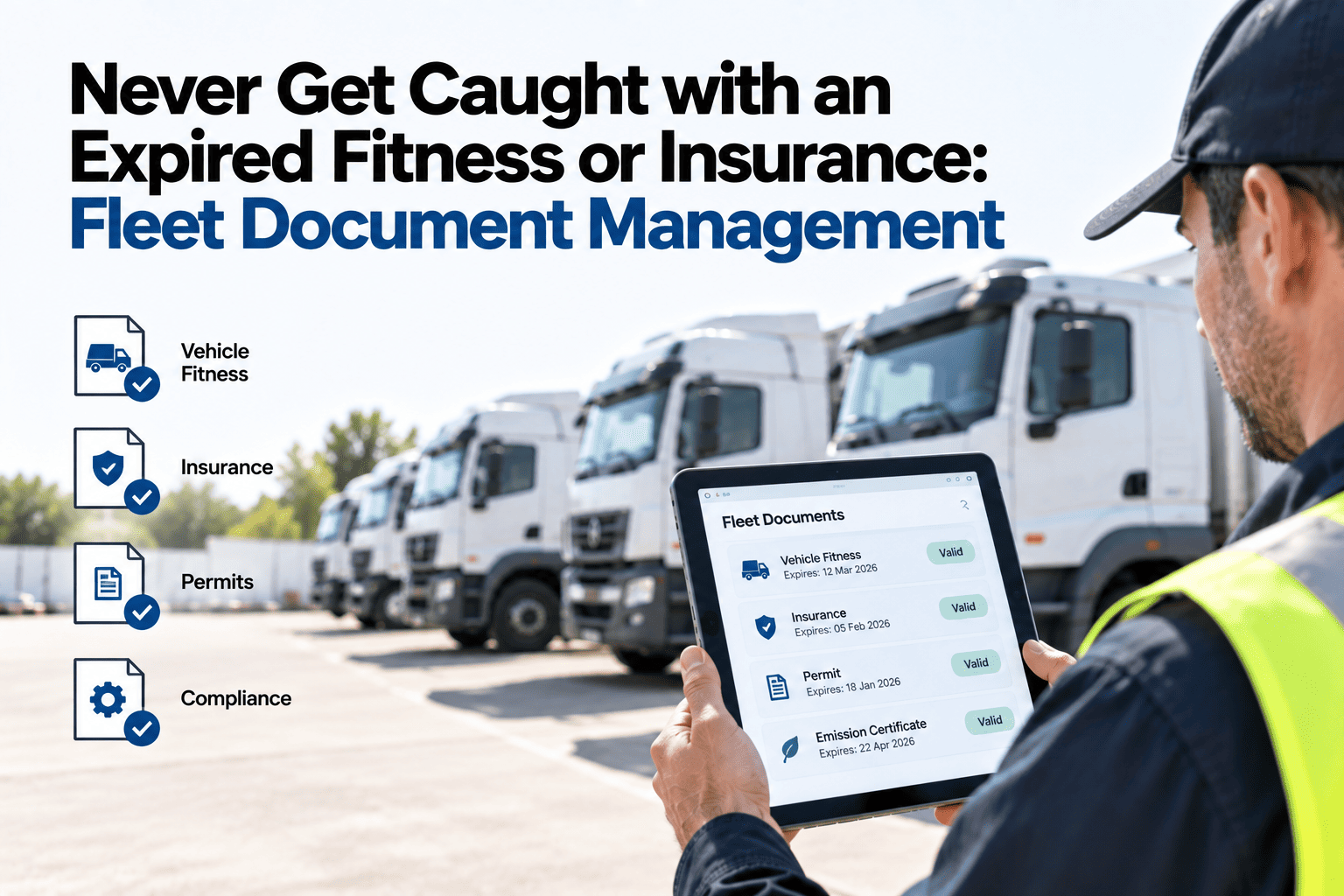
Registration, insurance, fitness, permit, emission certification, and load documentation as applicable, in current versions.
The site or transport office, within minutes
Originals or certified copies, plus a record of what was issued to which vehicle and when it was last replaced.
Centrally, on request
Full history including previous versions, renewal dates, and evidence of continuous validity across the period under question.
Put Every Document on the Driver's Phone
Current versions available offline against the vehicle and the person, updated centrally the moment a renewal is filed.
Before the Vehicle Leaves the Yard
A short pre-dispatch confirmation, sitting alongside the mechanical pre-trip check rather than replacing any part of it.
No vehicle document expires during the planned duration of this trip.
The assigned driver's licence and authorisation are current for this vehicle class.
Documents carried in the vehicle match the current versions held centrally.
Any permit covers every state or zone on the intended route.
The driver can retrieve everything on their device with no signal.
Frequently Asked Questions
Are digital copies acceptable at a check?
Acceptance of digital documents depends on the document, the authority, and current rules, and it has changed over time. Confirm the position for your operating states with your compliance officer, and carry physical copies where there is any doubt. We can show how both are managed together on a call with our team.
Which documents does our fleet need to carry?
It varies by vehicle category, permit, cargo, and route. A generic list published on a website is exactly the wrong thing to rely on, because the consequences of a gap fall on the operator rather than the publisher.
How do we stop old copies staying in cabs?
By removing the physical copy as the primary source. When the current version is on the device and updates centrally, the cab copy stops being what anyone depends on.
Who should own driver document tracking?
Someone named, because this is the category most often assumed to be handled elsewhere. Vehicle documents usually have an owner; driver documents frequently do not.
What is the quickest improvement?
Checking what is already expired across both vehicles and drivers. Most fleets find more than they expected, and it takes an afternoon. Start with a free trial.
Valid Is Not Enough — It Has to Be Producible
Keep current versions on the driver's device and available offline, track driver documents with a named owner, confirm expiry against trip duration before dispatch, and let your compliance officer define the list that applies to your fleet.