Steel plant mobile equipment works in a category of its own: much of it carries molten metal, so a torpedo car, ladle carrier, or hot-metal crane that fails has not caused downtime — it has caused an incident. Add radiant heat cooking hydraulics and tyres, a plant that never stops, and statutory crane examinations that read records, not assurances, and paper systems simply cannot keep up. HVI answers "was it fit this shift?" in taps — shift-wise inspections, examination ladders, heat-tuned PM, and 24/7 handover — sign up free and put your plant's fleet on it this week.
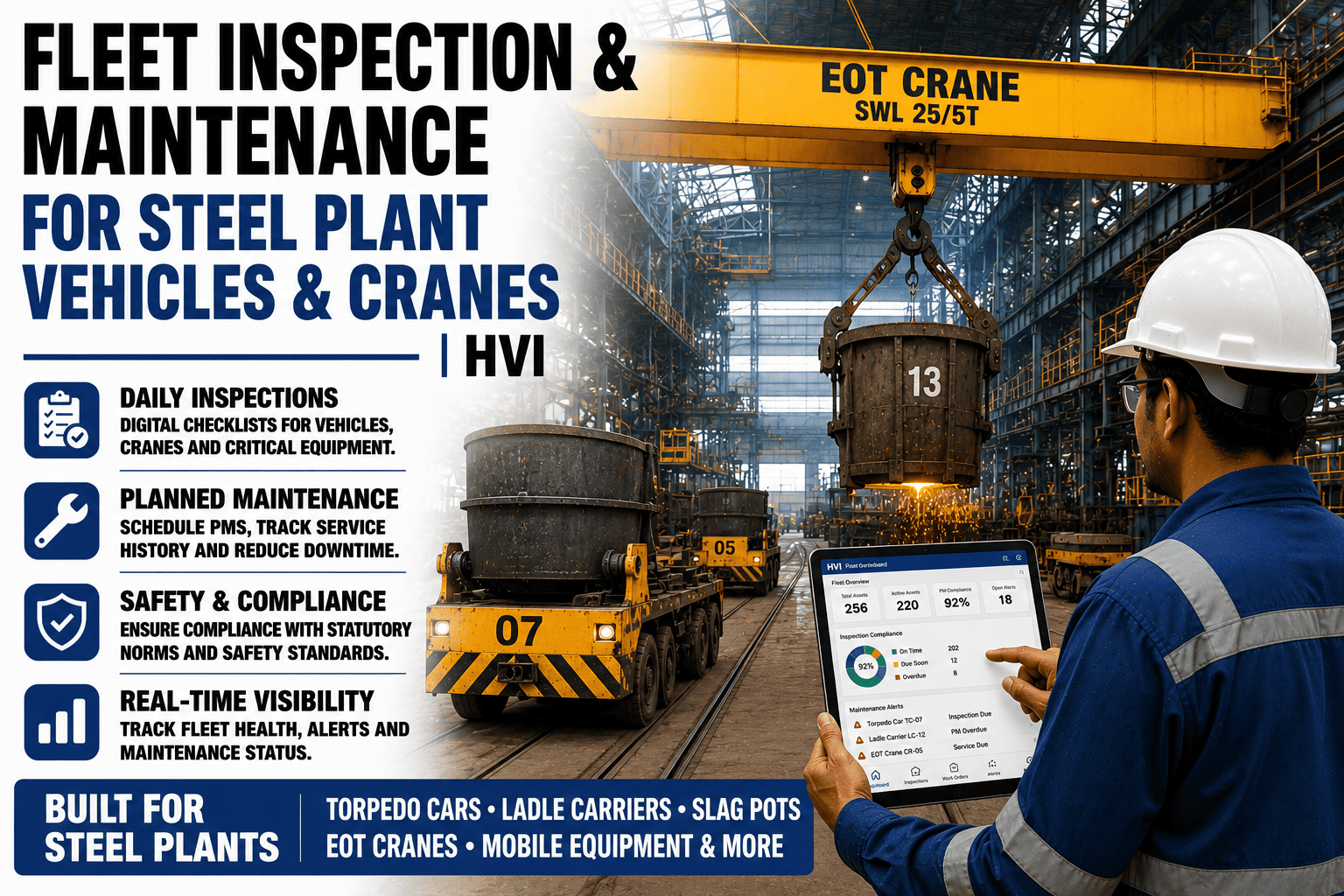
Fleet Inspection & Maintenance for Steel Plant Vehicles & Cranes
Torpedo cars, ladle carriers, slag pot vehicles, EOT cranes, and the support fleet — inspected every shift, examined on statute, and maintained on the heat's clock, across a plant that never stops.
The Hot-Metal Bloodstream
The furnace taps on its own schedule — and a torpedo car shortage at the cast house floor is the one logistics failure that reaches back into the furnace's rhythm itself.
Hot metal moves on wheels, bogies, and tilting gear that must simply work — with shell and refractory condition observed every trip, recorded every shift, and campaign wear tracked to plan relines before they plan themselves.
Ladle transfer cars and carriers hand liquid steel between converter, ladle furnace, and caster — short moves, zero tolerance, and equipment that cannot be allowed a surprise.
Slag pot carriers close the loop on the same punishing duty — pot condition, tipping gear, and heat-soaked hydraulics checked with the same seriousness as the metal side.
The chain's rule: hot-metal logistics equipment is production equipment and safety equipment at once — its availability question and its fitness question are the same question, asked every shift.
The Heat Tax: What the Plant Does to Machines
Hydraulics & Hoses
Radiant heat cooks seals, hoses, and fluid on any machine working the hot zones — inspection intervals tighten, heat shielding gets checked as a component, and hose condition joins the shift list instead of waiting for the burst.
Tyres & Undercarriage
Hot standings and scale-strewn floors destroy tyres from beneath — pressures, cuts, and heat damage checked every shift on carriers and loaders, because a tyre failure under a loaded slag pot is not a flat, it is an event.
Electricals & Cabs
Heat and conductive dust work on cables, connectors, and panels; cab HVAC becomes an availability item, since an operator who cannot see or breathe cannot run the machine the schedule assumes.
Cooling Systems
Radiators blind with scale dust while ambient heat steals their margin — daily visual checks and scheduled cleaning keep "engine trouble" from being a dirty core discovered the expensive way.
Every Unit on the Plant Roster
Start with the Hot-Metal Fleet and the Cranes
Put the torpedo cars, ladle carriers, and hot-metal duty cranes on shift-wise inspection first — checklists from the library tuned to your units in an afternoon, statutory examination dates loaded onto ladders, and the 24/7 handover running from day one. Bring your equipment list and examination registers to a 30-minute session, and our India team maps the plant-wide rollout with you.
Three Depths of Inspection, by What Failure Costs
Hot-Metal Carriers
Torpedo cars, ladle cars, slag carriers — where failure is an incident by definition. Trip-wise and shift-wise checks, refractory observations with photos, and any critical finding holding the unit before it holds metal.
Lifting Over People
EOT cranes and tackle on two clocks: shift-wise condition checks plus periodic examinations as prescribed under the factories regime — certificates on ladders, competent persons' reports attached, lapses flagging the crane off duty.
The Support Fleet
Loaders, forklifts, tankers, and trailers on daily pre-starts and hour-based PM — the ordinary discipline that keeps the ordinary fleet from producing extraordinary interruptions.
The Checks the Records Must Show
| Equipment | Safety-Critical Checks | Cycle / Regime |
|---|---|---|
| Torpedo cars | Refractory and shell observation, tilting gear, bogies and wheels | Per trip / per shift; campaign wear tracked |
| Ladle & transfer cars | Drives, rails, hydraulics, heat shielding | Shift-wise; PM by running hours |
| EOT cranes | Ropes, hooks, brakes, limit switches | Shift-wise + periodic examination as prescribed |
| Slag pot carriers | Pot condition, tipping gear, tyres, hydraulics | Shift-wise; tyres every shift on hot duty |
| Coil handlers & forklifts | Rams and forks, mast chains, brakes, horns and lights | Daily before use |
| Dispatch trailers | Coil cradles, lashing points, brakes, documents in force | Pre-dispatch; document expiry ladders |
Exact examination periodicities and formats follow the rules applicable to your establishment — the system holds each unit's prescribed cycle, alerts ahead of every date, and keeps certificates and inspection history attached where the safety department, the inspector, or the inquiry can read them in minutes.
Frequently Asked Questions
How are EOT crane statutory examinations tracked?
Each crane carries its examination dates on a ladder with the competent person's report scanned against it — renewals surface weeks ahead, shift-wise condition checks run in parallel, and a lapsed examination flags the crane off lifting duty until the new report is filed. The safety department's register and the workshop's reality finally match.
Can refractory condition be tracked meaningfully?
Yes — observation checklists with photo evidence log per vessel per trip, wear patterns accumulate against the campaign, and thresholds raise flags for the refractory team's inspection, so reline planning reads a record rather than a recollection. The system carries the observations; your refractory engineers keep the judgement.
The plant runs SAP PM. Where does HVI sit?
As the field layer — shift inspections, photos, and meter readings captured at the equipment post into SAP as notifications, orders, confirmations, and measurement documents, with SAP remaining the system of record. The gap between the shop floor and the ERP is exactly what this closes.
Internal logistics is contractor-operated. Whose records are these?
The plant's — the incident, the audit, and the production risk stay with the occupier regardless of whose payroll runs the torpedo fleet, so contractor crews work inside your system with vendor-scoped access, and their inspection history settles performance and billing questions with evidence; sign up free and hold every operator to one standard.
Does shift handover survive a 24/7 plant?
That is the point — every shift's inspections, defects, and open jobs are on the dashboard when the next shift logs in, with photos attached; a torpedo car flagged at 2 AM is still flagged at 6 AM, and nothing travels by shift chatter. See a full handover cycle in a 30-minute demo with our India team.
In a Steel Plant, "Is It Fit This Shift?" Is Never a Small Question
Machines that carry molten metal and cranes that swing loads over crews do not get the benefit of the doubt — their fitness is proven every shift or it is not known at all. Put the whole fleet on one system: shift-wise checks, examination ladders, heat-tuned PM, and a 24/7 handover, all posting into SAP where the plant already lives. Start free and load the hot-metal fleet this week, or bring your equipment list to a 30-minute session and leave with the rollout mapped.