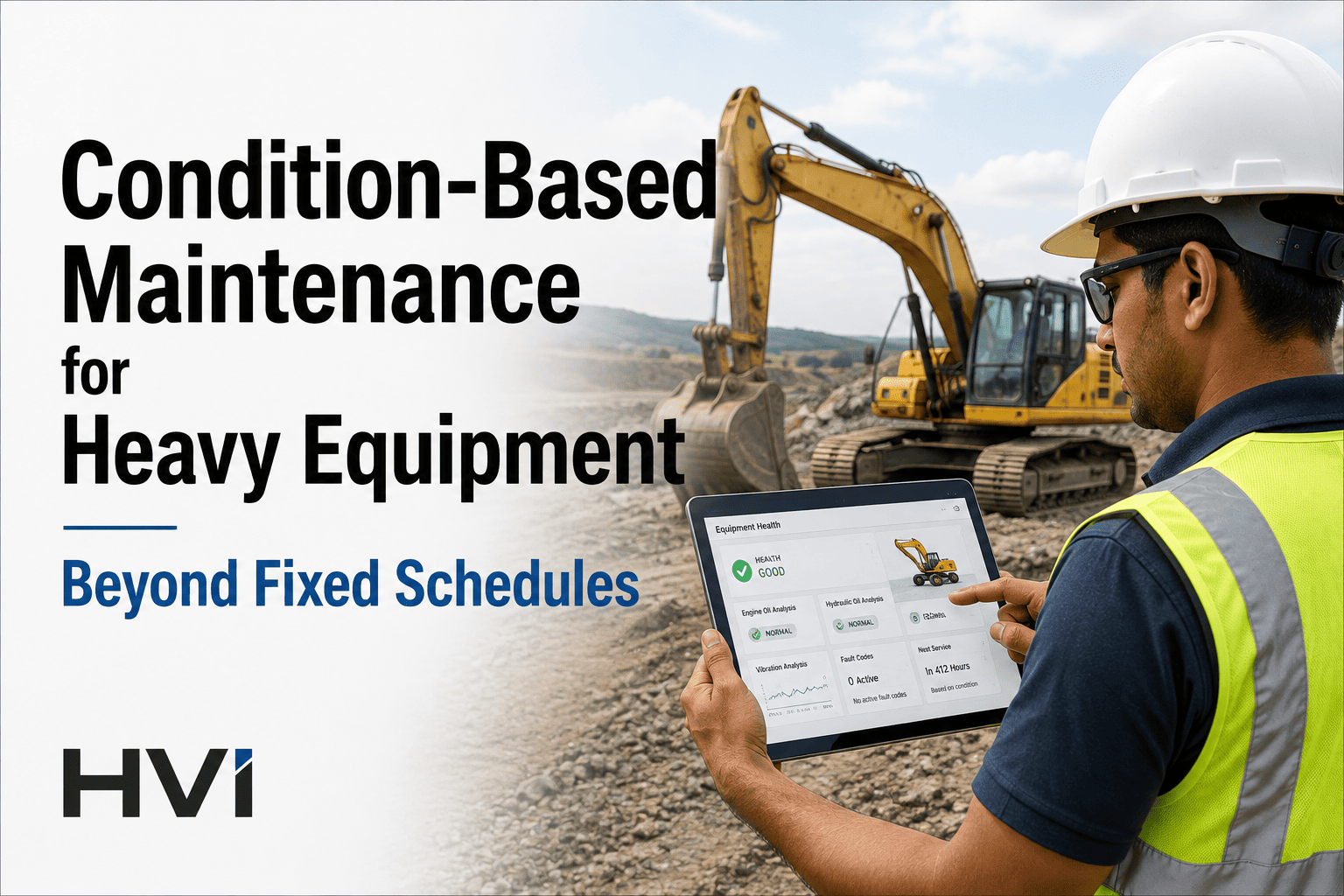
Condition-based maintenance is usually sold as a replacement for fixed schedules, which is the wrong frame and leads fleets into expensive disappointment. The decision is not whether your fleet should move to condition monitoring. It is which components on which machines have degradation you can actually measure, with enough warning to act on, and enough consequence to justify measuring. Some do. Many do not, and for those a fixed interval remains correct. A few are better left to fail, which is a legitimate strategy rather than an admission of defeat. You can work through your own components in a free 30-minute session.
Condition-Based Maintenance Is a Per-Component Decision
Not every component suits condition monitoring, and choosing the right strategy for each one matters more than adopting any single approach.
Three Strategies, Chosen Per Component
Suits components that degrade measurably over a period long enough to act on. Fluid condition, filter restriction, tyre and undercarriage wear, brake and friction material, structural cracking that propagates, and anything with a temperature or vibration signature.
Test it against: can you measure it, does the measurement change before failure, and is the warning long enough to do something?
Correct where degradation is not observable in service, where failure is sudden, or where the consequence is severe enough that waiting for a signal is unacceptable. Many safety-critical items sit here regardless of what could theoretically be monitored.
Test it against: would you accept this component running until a measurement told you to act? If not, keep the interval.
Appropriate for low-cost items with no safety consequence, no secondary damage, and quick replacement. A cab light or a non-critical gauge does not need a schedule or a sensor.
Test it against: if it fails right now, does anything other than that item need attention? If no, this is the cheapest correct answer.
Most fleets put everything in the middle category by default, which over-maintains the third group and under-protects the first.
What Condition-Based Actually Requires
A baseline for each machine
A reading only means something against what that machine normally shows. Fleet averages are a poor substitute, because identical machines in different applications differ substantially.
Consistent measurement
Same method, same point, same conditions. An inconsistent measurement produces a trend that reflects the measuring rather than the machine.
Enough history to see a trend
A single reading tells you almost nothing. The value is in direction and rate of change, which takes months to accumulate.
A defined action threshold
Decided before the reading arrives, or the threshold becomes whatever seems tolerable at the time — which is always higher when the machine is busy.
Someone who acts on it
The most common failure of condition monitoring is not measurement quality. It is readings that arrive and nothing happening, which teaches everyone the readings do not matter.
Start With What Your Inspections Already Measure
Readings captured during routine checks, trended per machine, with thresholds that raise work orders rather than notifications.
Where to Start Without Buying Anything
Condition monitoring usually begins with sensors in the brochure and with measurements you already take in practice.
Fuel per productive hour, trended per machine — the cheapest condition signal available and already in your data.
Filter restriction indicators, recorded as a value rather than as a pass or fail.
Tread depth and undercarriage wear measured on a defined cycle rather than judged visually.
Oil analysis on major components, which is inexpensive relative to what it detects.
Photographs of structural monitoring points from a consistent reference, so propagation is visible.
Defect recurrence per machine, which is a condition signal even though nobody calls it one.
Frequently Asked Questions
Do we need sensors to do condition-based maintenance?
For some components eventually, but not to start. Measurements captured during inspection cover a surprising amount, and proving the approach works on those makes the case for instrumenting anything further. You can work out which components justify sensors on a call with our team.
Can condition monitoring replace all fixed intervals?
No, and a vendor claiming otherwise is overselling. Components that fail without observable warning, and safety-critical items where waiting for a signal is unacceptable, belong on fixed intervals regardless.
Is run-to-failure really acceptable?
For items with no safety consequence, no secondary damage, and quick replacement, it is the cheapest correct strategy. Scheduling everything is a form of waste, not a form of rigour.
How long before condition data is useful?
Several months for most parameters, since the value is in the trend. Expecting decisions from the first few readings is the fastest way to lose confidence in the approach.
What is the most common reason it fails?
Readings that go nowhere. Measurement without a defined threshold and an owner produces data and no decisions. Start with a free trial.
Choose the Strategy Component by Component
Put measurable, slow-degrading items on condition monitoring, keep sudden-failure and safety-critical items on fixed intervals, let cheap consequence-free items run to failure, and begin with the measurements your inspections already produce.