A fixed schedule services a machine because a month ended; condition-based maintenance services it because the oil sample came back with iron in it, the telematics threw a coolant-temperature code three days running, or the operator's pre-start logged a hydraulic tank running hotter than last week. The difference is not philosophy — it is money in both directions: the hard-worked excavator gets its service before the wear becomes damage, and the lightly used loader stops getting oil changes it did not need. This page lays out the five condition signals, how each becomes a work order, and how Indian fleets run CBM today without a laboratory on site — sign up free and let the machine's condition set the date.
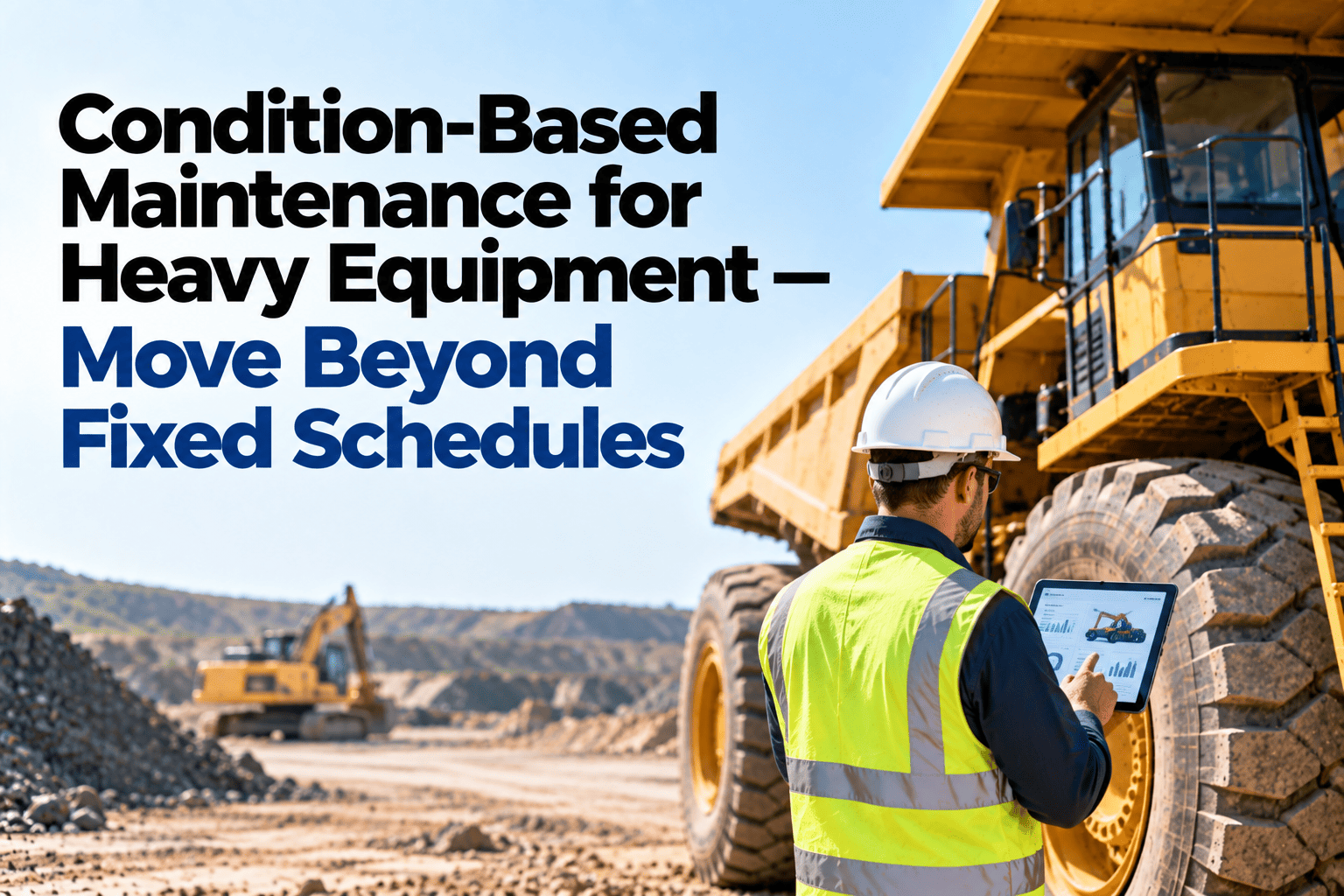
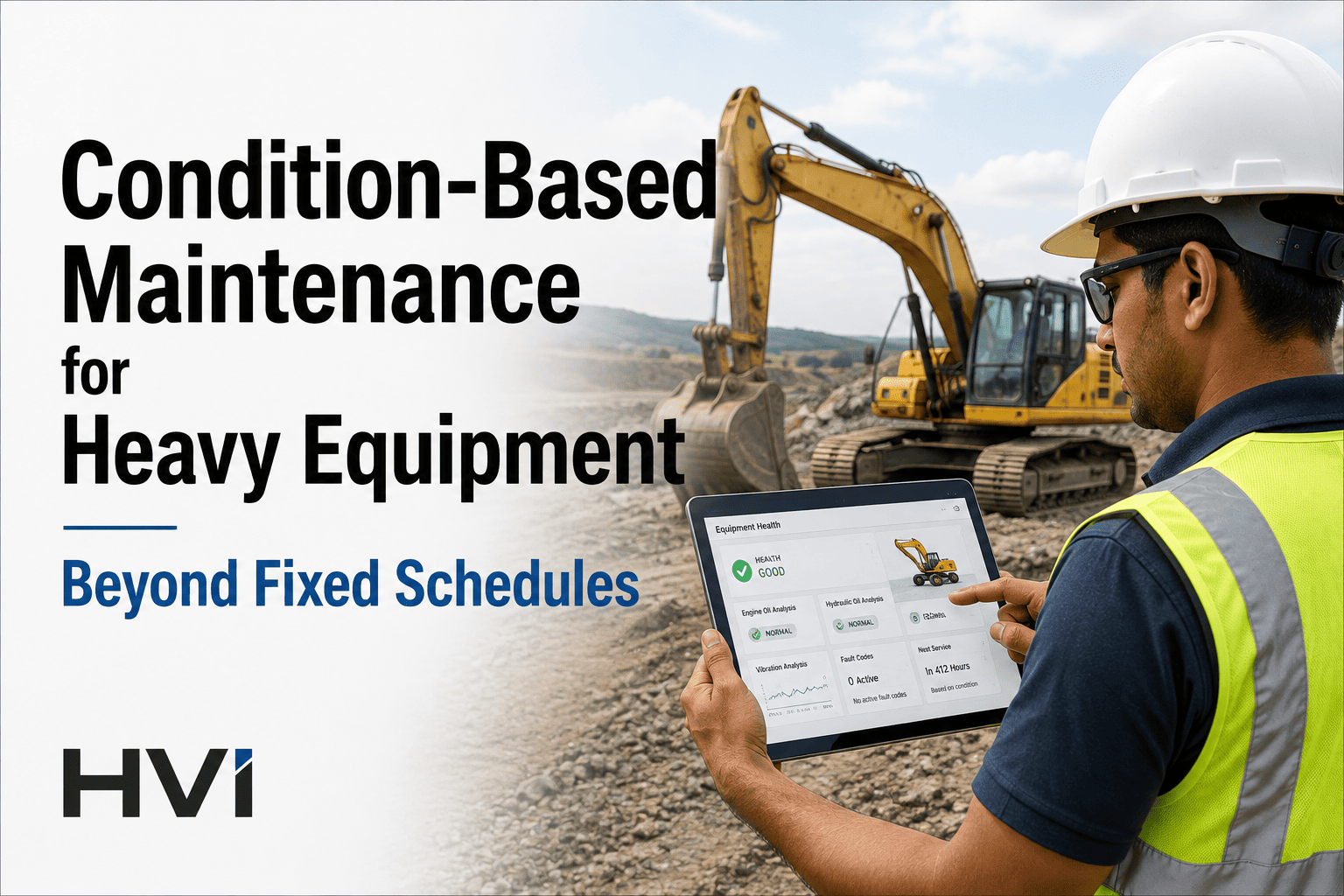
Condition-Based Maintenance for Heavy Equipment — Beyond Fixed Schedules
Trigger services from oil analysis, fault codes, temperature and vibration trends, and operator observations — so every machine is serviced by how hard it is working, not by when the calendar turns.
Three Generations of "When to Service"
Because a Month Ended
The service happens on a date, whatever the machine did in between — early for the idle ones, late for the busy ones, blind to dust and heat either way.
Because the Meter Said So
The service happens at running hours, adjusted for site — a large improvement that still assumes every hour wore the machine the same amount, which a 45°C afternoon on a breaker will not.
Because the Machine Said So
The service happens when a signal crosses a threshold — oil chemistry, a fault code, a temperature trend, a pre-start observation. Hours become the backstop; the machine's state sets the date.
The Five Condition Signals and What Each Triggers
| Signal | What It Detects | Where It Comes From | What It Triggers |
|---|---|---|---|
| Oil analysis | Wear metals, contamination, viscosity loss, coolant or fuel in oil | Sample drawn at site, commercial lab report attached to the asset | Oil change, flush, component inspection; interval adjusted up or down |
| Fault codes | Sensor-detected abnormalities — coolant temperature, boost pressure, hydraulic pressure, charging faults | Telematics or AIS-140 unit, or the operator reading the display on the pre-start | Severity-ranked work order; repeat codes escalate automatically |
| Temperature & vibration trends | Bearings, final drives, pumps, and cooling systems drifting from their baseline | Telematics where fitted; hand-held readings on weekly rounds where not | Inspection before the drift becomes a failure — the classic "days of warning" |
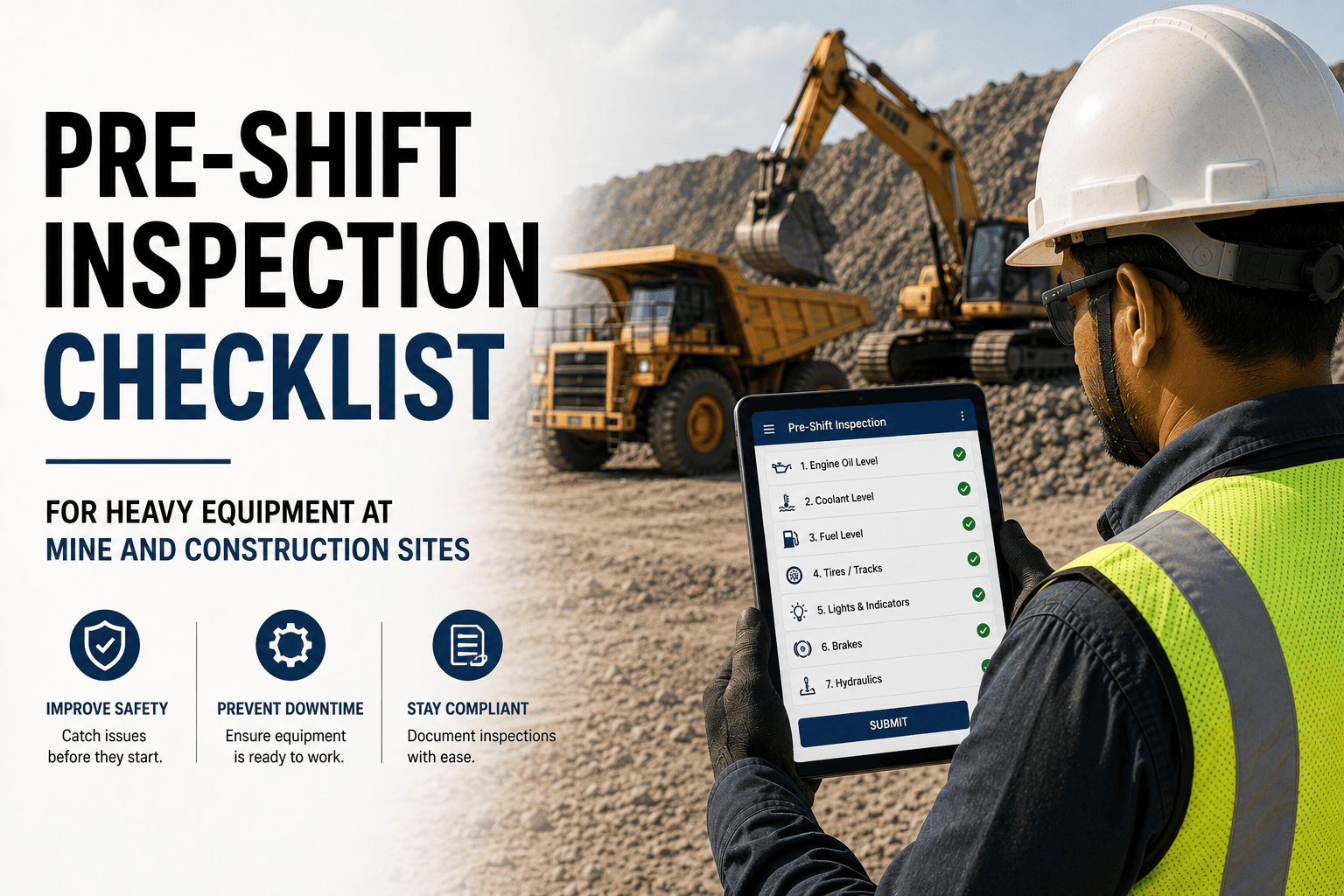
| Operator observations | Leaks, noises, sluggish response, smoke, play — what eyes and ears catch first | Photo-verified pre-start checklist, every shift | Defect with severity, converting to a work order the same shift |
| Meter & fluid trends | Fuel per hour creeping up, coolant or oil top-ups increasing, filter indicators | Daily readings logged on the pre-start; consumption from fuel and stores records | Investigation flag when a trend breaks its band, ahead of any symptom |
Two of the five need no sensors at all — operator observations and daily readings are condition data the moment they are captured digitally and compared against yesterday's. Most Indian fleets can run CBM on those two from the first week and add the others as the value proves itself.
Let the First Signal Set a Date This Week
Daily pre-starts and meter readings become condition data on day one, oil analysis reports and fault codes attach to the machine as they arrive, thresholds turn each signal into a severity-ranked work order, and the hour-based schedule stays underneath as the backstop — configured for your fleet in an afternoon. Bring a recent oil report or a fault-code history to a 30-minute session and our India team shows what it would have triggered.
From Signal to Work Order in Four Moves
Capture the Signal Against the Asset
Every signal lands on the machine's file, not in a folder or a phone — the oil report uploaded and its values entered, the fault code posted from telematics or typed from the display, the operator's observation photographed on the pre-start, the meter reading validated. Condition data that is not attached to an asset is not condition data; it is paperwork.
Evaluate Against a Threshold or a Trend
Each signal has a rule — an iron level, a code repeated three times, a temperature above the machine's own baseline, a fuel-per-hour figure outside its band — and the system checks every new value against it automatically, so nobody has to remember what last month's sample said to notice that this month's is worse.
Raise the Work Order With Severity
A crossed threshold creates a work order with the signal attached as evidence, a severity that decides its urgency, and the parts the likely fix will need — critical signals hold the machine and alert the workshop; trend flags queue an inspection into the next production window instead of the next breakdown.
Adjust the Interval and Learn
What the work order finds feeds back into the schedule — a machine whose samples keep coming back clean earns a longer interval, one whose codes keep repeating gets a shorter one and a root-cause investigation — so the fleet's maintenance plan is rewritten a little by every signal it receives, in the direction of the truth.
CBM Without a Laboratory on Site
What Works From Week One
Photo-verified pre-starts, daily meter and fuel readings trended per machine, fault codes logged from the display, and oil samples sent to a commercial lab with the report attached to the asset — no sensors, no capital, just the data you already have made comparable day to day.
When Sensors Earn Their Place
Connect the telematics and AIS-140 units already fitted before buying more; add vibration or thermal monitoring only where the component is expensive and the failure sudden — final drives, main pumps, crane hoists. A sensor pays when the failure it predicts costs more than the sensor.
Where Condition Wins, and Where the Fixed Schedule Still Should
Oil changes guided by analysis, filters by indicator, undercarriage by wear measurement, overhauls by trend — the items where the machine's state varies most with duty, and where servicing blind wastes money in one direction or the other.
Statutory examinations on their prescribed dates, safety-critical checks every shift regardless of condition, and time-aged items like belts, hoses, and batteries on the calendar — condition informs these; it never replaces them.
Mature fleets run both at once: condition triggers where the data is rich, hours and calendar as the floor everywhere else — and the same system holds all three clocks so nothing falls between them.
Frequently Asked Questions
Is condition-based maintenance the same as predictive maintenance?
Closely related — CBM acts when a signal crosses a threshold now; predictive maintenance extends it by projecting the trend forward to estimate when the threshold will be crossed. The same signals feed both; most fleets start with condition thresholds and grow into prediction as the history builds.
How often should we sample oil?
Commonly at each hour-based service on hard-worked or high-value machines, with extra samples after any abnormal signal — the OEM and the lab both give guidance, and the system schedules the sample as a task so it happens rather than gets intended.
Do our machines need telematics for fault codes?
Not to start — codes shown on the machine's display are logged on the pre-start with a photo, and repeat codes escalate the same way; where telematics or AIS-140 units exist, the codes arrive automatically and the operator's reading becomes the cross-check.
Won't we lose PM compliance if services stop following the calendar?
No — hour-based services stay as the backstop and count toward compliance, condition-triggered work orders sit alongside them, and the dashboard shows both; sign up free and run the two together from the first week.
Can we see CBM working on one of our machines before committing?
Yes — bring one machine's oil reports, fault-code history, or a month of pre-starts to a session and our India team loads them, sets thresholds, and shows the work orders that would have fired. Book the 30-minute demo and pick your hardest-worked machine.
The Machine Already Knows When It Needs Servicing. Start Listening.
Every oil report, fault code, temperature drift, and operator observation is the machine stating its condition — and a fleet that captures those signals against the asset and acts on thresholds services each machine exactly as hard as it is working. Start free and turn pre-starts and readings into condition data this week, or bring one machine's history to a 30-minute session and see the first trigger fire.